Table of Contents
- Introduction
- Why the Houses Matter More Than You Think
- The Framework: Angular, Succedent, and Cadent
- 1st House: The Querent
- 2nd House: Movable Possessions and Money
- 3rd House: Siblings, Neighbors, and Short Journeys
- 4th House: Home, Land, and Buried Things
- 5th House: Children, Romance, and Pleasure
- 6th House: Illness, Servants, and Small Animals
- 7th House: Marriage, Partners, and Open Enemies
- 8th House: Death, Debt, and Other People's Money
- 9th House: Travel, Learning, and Religion
- 10th House: Career, Status, and Authority
- 11th House: Friends, Hopes, and the Employer's Money
- 12th House: Secrets, Sorrow, and Large Animals
- The Most Common House Assignment Mistakes
- Where to Go From Here
Master the 12 Houses of Horary Astrology: A Clear, Practical Guide to What Every House Really Means
Most people learning horary astrology hit the same wall at the same point. They understand the planets. They understand the aspects. And then they try to assign a house to a question, get it wrong, and watch the entire judgment collapse before it even begins.
This is not a minor technical error. It is the single most common reason a chart reading fails, and it happens because most house descriptions are written for natal astrology, not horary. The houses mean different things when you're reading a birth chart for a whole life versus reading a question chart for one specific moment. Mix them up, and you'll be looking at the wrong planet entirely — reading the 7th house when you should be reading the 3rd, or treating the 10th as "career" when the question is actually about the querent's mother.
In my 5 Golden Rules of Horary Astrology, I covered the method. In my guide to answering specific question types, I showed you how house assignment works in practice. This article is the reference piece — the one you come back to when you need to know, quickly and clearly, what a given house actually governs in horary, and what mistakes to avoid when assigning it.
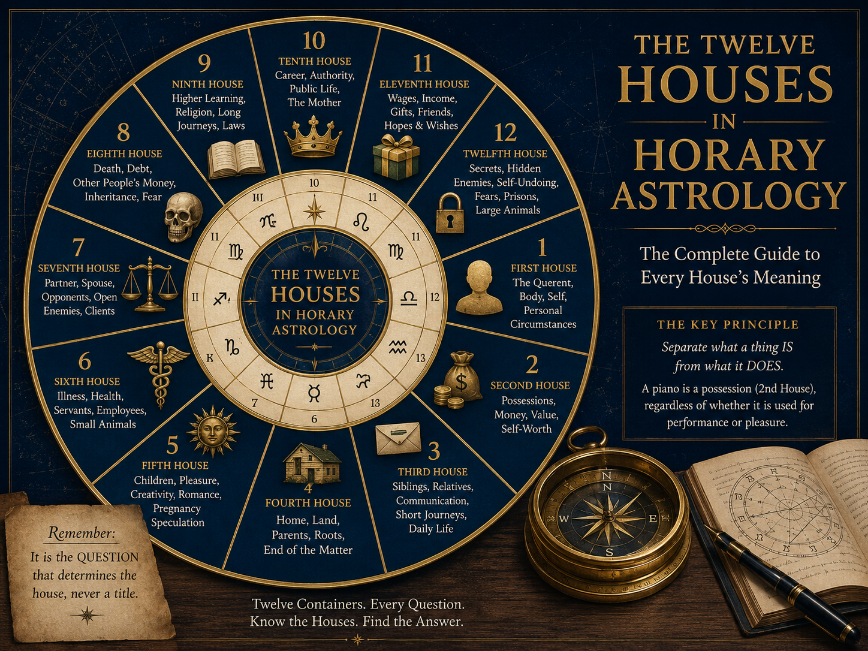
Why the Houses Matter More Than You Think
Here is the blunt truth: you can identify the right planets and the right aspects and still produce a wrong judgment if you assigned the wrong house at the start. The houses are not decoration. They are the architecture the entire judgment is built on.
In horary, every question involves at least two parties: the person asking, and the thing being asked about. The 1st house always belongs to the querent — that part is fixed. But the house you assign to the quesited — the person, object, or situation the question is about — changes with every question. A missing dog and a missing ring go to different houses. A sibling and a spouse go to different houses. A job and the salary from that job go to different houses. Get the assignment wrong, and you are not reading the chart for the question that was actually asked. You are reading a chart for a different question entirely.
The good news is that the system is consistent. Once you learn the logic behind the house assignments — including the essential skill of turning the chart — you stop having to memorize individual cases and start understanding why each assignment goes where it does. That is what the rest of this article is built to give you.
The Framework: Angular, Succedent, and Cadent
Before I walk through each house individually, it helps to understand the three categories all twelve houses fall into, because the category itself tells you something about the strength of whatever is placed there.
Angular houses — the 1st, 4th, 7th, and 10th — are the strongest. A planet in an angular house is active, visible, and powerful. Things happen quickly here. The 1st house, as the Ascendant, is the most angular of all, and any planet placed there is given an immediate, forceful role in the chart.
Succedent houses — the 2nd, 5th, 8th, and 11th — are moderately strong. They follow the angular houses and represent what sustains and supports them: money after the self, children after the home, shared resources after the partner, and friends after the career. Planets here are stable but less dramatic in their effects.
Cadent houses — the 3rd, 6th, 9th, and 12th — are the weakest. They fall away from the angles, and planets placed in them are quieter, slower to act, and sometimes outright hidden. A significator in a cadent house is not powerless, but it rarely acts quickly or forcefully on its own.
This hierarchy — angular, succedent, cadent — runs underneath every house judgment you will ever make. When you find a significator in a cadent house, that is information. It tells you something about the speed and strength of the outcome before you even look at an aspect.
1st House: The Querent
The 1st house is the simplest and most important house in horary. It always, without exception, represents the person asking the question — the querent. Their physical appearance, their health, their general state of being at the moment the question is asked — all of it lives here.
The planet ruling the sign on the 1st house cusp is Lord 1, the querent's primary significator. The Moon is the querent's co-significator in almost every chart, regardless of house position. Any planet sitting inside the 1st house itself is describing something — or someone — directly affecting the querent right now.
Common mistake: Forgetting that the 1st house also describes the querent's physical state. A malefic in the 1st, or Lord 1 in poor condition, can indicate illness or exhaustion even when the question is about something else entirely. The querent's condition always matters, because a weakened querent may not be able to act on a favorable answer.
Read more about the 1st House →
2nd House: Movable Possessions and Money
The 2nd house governs the querent's movable wealth — cash, income, personal possessions that can be carried or moved. In lost-object questions, this is the default house for missing items. In career questions, Lord 2 tells you about the querent's financial situation separate from the job itself, which I check because financial need is often the real driver behind a job search.
The 2nd is also the house of the querent's self-worth and personal resources in a broader sense — not just money, but whatever the querent relies on to sustain themselves.
Common mistake: Confusing the 2nd house with the 8th. The 2nd is the querent's own money. The 8th is other people's money — debts, loans, inheritance, the spouse's resources. If the question is "will I get the loan," the loan itself is 8th house, not 2nd.
Read more about the 2nd House →
3rd House: Siblings, Neighbors, and Short Journeys
The 3rd house governs siblings, cousins, and neighbors — anyone close by blood or proximity but not in the same household. It also rules short journeys, messages, letters, emails, phone calls, and rumors. If the question is "will my brother reply to my text," the brother is 3rd house, not 7th.
This is also the house of primary education and basic communication — not advanced study, which belongs to the 9th, but the everyday exchange of information.
Common mistake: Defaulting to the 7th house for any relationship question. A sibling is 3rd house. A cousin is 3rd house. A neighbor is 3rd house. The 7th is specifically for marriage, romantic partners, and open enemies — not family or acquaintances. I covered this distinction in detail in my guide to answering common horary questions.
Read more about the 3rd House →
4th House: Home, Land, and Buried Things
The 4th house is the querent's home, their real estate, their land, and anything buried or fixed in place. In lost-object questions, if the item is not merely misplaced but genuinely buried — under floorboards, in a garden, behind a wall — the 4th house becomes the relevant significator instead of the 2nd.
This house also governs the querent's father (though some traditions assign the father to the 10th; I follow the 4th for the father and the 10th for the mother, which is the older traditional assignment). The 4th is also the house of endings — the end of any matter, the grave, the final outcome in a literal sense.
Common mistake: Treating the 4th as the default for all lost objects. It is not. The 2nd house governs movable possessions. The 4th governs fixed property and genuinely buried items. Use the wrong one, and you will be looking in the wrong kind of place.
Read more about the 4th House →
5th House: Children, Romance, and Pleasure
The 5th house governs children, pregnancy, and creative works. It also rules romance in the early, pleasurable sense — dating, flirtation, attraction — as distinct from the 7th house, which governs marriage and committed partnerships. Gambling, speculation, sports, and entertainment all fall here as well.
In questions about missing persons, the 5th is the house for a missing child. In questions about creative projects, the 5th describes the work itself and whether it will succeed.
Common mistake: Using the 5th for a spouse or long-term partner. The 5th is romance, not commitment. If the question is about a marriage or a serious relationship, the 7th house is the correct assignment. Confuse the two, and you will read a chart about attraction when the querent is asking about permanence.
Read more about the 5th House →
6th House: Illness, Servants, and Small Animals
The 6th house governs illness and disease — specifically, the querent's sickness, not death itself, which belongs to the 8th. It also rules employees, servants, tenants, and anyone who works under the querent's direction. In questions about missing animals, the 6th governs small animals — anything smaller than a goat, by the traditional rule of thumb.
This is also the house of daily work and routine, as distinct from the 10th house of career and vocation. A question about a frustrating coworker belongs to the 6th. A question about a promotion belongs to the 10th.
Common mistake: Using the 6th for the querent's career. The 6th is service and subordinate labor. The 10th is profession and status. A question about a job should be read through the 10th; a question about a health problem or a missing pet should be read through the 6th.
Read more about the 6th House →
7th House: Marriage, Partners, and Open Enemies
The 7th house is the house of the other — the person directly opposite the querent in any significant one-to-one relationship. This includes spouses, romantic partners, business partners, and also open enemies, competitors, and opponents in a lawsuit. The 7th is the house of people you face directly, whether in love or in conflict.
In "will they contact me" questions, the 7th is the correct house only when the person in question is a spouse, ex, or romantic partner. A boss, a sibling, or a friend each belongs to a different house. I walked through this logic step by step in my article on answering specific horary questions.
Common mistake: Using the 7th as a default for any person the querent is asking about. It is not a catch-all. Every relationship has its own house, and the 7th is specifically for marriage, partnership, and open opposition — not for siblings, children, parents, friends, or bosses.
Read more about the 7th House →
8th House: Death, Debt, and Other People's Money
The 8th house governs death, fear, and anxiety. It also rules other people's money — debts, loans, taxes, inheritance, and the spouse's financial resources. In a marriage question, the 8th house is turned from the 7th and describes the partner's money, which is often exactly what the querent is actually worried about.
This is a house of transformation and loss, and planets placed here often describe something the querent is afraid of losing or being consumed by. A malefic in the 8th can indicate genuine danger; a benefic can indicate support arriving through someone else's resources.
Common mistake: Assuming the 8th only means death. In practical horary, the 8th comes up far more often for financial questions involving loans, inheritances, and shared assets than it does for literal mortality. Read the question before you assume the worst.
Read more about the 8th House →
9th House: Travel, Learning, and Religion
The 9th house governs long journeys — international travel, relocation, voyages — as distinct from the short trips of the 3rd. It also rules higher education, universities, law, philosophy, religion, and divination itself. If the question is about whether a course of study will be completed, or whether a visa will be granted, the 9th is the house to assign.
This is also the house of dreams and visions, and traditionally the house of astrologers and diviners. A question about whether to trust a spiritual teacher or a prophetic dream falls here.
Common mistake: Confusing the 9th with the 3rd. The 3rd is the short trip, the local journey, the quick message. The 9th is the long voyage, the university degree, the life-altering pilgrimage. The distinction is scale, and scale matters in horary judgment.
Read more about the 9th House →
10th House: Career, Status, and Authority
The 10th house governs the querent's career, profession, reputation, and public standing. It is the house of the mother in traditional assignment, and the house of kings, bosses, judges, and anyone in authority over the querent. In a job question, Lord 10 is the job itself, and Lord 1 or the Moon is the querent applying for it.
This is an angular house, and planets here are powerful and visible. A benefic in the 10th is a strong testimony of professional success. A malefic in the 10th often describes trouble with authority or damage to reputation.
Common mistake: Confusing the 10th with the 6th. The 10th is the career, the profession, the status. The 6th is the daily grind, the subordinate role, the health issue that interferes with work. A question about a promotion is 10th house. A question about an annoying coworker is 6th.
Read more about the 10th House →
11th House: Friends, Hopes, and the Employer's Money
The 11th house governs friends, alliances, social networks, and the querent's hopes and wishes. In career questions, this is also the house of the employer's money — the salary or payment that comes with the position — which I always check separately from the job itself, because a good job with bad pay shows up differently in the chart than a good job with good pay.
This is a succedent house, so planets here are stable but not forceful. A significator in the 11th often describes a situation developing through social connections rather than direct action.
Common mistake: Treating the 11th as the house of the job itself. It is not. The job is 10th house. The salary from the job is 11th. These are separate testimonies, and they can point in different directions.
Read more about the 11th House →
12th House: Secrets, Sorrow, and Large Animals
The 12th house governs hidden enemies, secrets, imprisonment, isolation, and self-undoing. It is a cadent house, and planets here are weak and often working against the querent's conscious interests. In questions about missing animals, the 12th governs large animals — anything larger than a goat.
This is also the house of hospitals, monasteries, and any place of confinement. A significator in the 12th often describes a situation the querent cannot see clearly, either because information is being withheld or because the querent is deceiving themselves about what is really happening.
Common mistake: Assuming every planet in the 12th means doom. A significator in the 12th is weak and hidden, but it is not automatically destroyed. It means the matter is obscured, delayed, or working behind the scenes — not that it has already failed.
Read more about the 12th House →
The Most Common House Assignment Mistakes
I want to close the house-by-house breakdown with a short list of the mistakes I see most often, because knowing what not to do is sometimes more immediately useful than knowing what to do.
- Defaulting to the 7th house for any relationship question. The 7th is marriage, partnership, and open enemies. A sibling is 3rd. A child is 5th. A friend is 11th. A boss is 10th. Check the actual relationship before you assign the house.
- Confusing the 2nd and the 8th. The 2nd is your money. The 8th is someone else's money. A loan, an inheritance, a spouse's income — all 8th house.
- Confusing the 6th and the 10th. The 6th is illness, service, and daily labor. The 10th is career, profession, and status. They are not interchangeable.
- Confusing the 3rd and the 9th. Short trips versus long journeys. Basic communication versus higher learning. The scale of the question tells you which house to use.
- Forgetting to check the turned houses. If the question is about the querent's spouse's money, that is the 8th house — which is the 2nd house turned from the 7th. Turned houses are not advanced technique. They are basic house logic, and skipping them produces wrong assignments. Learn this properly in my guide to turning the chart in horary astrology.
- Forgetting the 4th house for buried objects. A lost ring in a drawer is 2nd house. A lost ring buried in the garden is 4th. The distinction is fixity: movable versus fixed in place.
If you internalize these six warnings, you will avoid the mistakes that cause most beginner judgments to go wrong before they even reach the aspect analysis.
Where to Go From Here
The twelve houses are the skeleton every horary judgment hangs on. Get them right, and everything that follows — the dignity checks, the aspect analysis, the timing estimates — has a solid foundation to stand on. Get them wrong, and the most technically perfect aspect reading in the world will still be answering a question nobody actually asked.
This article is designed to be a reference — the one you bookmark and come back to when a question doesn't fit neatly into the categories you already know. The more you use it, the more the house logic will start to feel natural rather than memorized.
If you are ready to put this into practice, cast your free horary chart now and walk through the house assignment for your own question. My 5 Golden Rules of Horary Astrology will guide you through the full method from there, and the OracleSanctum Academy has structured lessons that build on everything covered here.
The houses are not complicated. They are consistent. Learn the logic once, and you will never have to guess at an assignment again.
No comments yet.