Table of Contents
- Introduction
- The Honest Question Behind This Article
- Why a 391-Year-Old Case Study Is the Right Evidence
- The Man and His Four Questions
- Setting Up the Chart: What Lilly Actually Checked First
- Weighing the Planets: Essential and Accidental Dignity
- The First Judgment: Would He Be Rich?
- By What Means: Reading the Second House Ruler
- The Time When: How Lilly Dated the Outcome
- Would It Continue? Reading Permanence Into the Chart
- The Overlooked Layer: Antiscia and Contrantiscia
- A Challenge Worth Making: What Doesn't Deserve the Weight It's Given
- So, Is Horary Astrology Accurate?
- You Don't Have to Believe This. You Only Have to Test It.
- Frequently Asked Questions
- Glossary of Terms Used in This Article
- Where to Go From Here
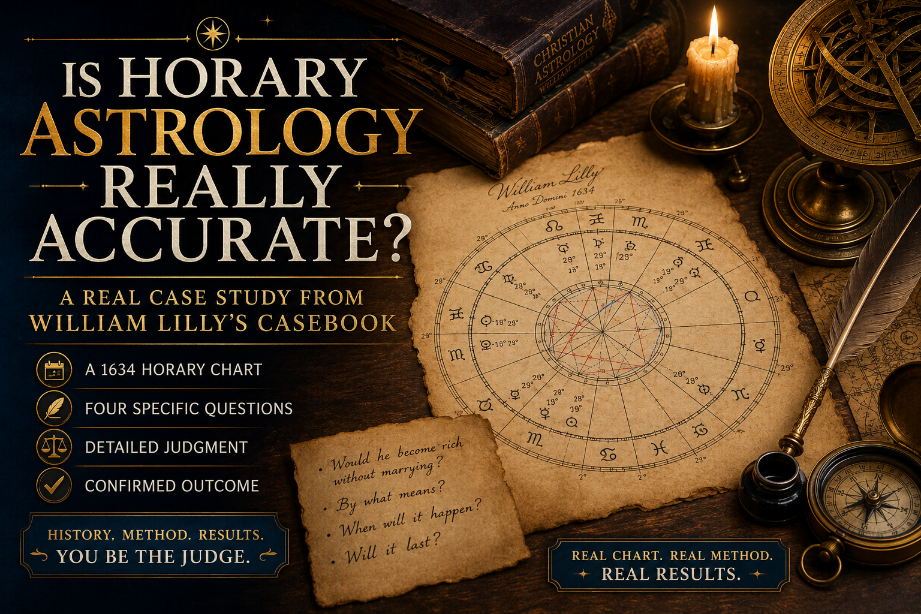
Is Horary Astrology Accurate? A Real Case Study from William Lilly's Casebook
Many people believe that a system built on planets and geometry can't possibly say anything real about a person's life. Most assume that if it sounds too precise — a timeframe, a specific outcome, a named condition that either shows up or doesn't — it must be vague enough underneath to mean whatever the reader wants it to mean.
But that's simply not true, and the best way to show it isn't to argue with you about it. It's to hand you a chart that was judged before the outcome was known, read exactly what was said, and let you decide for yourself whether it held up.
That's what this article does. In this article, I explained what horary astrology actually is — a chart cast not for a birth, but for the moment a real question is asked. I promised then that the question of accuracy deserved its own answer, with a real documented case, rather than a quick paragraph. This is that answer.
The Honest Question Behind This Article
Let me name the skepticism directly, because pretending it doesn't exist helps no one.
You've probably seen astrology used the way a mirror is used — vaguely, flatteringly, worded so that almost anyone could nod along. That kind of astrology deserves the skepticism it gets. If a "reading" could apply equally well to any person on any day, it isn't telling you anything. It's reflecting your own hopes back at you in nicer language.
Horary astrology makes a different kind of claim, and it's worth sitting with how different it actually is. A horary judgment names a specific outcome. It commits to a timeframe. It says the querent will marry, or won't; will find the object, or won't; will see the deal close within roughly this many weeks, not "sometime when the universe aligns." That specificity is what makes horary falsifiable — and falsifiable is precisely the quality vague mysticism avoids, because a vague statement can never be caught being wrong.
So here is the real question worth asking, and it's the one this article is built to answer: when a horary astrologer commits to something specific, in writing, before the outcome is known — does the chart hold up against what actually happens? The only honest way to answer that is with a documented case, not a promise.
Why a 391-Year-Old Case Study Is the Right Evidence
You might reasonably ask why I'm reaching back to 1634 for evidence instead of showing you something recent.
Here's the answer. Over years of practice, I've read a great many charts and watched a great many judgments confirm themselves against later events — client charts I could describe here, but won't, because a private reading isn't something I can verify in front of you, and asking you to simply trust my word would put me in exactly the position I just described as undeserving of trust. You weren't there. You can't check my timestamps. Anonymized, retold-from-memory cases can be as unfalsifiable as the vague astrology I just criticized — quietly reshaped by hindsight until they fit.
A 391-year-old case doesn't have that problem, and that's precisely the point. It was written down and published by the astrologer himself, in a widely studied book, decades before anyone reading it today was born. Nobody has edited it since to make it look better. William Lilly's Christian Astrology (1647) is one of the most complete horary casebooks ever produced, and it survives specifically because generations of students have been able to check his reasoning against his stated results — not because of reputation, but because the paper trail holds up to scrutiny.
I'm going to walk through one of his cases in full: his own questions, his own dignity tables, his own reasoning, and his own account of what the querent later confirmed. Nothing summarized past the point of usefulness. If horary is going to earn your trust, it should earn it on a case where the working is completely visible.
The Man and His Four Questions
In the year 1634, a tradesman of London came to William Lilly with a set of concerns that will sound familiar to anyone who has ever worried about money, timing, or whether their circumstances were about to change. Lilly recorded the encounter in his own words:
A Tradesman of this City in the year 1634 propounded these several Demands unto me: because I have seen the experience of my Judgment, and his Queries were pertinent for Resolutions of the Demands of this second House; I have inserted his several Queries, with the Reasons in Art of my so judging them.
The tradesman's questions were:
- Would he become rich, or be able to support himself without marrying?
- By what means would he attain wealth?
- When would this happen?
- Would it last?
Notice what these four questions actually are. They are not one vague inquiry about "the future." They are four precise, separable demands — condition, method, timing, and durability — and Lilly judged all four from the same chart, cast for the moment the question was understood. This is worth pausing on, because it's a direct, practical demonstration of something I explained in my first article: horary doesn't answer "what will my life be like." It answers the real question actually being asked, in full, including every specific part of it.
Setting Up the Chart: What Lilly Actually Checked First
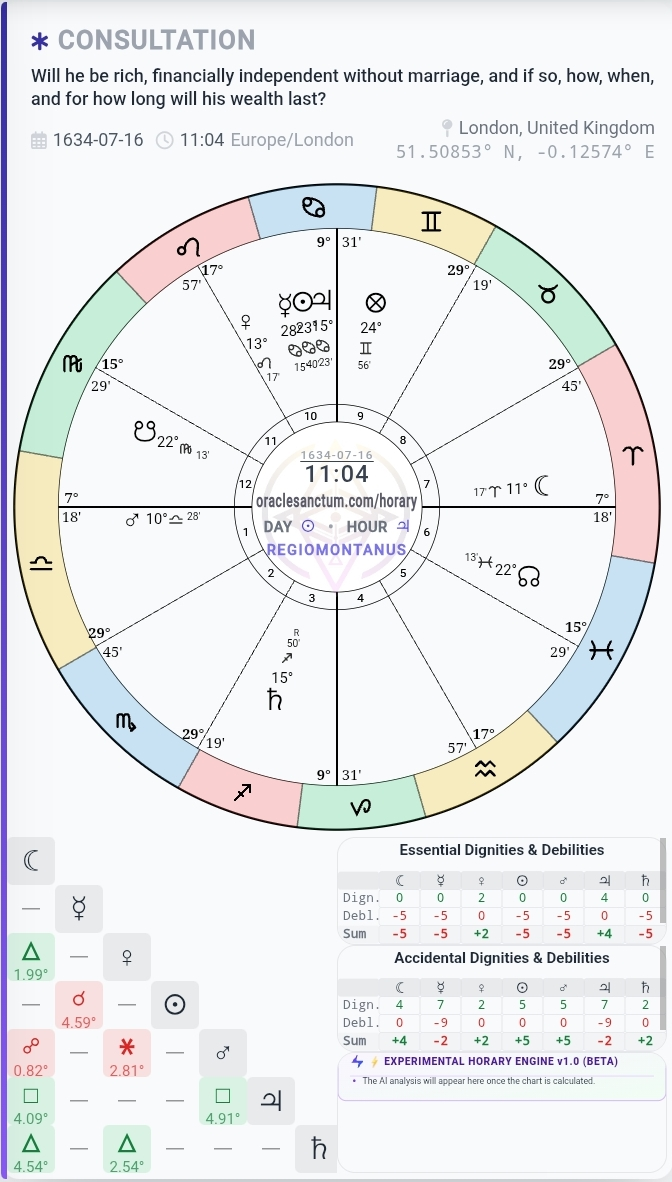
Before making any judgment at all, Lilly did something that modern horary students are still taught to do first, and that beginners very often skip: he checked the basic motion and condition of every planet in the chart.
He recorded the diurnal — daily — motion of each planet, and compared it against that planet's average motion, to establish whether each was moving quickly or slowly through the sky at that moment:
- Saturn, moving 24 minutes of arc that day, was slow.
- Jupiter, at 13 minutes against a mean of roughly 5, was swift.
- Mars, at 35 minutes against a mean of about 31, was swift.
- The Sun, at 57 minutes against its usual pace, was slow.
- Venus, at over a degree, was very swift.
- Mercury, also over a degree, was more swift.
- The Moon, at just under 12 degrees, was slow relative to her own average.
Why does this matter before anything else? Because speed and direction are part of a planet's condition, and a planet's condition is what horary judgment is actually built from. A slow, retrograde planet behaves differently in a judgment than a swift, direct one — much the way a person moving with energy and purpose toward something is a different situation than someone dragging their feet toward it, even if both are technically "heading the same direction." Lilly wasn't padding his work. He was establishing the raw material every later step of the judgment would depend on.
Weighing the Planets: Essential and Accidental Dignity
With motion established, Lilly turned to the two things every serious horary judgment weighs: essential dignity — a planet's strength based purely on its zodiacal position, independent of the specific chart — and accidental dignity — a planet's strength based on its actual placement and condition in this particular chart, right now.
He went through all seven traditional planets, scoring each one point by point. Here is exactly what he found, in his own tallies:
Saturn — no essential dignity in his degree of Sagittarius. Accidentally, he gained a small amount for being in the third house and free from combustion (a total of 6), but lost far more for being peregrine, retrograde, slow, and occidental (a total of 14). Net result: weak, by 8 testimonies.
Jupiter — strong on both counts. In his exaltation, angular in the tenth house, direct, swift, and free from combustion, his fortitudes totaled 20, with no debilities at all. Net result: strong, by 20 testimonies, with only a minor detriment from a wide square to Mars.
Mars — no essential dignity in his degree of Libra, but accidentally powerful: in the Ascendant, direct, swift, free from combustion, and within five degrees of the fixed star Spica (a total of 21). Against this, he was in his detriment, peregrine, and occidental (a total of 12). Net result: strong, by 9 testimonies, despite the essential weakness.
The Sun — dignified in his own house and near the Midheaven (a total of 10), weakened only by slow motion (2). Net result: strong, by 8.
Venus — strongly placed in the eleventh house, direct, swift, occidental, free from combustion, and conjunct the royal star Regulus (a total of 23), reduced only by being peregrine (5). Net result: strong, by 18.
Mercury — in the tenth house, direct, swift, free from combustion (a total of 18), reduced by being peregrine (5). Net result: strong, by 13.
The Moon — in the tenth house, increasing in light, free from combustion (a total of 12), reduced by slow motion and being peregrine (7). Net result: strong, but only mildly, by 5.
Lilly then did something explicitly instructive: he laid out the rule behind all of this, so a student would understand not just the numbers but the method itself.
You must ever consider, whether your Planet have more Fortitudes or Debilities, and having subtracted the lesser number from the greater, make use of what remains, whether they be Fortitudes or Debilities, and so judge.
This is the whole discipline of dignity in a single sentence: tally what strengthens a planet, tally what weakens it, subtract one from the other, and judge from what's left. Nothing mystical. A structured accounting method applied to the sky.
The First Judgment: Would He Be Rich?
With every planet weighed, Lilly moved to judgment — and it's worth reading his own summary of his general impression before the technical detail, because it shows how a horary astrologer builds a picture in layers:
I also well considered that Venus Lady of the Ascendant was near to Cor Leonis, a Star of great virtue and influence, the Moon increasing in light, Jupiter almost culminating: From hence I collected thus much in general, that he should subsist in the Common-wealth, and live in good rank and quality amongst his Neighbours.
Only after establishing that general picture did Lilly narrow in on the specific question of wealth. He identified Mars as ruler of the second house — the house of money and possessions — and noted that Mars was also disposing the Part of Fortune and sitting near Spica, a fixed star traditionally associated with abundance. He then brought in Jupiter, the chart's general significator of wealth, found in its exaltation and angular, casting a supportive aspect close to the Ascendant.
From these combined testimonies, Lilly concluded that the tradesman would indeed acquire a genuine estate — but with one important qualification, because Mars, despite its strength, was essentially an infortune in this chart:
I judged that the Demandant would acquire an Estate, and have a competent fortune in this world, but attain it with labour and care, because it is signified by an Infortune.
And then he added a note that directly answers the tradesman's first question — whether he could subsist without marrying:
Mars Lord of the seventh house (which is the house of Women and Wives) hath the most material signification of the thing demanded, viz., Wealth and Riches. I advised to marry, and acquainted him, that without Marriage he should nothing so well subsist.
This is a genuinely bold, specific piece of judgment. Lilly didn't hedge. He named a condition — marriage — as materially connected to the outcome, based on a planetary ruler carrying double meaning in the chart, and said so plainly to a client who had come to him for real guidance, not vague comfort.
By What Means: Reading the Second House Ruler
The tradesman's second question — by what means — is where horary starts to feel less like fortune-telling and more like reading a structural diagram of someone's actual situation.
Lilly reasoned that because Mars, ruler of the second house, was found in the Ascendant rather than sitting in the second house itself, the wealth would come substantially through the querent's own industry — a horary reading of house placement translating directly into a real-world mechanism, not a mood. And because Mars — again wearing its second hat as ruler of the seventh, the house of marriage — was so strongly and favorably placed, Lilly extended his earlier advice into something far more specific:
I acquainted him he would marry a Woman who would produce him a good fortune, and it fixed, and more than he could very well look for.
He supported this further by pointing to Venus, ruling the eighth house of the wife's resources, and noted she was exceptionally well fortified — one of the strongest placements in the entire chart, as the dignity tally above shows.
Finally, tying the reading to the tradesman's actual profession, Lilly turned to the Moon as ruler of the tenth house — the house of trade and vocation — and to Jupiter's placement there:
I advised him to diligence in his profession, and that he should thereby attain a very good or competent Estate. He hath, as he informs me, had a good fortune with his Wife, both money and Land; and for his Trading it hath been very good; for Jupiter in the tenth is a certain and infallible argument that the querent shall have plenty of Trading.
Read that sentence again: he hath, as he informs me. Lilly is not speculating after the fact. He is recording, in the same text, that the tradesman came back and confirmed the outcome — both the marriage and the trade — matched what the chart had said before either had happened.
The Time When: How Lilly Dated the Outcome
This is where horary makes its boldest and most testable claim, because timing is the piece that can't be reworded after the fact to fit whatever occurred.
Lilly's method for dating the outcome was mechanical and specific. He noted that the significators were mostly in angular or oriental positions, and that most of the planets were swift in motion — both of which, by traditional rule, compress the timeframe rather than stretch it out:
All the significators either in the Ascendant or Oriental quarter of heaven, and five of the Planets swift in their motion, promise Substance in a small compass of time, after the proposal of the Question.
He then measured the actual distance, in degrees, between the Ascendant and Mars — about two degrees — and converted that measurement directly into a unit of time:
The distance of the Ascendant from Mars being about two degrees, did in this way of judgement signify two years or thereabouts, at what time he had a Portion with his Wife.
Two degrees. Two years. This is the "degrees-for-time" method that runs through classical horary — a specific, repeatable conversion, not an impression. Lilly then layered a second, independent measurement on top of the first, checking the distance between the Moon and her upcoming conjunction with Venus, finding six degrees and 27 minutes remaining:
From hence and the former consideration, I concluded, that about two years after the Question propounded, or sooner, he should sensibly perceive a melioration in Estate by means of a Wife, or by his own proper diligence and industry, and about 1640, which was six years after the Question, he should have very great trading, and live in excellent repute.
Two separate testimonies. Two separate calculations. Two dates — roughly 1636, and specifically 1640 — stated in advance, in writing, years before either could be confirmed.
Would It Continue? Reading Permanence Into the Chart
The tradesman's final question was about durability — not just whether wealth would come, but whether it would last. Lilly answered this by looking at the quality of the placements rather than their raw strength:
This I resolved by the Cusp of the second, which being a Sign fixed, and Saturn in it, and Jupiter in his exaltation and Angular, and Venus the Dispositor of Mars, and the Moon in Leo, a firm and stable Sign, I judged he would continue in a plentiful estate, and that the riches God should bless him with all would be permanent.
Notice the specific reasoning: fixed signs, in traditional astrology, signify stability and endurance, the same way cardinal signs signify beginnings and mutable signs signify change and adaptation. Lilly wasn't simply repeating "he'll be rich" with more confidence. He was reading a genuinely different quality — permanence — from a genuinely different feature of the chart, the fixity of the signs involved rather than the strength of the planets in them. That's the kind of distinction that separates a structured method from a system that just tells you what you want to hear in slightly different words each time.
The Overlooked Layer: Antiscia and Contrantiscia
Here is something I want to highlight directly, because it's a part of Lilly's own method that modern horary practice tends to treat as optional — and I think that's a mistake worth naming plainly.
Antiscia are degree-for-degree mirror points across the solstitial axis (the Cancer–Capricorn line) — a way of finding a planet's symbolic "shadow position" elsewhere in the zodiac, one that carries real, if quieter, influence over the chart. Contrantiscia are the corresponding mirror points across the equinoctial axis (Aries–Libra), and traditionally carry a more discordant, testing quality than the more harmonious antiscion.
In this very chart, Lilly calculated the antiscia and contrantiscia of every planet — Saturn, Jupiter, Mars, the Sun, Venus, Mercury, and the Moon — as a matter of course, not as an afterthought. And he was honest, in his own writing, about when they didn't apply:
The Antiscions of the Planets could be made little use of in this Figure, because none of them fell exactly either upon the Cusp of any material house, or with the exact degree of any Planet.
That honesty is exactly the point. Lilly didn't force significance where none existed. But he didn't skip the calculation either — and where a contrantiscion did land meaningfully, he used it, and it changed his judgment:
I observe the Contrantiscion of Saturn falls near to the degree of Jupiter; from whence I judged, no great unity betwixt him and his kindred, or Brothers and Sisters, for you see Saturn personally in the third, and Jupiter Lord of that house, disturbed by Saturn his Contrantiscion.
Think about what's happening there. Nowhere else in the entire chart — not in essential dignity, not in accidental dignity, not in any major aspect — is there a direct testimony about the tradesman's relationship with his siblings. That specific insight comes from exactly one place: Saturn's Contrantiscion falling on Jupiter's degree, disturbing the ruler of the third house of siblings. Remove antiscia from the method, and this entire layer of judgment simply disappears. Not softened. Gone.
I bring this up because I've watched a real pattern in modern horary discussion: antiscia get mentioned in passing, treated as a curiosity for advanced students, or skipped outright in the interest of keeping things simple. I understand the impulse — horary should stay disciplined, not bloated with every technique available. But "keep it simple" and "skip a layer that changed Lilly's own judgment in his own casebook" are not the same instruction. In my own practice, checking antiscia and contrantiscia against the angles and against the other significators has repeatedly surfaced exactly this kind of testimony — quiet, specific, and found nowhere else in the chart. A method this precise deserves to be used completely, not selectively.
A Challenge Worth Making: What Doesn't Deserve the Weight It's Given
If I'm going to argue that antiscia deserves more attention than it usually gets, intellectual honesty demands I do the opposite somewhere else — because a fair method points its scrutiny in both directions, not just the one that supports my own preference.
So here is a genuine challenge, offered in the same spirit as the rest of this article: the classification of an aspect as Dexter (cast from a planet ahead in zodiacal order, traditionally felt as a stronger, more assertive influence) versus Sinister (cast from a planet behind, traditionally felt as gentler and slower to unfold) is, in my experience, one of the most over-specified distinctions in modern horary teaching relative to how rarely it actually changes a judgment.
I'm not saying the classical texts are wrong to define it. Lilly himself references directional quality in his reasoning above, noting that Jupiter's square to the Ascendant was "sinister" and treating a sinister square in long-ascension signs as closer to a trine in effect — which is itself the more useful and interesting point buried inside this whole topic. But that's precisely my challenge: the useful content of dexter/sinister analysis is almost always really about something else entirely — aspect type, sign relationship, reception — with the directional label riding along as a footnote. Treated as a standalone deciding factor on its own, separate from those underlying testimonies, it rarely tips a judgment one way or the other in real practice.
Ask yourself the same question I ask myself before leaning on any secondary technique: does this testimony change the verdict, or does it just add texture to a verdict the major testimonies already established? Essential dignity changes verdicts. Accidental dignity changes verdicts. Reception changes verdicts. House rulership changes verdicts. The direction from which an otherwise-ordinary aspect is cast, on its own, rarely does — and treating it as though it routinely does is exactly the kind of technique-stacking that Lilly himself warned against when he advised students to "stick to the basics" rather than reach for every available layer of detail.
This is not a rule to follow blindly, and I'm not asking you to. I'm asking you to test it the way I tested it: the next time you're tempted to let a dexter/sinister distinction settle a close judgment, look instead for what the major testimonies already say, and ask whether the direction of the aspect is actually adding new information — or just decorating a conclusion the dignities had already reached.
So, Is Horary Astrology Accurate?
Let's return to the honest question I opened with, now that the full case is on the table.
Lilly named a specific condition: the tradesman needed to marry to subsist well. He named a specific mechanism: wealth through the querent's own industry and a fortunate marriage. He named two specific dates: roughly two years for a first improvement, and 1640 — six years out — for substantial, established trading. And in his own words, written into the same text, he recorded that the tradesman returned and confirmed the marriage, the fortune with his wife, and the strong trade, matching what had been judged years earlier.
Nothing about this reads as a lucky guess dressed up afterward. The reasoning is visible at every step — the dignity tallies, the degree-based timing calculations, the specific house rulerships tied to specific real-world outcomes. You can disagree with the underlying philosophy of horary and still recognize that this is a structured, falsifiable method that was tested against reality and, in this documented instance, held up.
Is horary astrology accurate? On the evidence of one publicly documented, three-and-a-half-century-old case, worked in full and confirmed by the querent himself: yes, in this instance, precisely and specifically so. I'm not asking you to accept that on my word, or Lilly's. I'm asking you to treat it the way any real claim should be treated — as something to test.
You Don't Have to Believe This. You Only Have to Test It.
Here's the good news, and it's the entire reason this article exists rather than just quietly asserting "horary works" and moving on: you don't need to take my word for any of this, and you shouldn't.
You don't need years of study to check it. You don't need to trust me, or Lilly, or anyone. You need one real question and about a minute of your time.
Go to my free horary chart calculator, enter your question, the time, and the location — that's genuinely all it takes — and let the AI-powered interpretation walk you through what the chart shows, in plain language, even if you have zero background in astrology today. It explains the significators, the aspects, and what they mean for your actual question as it goes, the same way this article just explained Lilly's chart to you step by step.
And here's the part I'd genuinely encourage you to try first, before asking about anything new: think of a real question from your past — something you already know the outcome to, something you had real doubts about at the time — and cast a chart for the moment you first asked it, or first genuinely wondered it. Then see what the chart says, and compare it to what you already know happened. That's the same test I just walked you through with a stranger's chart from 1634. Now run it on your own life, with an outcome only you can verify.
It's free. It's fast. And unlike this article, it doesn't ask you to trust a story about the past — it lets you check the present against a past you already lived through.
Frequently Asked Questions
Is this the only case where horary astrology has been documented as accurate?
I chose this particular case because it's fully documented, publicly available, worked in complete technical detail, and confirmed in the astrologer's own written record — which makes it something you can actually check rather than simply take my word for. It's one representative example from a much larger historical casebook, not a cherry-picked outlier.
Why use a case from 1634 instead of a recent example?
Because a historical, published case can't be quietly reshaped by hindsight. It was written down, in full, before anyone reading it today was born, and the reasoning has been open to scrutiny by students and skeptics alike ever since. A private modern case, however real, asks you to trust my retelling. This case only asks you to read Lilly's own words.
Do I need to understand essential and accidental dignity to trust this case study?
I walked through the full technical reasoning so you could see the working, not because you need to master it before trying horary yourself. My free chart calculator explains dignity, aspects, and significators in plain language as part of your reading, even with zero prior experience.
What if my chart doesn't seem accurate when I test it?
Test it against a real question where the timing and details were handled carefully, and consider testing it against a past outcome first, since you'll have a clear standard to check it against. Horary is a structured method, not magic — a poorly formed or insincere question tends to produce an unclear chart, which is itself part of how the system has always worked, as I explained in my what is horary article.
Is horary astrology the same thing as fortune telling?
Not in the way that phrase usually implies. As this case shows, horary commits to specific, falsifiable outcomes and timeframes through a documented, rule-based method — closer to a diagnostic process than to open-ended guessing.
Glossary of Terms Used in This Article
- Essential Dignity: A planet's strength based purely on its zodiacal position — sign, degree, and rulership — independent of any specific chart.
- Accidental Dignity: A planet's strength based on its actual condition and placement in a specific chart, including house position, speed, and combustion.
- Significator: The planet chosen to represent a specific person or matter in the chart, typically through house rulership.
- Part of Fortune: A calculated point in the chart, traditionally tied to the querent's material substance and fortune.
- Antiscia: Mirror-point degrees reflected across the Cancer–Capricorn axis, revealing a quieter, secondary layer of planetary influence.
- Contrantiscia: Mirror-point degrees reflected across the Aries–Libra axis, traditionally carrying a more discordant quality than the antiscion.
- Dexter / Sinister: Terms describing the zodiacal direction from which an aspect is cast, traditionally associated with a stronger (dexter) or gentler (sinister) manner of unfolding.
- Reception: A condition where one planet is received into a sign or dignity ruled by another, traditionally softening or assisting an otherwise difficult testimony.
Where to Go From Here
I could have filled this article with dozens of chart judgments from my own practice — client questions I've read, timed, and watched confirm themselves. I chose not to, and deliberately so. A story you can't check is worth very little, no matter how many of them I stacked up. One case you can verify, worked completely and in the astrologer's own words, is worth more than fifty you'd have to take on faith.
That's really the whole argument of this article: horary astrology doesn't ask for belief. It asks for a real question and a willingness to check the answer against reality — which is exactly what William Lilly did in 1634, and exactly what you can do today.
So don't stop at reading about it. Cast your own free horary chart now — start with something from your past, if you'd like a result you can check immediately, or bring a real question you're sitting with today. Either way, you'll be doing precisely what this entire article has been building toward: not believing horary works, but testing whether it does.
If you'd like to go deeper into the method itself before your next reading, my guide to the twelve houses is the natural next step.
No comments yet.