
Table of Contents
What Is Horary Astrology? The Complete Guide to Reading a Chart Cast for a Question
Many people believe astrology is only about birth charts — pages of psychological data, a lifetime mapped out from the moment you took your first breath. Most assume that without an exact birth time, there's nothing an astrologer can honestly tell you.
But that's simply not true.
There is an entire branch of astrology that asks for none of that. No birth date. No birth time. No twenty years of biography before the astrologer can say anything useful. You bring one question — a real one, something that's actually bothering you — and the sky answers it.
That branch is called horary astrology, and understanding what it is, right now, may be the fastest way to get a straight answer to something you've been sitting with for a while.
What Is Horary Astrology?
Horary astrology is the practice of answering a specific question by casting an astrological chart for the exact moment that question is asked and understood — not for the birth of a person, but for the birth of a question.
Think of it as the emergency room of astrology. Someone walks in with something urgent: Is my cat coming back? Will this business deal go through? Is he going to reply? A natal astrologer would need to see your birth chart, understand your whole life pattern, then work forward from there. A horary astrologer doesn't need any of that. They need the moment. The chart is cast for the second the question becomes real, and the answer is read from what the planets are doing right then.
This is why horary is often the starting point for people who want to learn astrology properly. It teaches the core mechanics — houses, planets, aspects, timing — without requiring you to first master an entire natal chart. And unlike a lot of learning, it's immediately useful. You can cast a real chart and make a real judgment on your very first day of study. If you have a question right now, you can try it yourself on our free horary chart calculator.
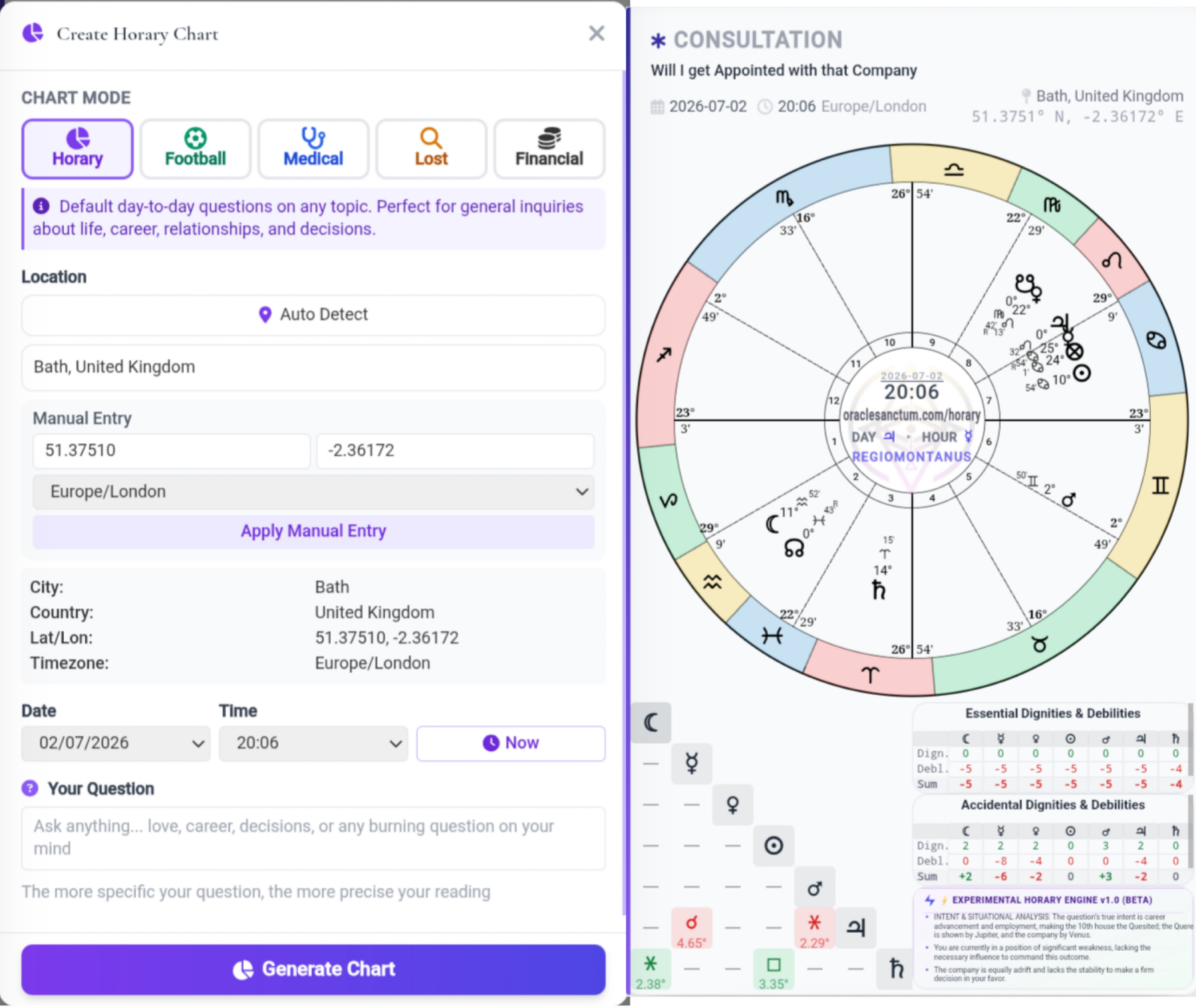
What Does "Horary" Actually Mean?
To understand horary astrology's meaning, look at the word itself. Horary comes from the Latin word hora, meaning "hour." So horary astrology, at its root, means the astrology of the hour — the astrology of the moment.
This surprises a lot of people the first time they hear it, because the natural assumption is that horary must be about the person asking. It isn't. The chart isn't built around the querent's birth. It's built around the question's birth. The instant a sincere question is fully understood by the astrologer, that instant becomes a kind of event in its own right — and the chart cast for that exact time and place is read as a symbolic record of the situation and where it's heading.
That single shift in thinking — from "whose chart is this?" to "when was this question born?" — is really the whole foundation of horary astrology. Once you understand that, the rest of the system starts to make sense.
How Is Horary Different From Natal Astrology?
This is usually the first real question people have, and it deserves a direct answer.
Natal astrology maps an entire life. It uses your exact birth time, date, and location to build a chart that describes your personality, your patterns, your long-term potential. It's broad by design — a natal chart is meant to say something true about decades, not minutes.
Horary astrology does the opposite. It's narrow, specific, and immediate. It doesn't ask "who are you?" It asks "what's happening with this one thing you're asking about, right now?" You don't need your birth details at all. You need a genuine question and the moment you asked it.
A simple way to hold the difference in your head: natal astrology is a portrait. Horary astrology is a photograph — one frame, one moment, one question, answered in full.
That difference is also why horary feels so immediately practical to people who try it. You're not waiting for a broad personality reading to eventually become relevant to your situation. You're getting judgment on your situation directly.
Is Horary Astrology Real? A Word on Its History
It's fair to ask whether this is a modern invention dressed up in old language, or something with real roots. It's the latter, and the history is worth knowing — not as trivia, but because it explains why horary is built the way it is.
Horary is one of the oldest branches of Western astrology, practiced for centuries by scholars, physicians, and advisors who used it for genuinely practical purposes: locating lost property, judging the outcome of a legal dispute, advising on a medical treatment, or answering questions about travel and safety. This wasn't fringe practice. The 10th-century Persian polymath Al-Biruni, one of the more rigorous scientific minds of the medieval world, served for years as a working court astrologer and wrote a detailed instructional text on the subject — treating it with the same structured seriousness he brought to mathematics and astronomy.
The most influential name in horary's history, though, is the 17th-century English astrologer William Lilly. Lilly's 1647 masterwork, Christian Astrology, remains one of the most complete and authoritative texts on horary ever written — detailed enough that practitioners still study it directly today, nearly four centuries later (Lilly, William. Christian Astrology. London, 1647. Available via public-domain archives such as Archive.org). Lilly didn't rely on vague impressions. He worked from strict, observable rules, and his casebook is full of specific, dated judgments — the kind of documented track record that's rare in any historical practice, let alone one this old.
That's really the point worth sitting with: horary wasn't built by people guessing and hoping. It was built by people who wrote down their reasoning, their rules, and their results, and let later students check their work against real outcomes. It survives not because of mystique, but because generations of careful practitioners kept finding that it held up.
The Core Idea Behind How Horary Works
Horary astrology is not a machine that spits out an automatic yes or no. It's closer to a craft — a disciplined method of reading meaning out of a specific moment.
Here's the basic mechanism. Every question involves at least two things: the person asking, and the thing being asked about. In the chart, each of those gets a symbolic stand-in — a planet, assigned through the houses. If the planet representing you is moving toward a harmonious connection with the planet representing the job, the relationship, the missing object, or whatever the question concerns, that's read as a "yes" forming. If the planets are moving apart, or clashing, that's read as a "no." The system holds together because the chart functions as a mirror of the situation itself — not a prediction pulled from nowhere, but a structured reflection of where things already stand.
Why should a chart cast for a moment reflect a real-world situation at all? This is where the deeper philosophy of horary comes in — the idea, inherited from a much older worldview, that everything happening at a given moment shares a kind of symbolic relationship with that moment. It's the same underlying principle Carl Jung later described, in a completely different context, as synchronicity: meaningful coincidence between an inner state and an outer event. Horary astrologers were working with a version of that idea centuries before Jung gave it a modern name.
You don't have to resolve that philosophical question to use horary. But it's worth knowing it's there, because it's the reason the system isn't arbitrary. The chart isn't guessing at your situation. It's treating your situation, and the moment you asked about it, as genuinely connected.
The Mindset Horary Asks You to Bring
Before anyone gets to the technical side of horary — the houses, the planets, the rules of judgment — it helps to understand the mindset the practice actually asks of you. This shows up clearly and consistently across how horary is taught, and it says a lot about why the system works the way it does.
- Stick to the basics. It's tempting, once you know a little astrology, to reach for every technique available — minor aspects, obscure points, extra layers of detail. In horary, that usually adds noise, not clarity. The traditional seven planets, the aspects, and the dignities do almost all of the real work.
- There is always an answer. A chart can look complicated at first glance. That's rarely a sign the system has failed — it's usually a sign you haven't looked closely enough yet. The answer tends to be there, just past the point where people give up looking.
- Use common sense. William Lilly himself advised mixing discretion with art. A horary judgment should make sense against real life. If a technically "correct" reading produces a conclusion that contradicts the obvious facts of the situation, that's a signal to slow down and look again — not to override common sense in favor of the technique.
- Talk to the querent. If a question is vague, or an important detail is missing, the right move is to ask before casting the chart, not to guess and cast anyway. A foggy question produces a foggy chart.
- Accept that you'll make mistakes. This is a skill, and like any skill, it's built through practice and error. The goal isn't never being wrong. The goal is learning more from the misses than from the lucky hits — and getting a little sharper each time.
That combination — discipline, patience, honesty about your limits — is really what separates a serious horary practice from guesswork wearing astrology's clothing. If you're ready to start practicing, our astrology academy walks you through the method step by step.
What Can You Actually Ask a Horary Chart?
One of the most common misconceptions is that horary astrology exists purely to predict distant future events. It doesn't — or at least, that's a small part of what it does. Horary is just as often about the present or even the past.
You could ask about the future: Will I get this job? Will this relationship last? You could ask about right now: Is my partner being honest with me currently? You could even ask about the past: Did my neighbor actually return what he borrowed, or is something else going on? All three are legitimate horary questions, because all three share the one thing horary actually requires — a genuine, specific concern, sincerely held by the person asking.
Size doesn't matter here either. A question about a missing house key is just as valid as a question about a major legal outcome, provided the person asking genuinely cares about the answer. What matters isn't how dramatic the question sounds. It's whether it's sincere.
This is also where the discipline of the practice shows up again: you cannot ask the same question twice. Even using identical words, the moment cannot be repeated, and a new chart represents a new — if closely related — question. This isn't a technicality. It reflects the core idea that the chart is tied to the birth of a specific question at a specific instant, not to the topic in general. For more guidance on forming questions that produce clear answers, read our guide on how to ask effective horary questions.
The Foundation Every Horary Chart Is Built On
Once a real question exists, two things determine everything that follows: the exact time and place the chart is cast for. Get either one wrong, and everything built on top of it will be wrong too.
The time is the moment the astrologer receives and fully comprehends the question — not when the querent first thought of it, not when a message was sent, not when a notification appeared on a phone. If you read and understand a written question at 3:47 in the afternoon, that's the moment the chart is cast for, regardless of when it was actually written.
The place is the astrologer's location at that moment — not the querent's, even if they're on the other side of the world. In the era when horary was first developed, astrologer and client were almost always in the same room, so this distinction barely mattered in practice. Today, with questions arriving by text, email, or a chart-casting tool from anywhere on earth, it matters a great deal, and the rule hasn't changed: time and place belong to the astrologer, at the instant of understanding.
There's a reason this level of precision matters so much. Cast a chart even a few minutes early or late, and it can shift which sign is rising — which changes which planet represents the querent, which can change the entire reading. This is also, in a sense, horary's built-in accuracy check: get the timing genuinely right, and verifiable past details of the situation tend to show up clearly in the chart. Get it wrong, and the reading tends to feel slightly off, even to a beginner.
The Real Question, and the Real Person Asking It
People rarely bring perfectly clean questions. What arrives is usually a story — some relevant, some emotional noise, some details that don't actually matter to the judgment. Part of a horary astrologer's job, before any chart is even cast, is separating the real question from everything wrapped around it.
Equally important is identifying who the real querent is — the person the chart is actually being cast for. Normally this is straightforward: someone asks about their own situation, and they get the First House, the traditional seat of the querent in any chart. But it isn't always that simple. If a friend is relaying someone else's question purely because that person can't ask directly themselves, the person with the actual concern remains the querent. If, instead, the friend is asking about someone else out of their own curiosity or concern — "Is my friend going to get that job?" — the friend becomes the querent, and the other person is represented by a different house, based on their relationship. Confuse these two situations, and the chart will describe the wrong person's circumstances entirely.
This is also where sincerity gets tested. A question casually invented to practice a technique, or nudged into existence by the astrologer's own curiosity rather than arising from genuine concern, isn't considered a real horary question — and traditionally, the chart won't hold together the way a real one does. The system, in other words, seems to know the difference between an actual question and a manufactured one.
Understanding the Default Outcome
There's one more principle that has to be in place before a chart can be read correctly, and it's one beginners frequently skip: the default outcome. In every judgment, the question to ask first is — what happens if nothing else interferes? Where is this situation already headed, on its own, before the chart adds anything new?
Consider the same question asked in two different contexts. "Will she marry me?" asked five minutes after meeting someone has an obvious default: no marriage. The chart would need strong, unambiguous testimony to overturn that baseline. Asked instead on the actual morning of a wedding, with a ceremony already booked and both parties already committed, the default flips entirely — now the chart would need clear evidence of a serious disruption to prevent the marriage from happening. Same words. Completely different starting point. Completely different reading.
The same logic applies everywhere. "Will I get the job?" carries a different default depending on whether you haven't applied yet or you've already signed a contract starting next week. Skip this step, and even a technically accurate chart reading can produce the wrong real-world conclusion — because you were measuring movement from the wrong starting line.
Where Horary Astrology Fits in Your Learning
If any of this resonates — if you've had a genuine question sitting with you, the kind you'd like a straight answer to rather than a vague impression — horary is very likely the most direct entry point into astrology as a serious practice, not just a curiosity.
It doesn't ask you to first learn an entire natal chart. It doesn't ask for a birth time you might not even know. It asks for one real question and a willingness to learn a structured, logical method for reading it. From there, the technical layers — the twelve houses, the seven traditional planets, the essential and accidental dignities that measure a planet's strength — build naturally, one on top of the last, each one sharpening your ability to read what the chart is actually saying. For a deeper dive into those technical layers, explore our guide to the 12 houses in horary astrology.
That's really the invitation horary makes: not "believe in this," but "test it, and see what it shows you."
Frequently Asked Questions
Do I need my birth time to get a horary reading?
No. This is one of horary's defining features. The chart is cast for the moment the question is asked and understood, not for anyone's birth. You need a genuine question — nothing else.
Can I ask the same horary question twice?
No. Each chart is tied to a specific, unrepeatable moment. Even identical wording produces a different chart, and a different question, the second time — because the situation itself has moved on.
Is horary astrology the same as fortune telling?
Not in the way that phrase usually implies. Horary follows a structured, rule-based method developed and refined over centuries, closer in spirit to a diagnostic system than to guesswork. It has both a documented history and a real technical framework behind every judgment.
Is horary astrology actually accurate?
That's a fair and important question — important enough that it deserves its own dedicated answer, including a real documented case study, rather than a quick paragraph here.
What's the difference between horary and natal astrology?
Natal astrology reads an entire life from a birth chart. Horary reads a single question from the moment it's asked. One is broad and long-term; the other is narrow, specific, and immediate.
Glossary of Key Terms
- Querent: The person asking the question.
- Quesited: The person, thing, or situation the question is actually about.
- Radical Chart: The chart cast for the exact moment a question is understood, with the querent placed in the First House.
- Horary: From the Latin hora, meaning "hour" — the astrology of the moment a question is born.
- Default Outcome: The direction a situation is already heading if nothing further interferes — the baseline every judgment must be measured against.
Where to Go From Here
Horary astrology is specific, disciplined, and — once you understand its logic — genuinely accessible. It strips away the guesswork and asks you to look at a real question through a structured, time-tested method: identify the real question, find the real querent, understand the default outcome, and read what the chart shows from there.
None of that requires belief up front. It only requires a real question and a willingness to look closely.
So here's the natural next step: if you've been sitting with a question of your own, that's exactly where horary begins. Cast your free horary chart now. Apply the method. See what it shows you.
No comments yet.