Table of Contents
- Introduction
- Why Rules Matter More Than Talent in Horary
- Rule 1: The Chart Is Cast for the Moment of Understanding
- Rule 2: Know the Real Question — and the Real Querent
- Rule 3: Establish the Default Outcome Before You Read a Single Aspect
- Rule 4: Read the Chart Through Rulers and Aspects — Not Guesswork
- Rule 5: Trust the Chart, Not the Urge to Overcomplicate It
- How to Cast Your First Horary Chart
- Where to Go From Here
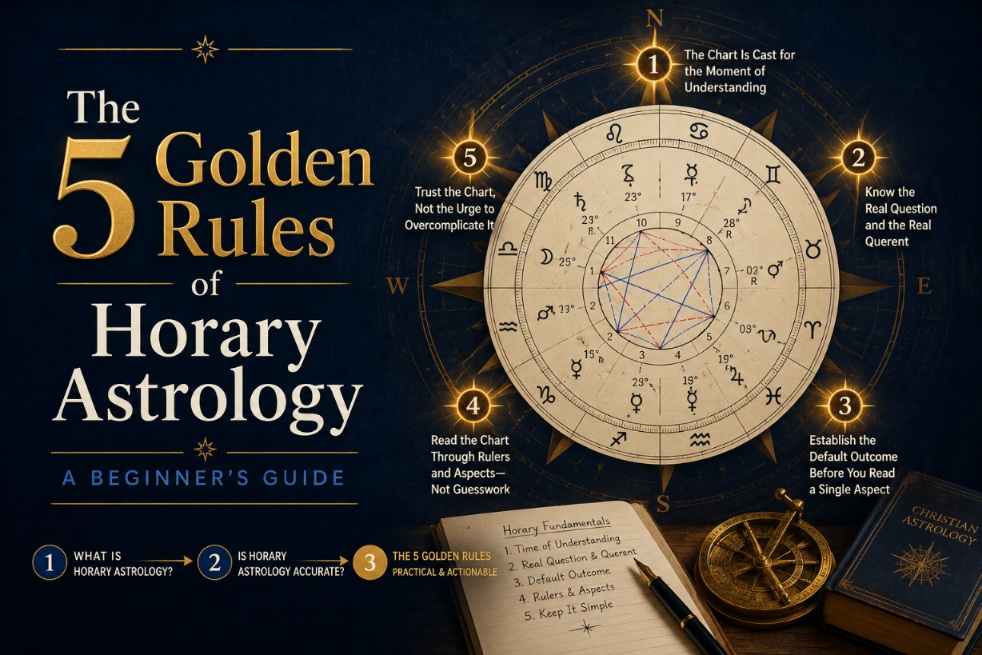
The 5 Golden Rules of Horary Astrology (And How to Cast Your First Chart)
Most people assume horary astrology needs years of study before you can ask it a real question. That's not true. Horary is one of the fastest astrological methods to actually use — not because it's shallow, but because it runs on a small number of rules, applied with discipline.
That's the trade horary makes. Natal astrology maps a whole life. Horary maps one moment: the moment a question becomes real. In exchange for that narrow focus, it gives you something rare — a direct, structured answer to whatever is actually on your mind.
In What Is Horary Astrology?, I explained what horary astrology is and how it differs from natal astrology. In Is Horary Astrology Accurate?, I demonstrated that the method can produce specific, testable judgments through a documented case study. Now it's time to show you how it works—the practical rules every horary astrologer follows before, during, and after casting a chart.
Five rules. That's the method. Learn them well, and you'll understand more about sound horary judgment than most people ever will.
Why Rules Matter More Than Talent in Horary
Here's a common misconception: that reading a chart is a gift, something you either have or don't. In horary, that's backwards. The chart doesn't reward intuition. It rewards structure.
Think about it like reading an X-ray. A doctor doesn't guess at what's broken — they follow a method: check the bone density, look for a fracture line, compare it to the healthy side. Horary works the same way. You check the time, identify the querent, establish the default outcome, read the significators, and follow the aspects. Skip a step, and the whole judgment can tip over.
This is why the rules below exist — not to make horary complicated, but to keep it honest. Once you understand them, casting and reading your first chart becomes a matter of following a sequence, not waiting for inspiration.
Rule 1: The Chart Is Cast for the Moment of Understanding — Not the Moment of Asking
This is the foundation. Get it wrong, and everything built on top of it is wrong.
The time you use is not when the question was typed, sent, or thought about. It is the exact moment you, the astrologer, receive and fully understand the question. If a message arrives while you're out and you don't read it until you're home with your coffee, the chart is cast for the coffee moment — not the moment it landed in your inbox.
The same logic applies to place. You cast the chart for wherever you are when you understand the question — not where the querent is. In an age of video calls and voice notes, astrologer and querent are rarely in the same room. It doesn't matter. The time and place are always yours.
There's a nuance worth sitting with here. Some people hesitate before asking — "I want to ask something... actually maybe it's different..." That delay is not wasted time. It often means the real question hasn't fully formed yet. You wait until they arrive at it, then cast for that moment. Cast too early, and you'll be reading a chart for a question that wasn't really being asked yet.
One firm boundary: you never choose a time because the planetary positions look favorable. That's not horary — that's electional astrology, a different discipline entirely. In horary, the moment is given to you. You don't select it, and you don't wait for the "safe" degree of a planet to pass a hard aspect before recording the time. The question chooses its own moment. Your job is only to notice when that moment arrives.
Rule 2: Know the Real Question — and the Real Querent
Before you can read a chart, you need to know what you're actually reading it for. This sounds obvious. It isn't.
People rarely bring you a clean question. You'll get a long story wrapped around it, emotional context, details that don't matter to the judgment at all. Your first task — before touching a chart — is to find the actual issue underneath the noise. Most horary questions fall into recognizable patterns: does this person love me, will I get the job, will the deal close, is this thing lost coming back. Once you can recognize the pattern, the noise stops being distracting.
Here's something many beginners miss: the same question, asked twice, is not the same question. Even if the wording is identical, the moment has changed, and horary is built on moments. If someone asks "should I leave him?" this week and "will I be okay if I leave him?" next week, those are two different charts answering two related but distinct questions. Each deserves its own judgment.
Then there's the matter of who is really asking. If someone asks about their own situation, they are the querent, and the first house belongs to them. But sometimes a person relays someone else's question — a friend translating for someone who doesn't speak the language, for example. In that case, the person whose concern it actually is remains the querent, even though someone else is speaking the words. Change the phrasing slightly — "is my friend going to marry her?" instead of "am I going to marry her?" — and the querent changes too. Get this wrong, and the chart will describe the wrong person's life.
One more thing worth asking yourself honestly: is this question genuinely theirs, or did you nudge it into existence because you wanted to practice? A question pulled out of someone mid-conversation, just so you'd have something to chart, rarely holds up. Sincerity is what makes a horary question real — not how big or small it sounds. "Where is my cat?" carries just as much weight as "will my business survive?" if the person asking genuinely cares about the answer.
Rule 3: Establish the Default Outcome Before You Read a Single Aspect
This is the rule that separates a considered judgment from a guess.
Before you look at the chart, ask: if nothing else happens, what direction is this situation already heading? That's your default outcome — your baseline. The chart's job is either to confirm that baseline or show you something strong enough to overturn it.
Consider the question "will she marry me?" Ask it five minutes after meeting someone, and the default is obviously no — nothing has been set in motion. For the answer to be yes, the chart would need to show unusually strong testimony. Ask the same words on the morning of the wedding, and the default flips entirely. Everything is already in motion toward marriage. Now it would take a significant testimony of disruption for the answer to be no.
Same question. Completely different judgment. The words never tell you the default — the real-world context does.
This applies everywhere. "Will I get the job?" asked before you've even applied has a default of no. Asked after you've signed a contract and have a start date, the default is yes, unless the chart shows something interrupting it. Skip this step, and you'll read every chart the same way regardless of context — which is exactly how sound judgments go wrong.
Rule 4: Read the Chart Through Rulers and Aspects — Not Guesswork
Once you know the moment, the question, and the default, you're ready to actually look at the chart. This is where structure replaces intuition entirely.
Every horary chart is a circle of twelve houses, each governing a different area of life, with the twelve zodiac signs running around the outside. Each house begins at a cusp, and the sign on that cusp tells you which planet rules the house. If the first house cusp falls in Sagittarius, Jupiter rules that house — and Jupiter becomes the significator for the querent. This is how you identify the key players in any chart: not by feeling, but by reading the cusps.
In horary astrology specifically, we use the Regiomontanus house system. It's the traditional choice, and it produces the house divisions this method was built around — make sure your charting tool is set to it.
Once you've identified your significators — the querent's ruler and the quesited's ruler — the next question is simple: is there an aspect between them? Focus on the five major aspects and what each one signals:
- Conjunction — two planets sharing the same degree. Its meaning depends entirely on context; it can be helpful or difficult.
- Sextile — 60 degrees apart. Generally helpful, easy, good indifferent.
- Square — 90 degrees apart. Tension and obstacles — something may still happen, but not without friction.
- Trine — 120 degrees apart. Unity, concord, an easy path.
- Opposition — 180 degrees apart. Conflict or separation.
If you see an "R" beside a planet, it's retrograde — appearing to move backward through the sky. This usually points to delay, reversal, or a return of something already in motion.
Here's how it fits together. Say the question is about a job: the querent is ruled by the first house, the job by the tenth. If the tenth-house ruler is applying toward a trine with the first-house ruler, that's a yes — and a smooth one. If it's a square instead, the outcome may still land, but with real obstacles along the way. Houses, rulers, and applying aspects — that's the engine of every horary judgment.
Rule 5: Trust the Chart, Not the Urge to Overcomplicate It
The final rule isn't a technique. It's a discipline — and it's the one experienced practitioners return to most often.
When a chart looks complicated, the temptation is to reach for more: minor aspects, extra points, layers of software output you don't actually need. Resist that. Go back to fundamentals instead. What are the aspects? What is the dignity? Is there reception between the planets? If an answer isn't clear yet, it's rarely because the chart is hiding something from you — it's usually because you haven't looked closely enough at what's already there.
There's a persistent myth that you need three separate testimonies before you're allowed to give a judgment. That idea doesn't hold up. If the chart offers one clear testimony, that's what you work with. A single clean aspect can carry as much weight as a pile of ambiguous ones.
And when your judgment turns out wrong — because it will, for every practitioner, at some point — that doesn't mean the method has failed. It means you missed something this time. Learn from it, and keep practicing. The goal was never perfection on day one. It was building the habit of clear, structured thinking every time you sit down with a chart.
How to Cast Your First Horary Chart
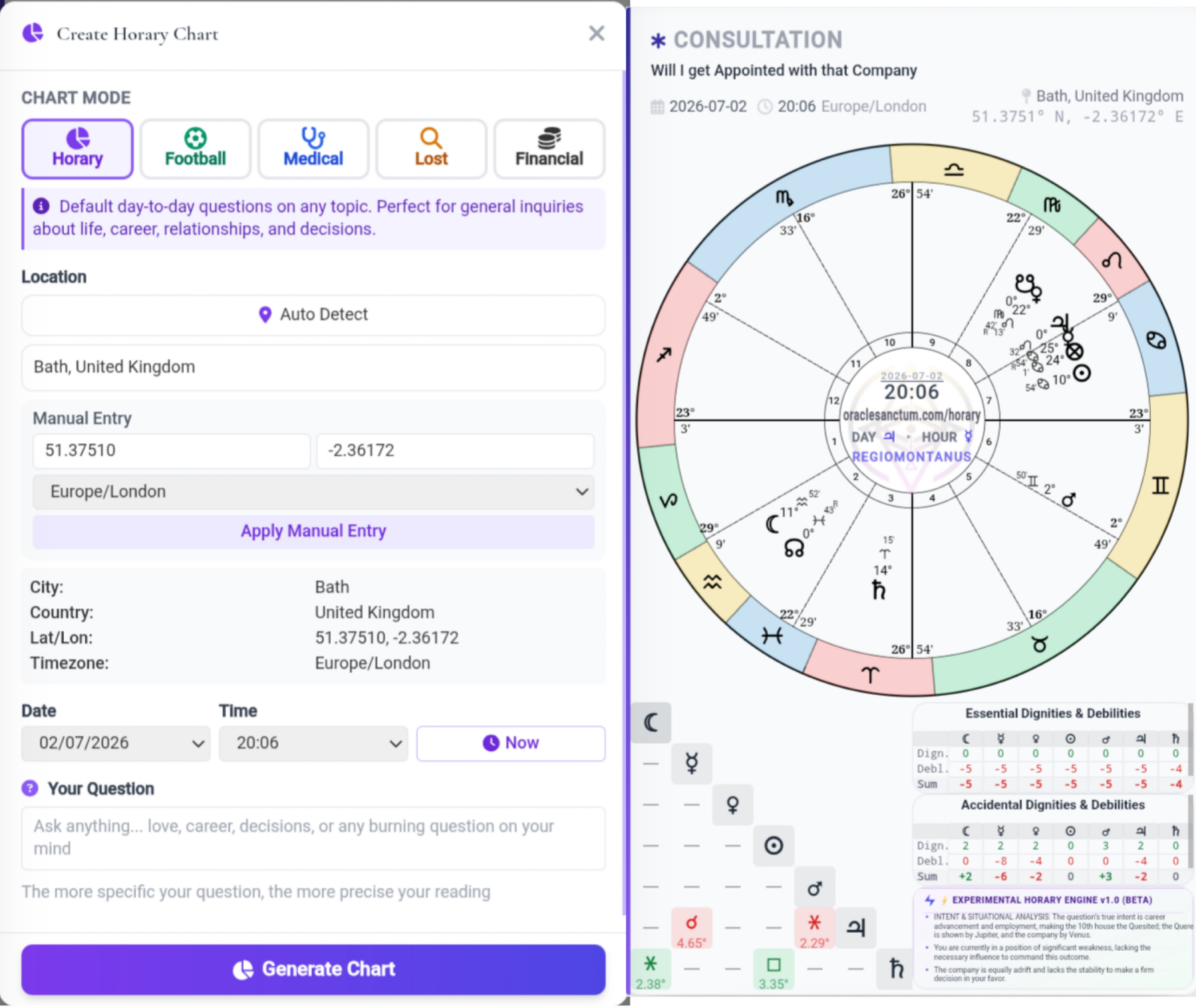
With the five rules in mind, casting your first chart is straightforward. Here's the sequence, using the free OracleSanctum Horary Chart Tool:
- Gather your basics. Note the exact time the question became clear to you, your location at that moment, and the question itself, worded as precisely as you can.
- Open the tool. Go to oraclesanctum.com and select "Create Your Chart" from the menu, or go directly to oraclesanctum.com/horary. Confirm "Horary" is selected under Chart Mode.
- Set your location. Use Auto Detect for the most accurate result, search for your city directly, or enter your coordinates manually.
- Set the time and date. The tool defaults to the current moment — tap "Now" to refresh it, or adjust the fields if you're casting for an earlier moment you noted down.
- Enter your question. This step is optional, but it unlocks the tool's AI-assisted judgment and lets you save the chart to revisit later.
- Generate your chart. One click, and your first horary chart is ready to read.
Once it loads, you'll see the chart wheel itself, followed by Essential and Accidental Dignity tables, and our Experimental Horary Engine, which offers an AI-assisted first read of the chart. Take your time with the wheel before leaning on the engine — the goal is to build your own eye for the rulers and aspects described in Rule 4.
Where to Go From Here
These five rules are the foundation everything else in horary is built on. The twelve houses, the seven classical planets, the dignities that show which significators are strong and which are weak — all of it depends on the discipline covered here: the right moment, the real question, the honest default, the structural read, and the trust to stop overcomplicating what the chart already shows you.
Try it yourself. Take a genuine question — yours or someone else's — note the moment you understood it, and cast a chart. Walk through the five rules in order. You won't get every judgment right on the first attempt. Nobody does. But you'll be reading the chart with structure instead of guesswork, and that's the real starting point of horary.
Ask your question. Then let the rules do their work.
Ready to go deeper? Start with my guide to the twelve houses in horary astrology, where you'll learn how each house represents a different area of life and how they're used in real chart judgments. If you want structured lessons, visit the OracleSanctum Academy.
No comments yet.