Table of Contents
The Third House in Horary: Communication, Siblings, Short Journeys
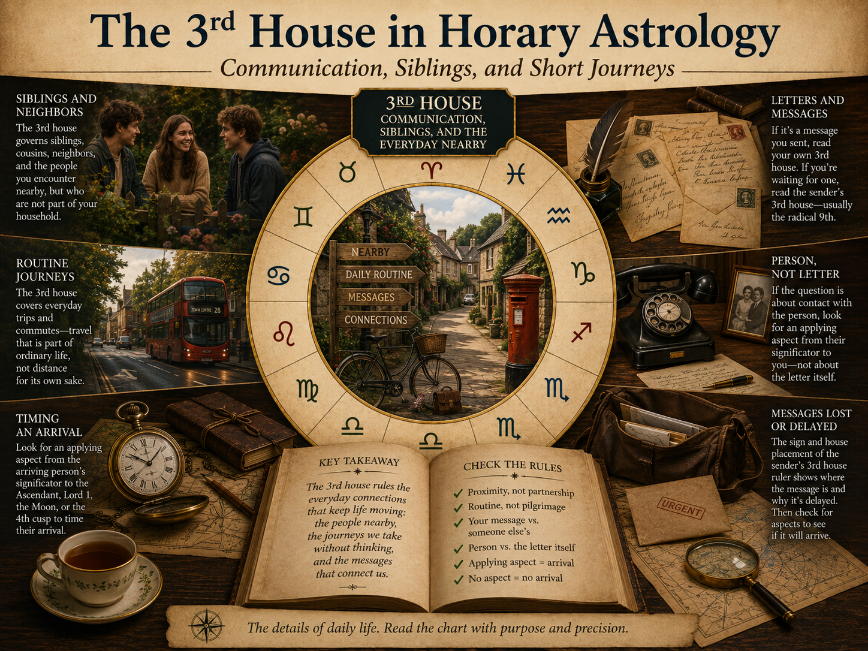
The 3rd house governs the texture of ordinary life — the people nearby but not in your household, the trips you take without thinking about them, the messages that arrive and the small talk that circulates around you. It's an easy house to underestimate, because none of what it governs feels significant on its own. But that's precisely its role: the 3rd house is where horary astrology handles everything routine, so the more dramatic houses are free to handle everything else.
It's also a house with a real trap built into it — one Frawley calls out directly, because it's tempting enough that even careful students fall into it.
Siblings, Neighbors, and the People Nearby
The 3rd house governs the querent's siblings, cousins, and neighbors — people connected by proximity or blood but distinct from the closer relationships governed elsewhere. "Neighbors" can be read in a wide sense, in something like the old biblical meaning of anyone encountered in daily life, but in ordinary horary practice it usually means exactly what it sounds like: the people who live next door or on the same street.
This matters because relationship questions have a strong pull toward the 7th house — the house of marriage and partnership — and that pull is often wrong. A sibling asking whether they'll patch things up with a brother is not a 7th house question. A question about whether a neighbor will return a borrowed tool is not either. Both stay in the 3rd, because the 7th house is reserved specifically for one-to-one committed partnership and open opposition, not for every person who isn't the querent.
Routine Journeys, Not Short Distances
The traditional label for this part of the 3rd house is "short journeys," and that phrase causes more confusion than it resolves, because it sounds like the rule is about distance. It isn't. It's about purpose.
The 3rd house governs journeys that are part of ordinary, habitual responsibility: the daily commute, a trip to the shops, driving children to school. What makes a journey 3rd house isn't how far you travel — it's that the journey is routine, functional, part of the unremarkable texture of getting through a day.
A journey with a different quality of purpose — even one covering less physical distance — belongs elsewhere. Walking around the corner to visit a shrine isn't a 3rd house matter; it's a pilgrimage, and pilgrimages belong to the 9th house regardless of how close the destination is. The same querent, on the same day, might have a 3rd house journey to work and a 9th house journey to church that's physically shorter but categorically different. Distance tells you nothing here. Purpose tells you everything.
Letters, Messages, and Whose Third House You're Reading
This is where the 3rd house gets genuinely tricky, because the house assignment depends entirely on whose message you're asking about — the querent's, or someone else's.
If the question concerns something the querent themselves sent — "did she get my letter?" — you're working with the querent's own radical 3rd house, and you'd look for a separating aspect between the recipient's significator and Lord 3 (the letter itself), since a separating aspect shows something that has already happened.
But most real questions aren't about a letter the querent sent. They're about something the querent is waiting on: "when will I hear from him?" or "when will the book I ordered arrive?" In cases like this, you're not reading the querent's 3rd house at all — you're reading the sender's 3rd house, found by turning the chart to that person's perspective. Since the people querents are usually waiting to hear from are romantic interests or business contacts (both 7th house relationships), the sender's 3rd house typically lands on the radical 9th — the 3rd house counted from the 7th.
Once you've correctly located that turned house and its ruler, look for an applying aspect between that ruler and Lord 1, the Moon, or Lord 2. An aspect specifically to Lord 2 shows the letter or parcel arriving into the querent's actual possession, not merely that contact has been made. No applying aspect at all means no arrival is coming.
There's a related distinction worth holding onto: once a letter physically reaches the querent, it stops being anyone's 3rd house matter and becomes the querent's own 2nd house possession. The house governing "will this letter arrive" is not the house governing "what happens to this letter once I have it" — those are two different questions about two different points in time, even though they concern the same physical object.
When the Question Is About the Person, Not the Letter
Not every "will I hear from them" question is really about a letter or a phone call as an object. Often, the point at issue is contact with the person, and treating it that way simplifies the judgment considerably.
If the querent is waiting to hear from a sweetheart, or waiting for their mother's phone call, the underlying question is contact with that person — not the specific medium of a phone call considered as a turned 3rd house matter. In that case, an applying aspect from that person's own significator (Lord 7 for a partner, Lord 10 for a parent, and so on) directly to the querent is sufficient for a "yes." There's no need to complicate the judgment by hunting for a turned 3rd house when the real question is simpler than that.
The reverse case matters too. If the querent has ordered a book and the transaction is complete, an applying aspect from the seller's significator (Lord 7, since a seller is a business contact) back to the querent is not what you want to see — the querent has no interest in further contact with the seller once the book has shipped. Here, the letter or parcel itself, not the sender as a person, is the actual point of the question, so you go back to tracking the parcel through the turned 3rd-from-7th, not the seller's direct aspect to the querent.
Timing an Arrival
Questions about arrivals — a visitor, a phone call, a delivery — typically operate on a short, contained time-scale, and that changes how you time the answer. Take the ruler of the arriving person's relevant house (11th for a friend, 6th for a plumber, for example) and look for an aspect to, in order of preference: the Ascendant, Lord 1, the Moon, or the 4th cusp (representing the querent's home). No aspect at all means no arrival is coming.
Where there is an aspect, the tight time-scale of these questions makes timing unusually precise. Anything under a full degree of separation can generally be read as "arriving immediately," though timing down to the minute is possible. In fact, for same-day arrival questions specifically, minutes of arc can often be read directly as minutes of clock time — if a significator sits 35 minutes of arc from the Ascendant, the practical reading is an arrival in roughly 35 minutes.
It's worth noting explicitly that direction of application doesn't carry meaning here the way it might seem to. If Lord 1 is applying toward the visitor's significator, rather than the visitor's significator applying toward Lord 1, that does not mean the querent needs to go out and meet them halfway. Who travels to whom is answered by the actual circumstances of the question, not by which planet happens to be the one in motion toward the other in the chart.
A Worked Reasoning Example
To see how the 3rd house's location logic works in practice, consider a composite scenario built on Frawley's method for tracing an object once you know which house its significator occupies, applied here to a 3rd house situation: an important message the querent is certain they sent, but which appears to have gone astray somewhere in transit.
Suppose the querent asks, "did my message actually reach him?" — and the chart shows the recipient's significator, ruling his own 3rd house, sitting in an earth sign within a cadent house. Frawley's method for object location proceeds sign by sign, planet by planet, rather than jumping straight to a conclusion. The cadent placement tells you first that whatever is happening with this message is slow and not yet visibly resolved — cadent houses are the weakest of the three categories, and things placed there act quietly, if at all. The earth sign adds a further layer: earth signs, in Frawley's framework for locating objects, suggest something sitting low, near the ground, or held rather than moving.
Read together, rather than separately, these two testimonies tell a coherent story: the message hasn't been actively rejected or lost outright, but it also hasn't been acted on. It's sitting somewhere ordinary and inert — an inbox, a desk, a pocket — rather than moving toward a reply. The next step in the judgment isn't to guess wildly; it's to look for an applying aspect from that recipient's significator back toward the querent's own significator or the Moon. Its presence or absence answers the real question — will contact eventually happen — while the placement itself explains why nothing has happened yet.
This is the method underneath nearly every 3rd house location question: sign and house first tell you the quality and pace of the situation, and only then do you look to aspects to tell you whether the matter resolves. Jumping straight to the aspect without reading the placement first is how confident-sounding judgments turn out wrong.
Where This Fits
The 3rd house rewards precision more than most, because its boundaries with the 7th and 9th houses are exactly the boundaries a beginner instinct tends to cross first. Every relationship question tempts you toward the 7th. Every journey tempts you toward measuring by distance instead of purpose. Holding those two lines — proximity versus partnership, purpose versus distance — is most of what this house asks of you.
For the complete method these house judgments plug into, see the 5 Golden Rules of Horary Astrology. For how all twelve houses relate to each other at a glance, Master the 12 Houses of Horary Astrology is the reference page to keep close by. And if your own question involves something or someone missing rather than simply delayed, Can Horary Astrology Really Find Lost Objects, Missing People, or Answer "Will They Contact Me?" covers that ground directly.
The worked example above is an illustrative composite built on Frawley's traditional method for object and message location, not a documented historical case.
No comments yet.