Table of Contents
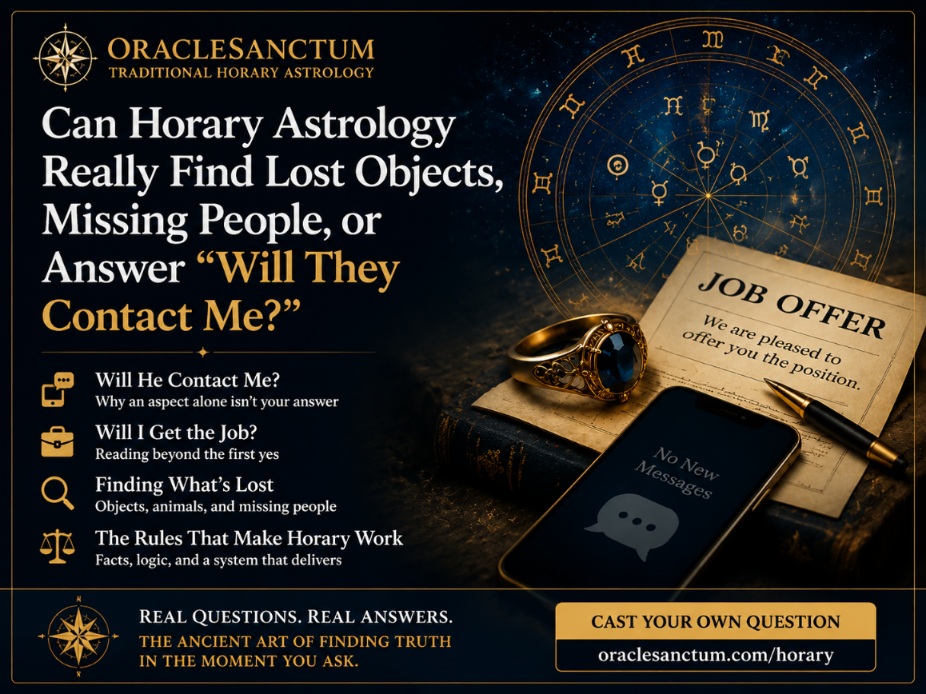
Can Horary Astrology Really Find Lost Objects, Missing People, or Answer "Will They Contact Me?"
Most people find horary astrology the same way. They are not researching astrology in general. They are sitting with one specific, urgent question — a missing ring, a silent phone, a job application left hanging — and they type that exact question into a search bar, half-expecting no real answer to exist.
I understand that instinct completely. It is a fair question to ask before you trust any system with something that matters to you. So let me answer it directly, the way I try to answer everything on this site: not with reassurance, but with the mechanics.
Horary astrology does not work by intuition, and it does not work by vague symbolism either. It works because a chart cast for the exact moment a question is asked can be read using a fixed set of rules — rules for who represents whom, rules for what a planetary movement means, and rules for when a promising sign is cancelled out by something stronger. If you already want the full grounding in how and why this works, I've laid out the core method in the 5 Golden Rules of Horary Astrology. What I want to do here is something narrower and, I think, more useful: walk through exactly how the chart handles four of the most common situations people bring to me, so you can see the reasoning for yourself rather than simply being told to trust it.
"Will He Contact Me?" — Why an Aspect Alone Isn't Your Answer
This is probably the single most emotionally loaded question I get, and it's also the one most badly served by generic advice. The usual answer floating around online is: find an applying aspect between the two significators, and if it exists, the answer is yes. That rule isn't wrong. It's just dangerously incomplete on its own.
Think about it this way. An applying aspect tells you two people are moving toward a moment of connection. It does not tell you whether that connection will actually happen, or what state the other person will be in when it does. To get a real answer, I work through three stages, in order.
First, I assign the correct house. You cannot default to the 7th house for every "will they contact me" question, because the 7th house specifically governs spouses, exes, and romantic partners. A sibling is shown by the 3rd house lord. A boss or authority figure is shown by the 10th house lord. Get the house wrong, and every rule that follows is answering the wrong question. Before I even look at an aspect, I also check whether their planet is sitting directly on my 1st house cusp or inside the 1st house itself. When that happens, the chart is being literal — they are already arriving, in a very physical sense.
Second, I track the aspect and check for interference. If their planet isn't already in my space, I look for an applying aspect between the two significators. But an application is a declaration of intent, not a finished event. I have to check whether a third, faster planet is about to cut between them before the aspect perfects. In traditional horary this is called prohibition, and in real life it looks exactly like what you'd expect — the friend who steps in, the sudden emergency, the interruption that gets in the way of the call actually happening.
Third, and this is the step most people skip entirely, I grade the other person's condition. An aspect only opens the door. It does not tell you whether the person on the other side has the strength or the will to walk through it. If their significator is retrograde and sitting in its detriment or fall, that planet is weak — and in practical terms, that often shows someone who wants to reach out but genuinely can't manage it right now. I also check what sign their planet occupies. If it happens to fall in the sign of my own planet's detriment or fall, that's a sign of quiet resentment. The connection might still occur, mechanically, but it won't feel like the reunion you were hoping for.
An aspect is a conversation waiting to happen. Whether that conversation actually arrives, and what tone it carries, depends on the condition of the planet representing them — not just the geometry between two points in the sky.
"Will I Get the Job?" — Reading Beyond the First Yes
Career questions look simple on the surface and rarely stay that way once you're inside the chart. The basic setup is this: the querent is shown by Lord 1 (and often the Moon), and the job itself is shown by Lord 10. An applying aspect between them is the foundational testimony that, all else being equal, the querent gets the job.
But "all else being equal" is doing a lot of work in that sentence, and I want to show you why.
The type of aspect matters. A trine suggests the job comes easily. An opposition might still mean you get it, but you may not keep it long, or you'll wish you hadn't taken it. I also always check for an intermediary — an agent, recruiter, or head-hunter — since a collection or translation of light involving that third party can shift the entire outcome.
Placement carries its own weight, separate from any aspect. Finding the querent's significator in the 10th house is a minor positive testimony — it shows desire for the job, and desire helps, but it isn't the same as getting hired. Finding Lord 10 sitting inside the 1st house is far stronger: it suggests the position is effectively already in the querent's pocket, and the closer that planet sits to the cusp, the more weight it carries.
Then there's the question almost nobody asks up front: even with a good aspect, is the querent's planet actually strong enough to be hired? A retrograde planet sitting in its detriment describes someone unlikely to be chosen even in a favorable configuration — because no employer, symbolically or literally, tends to want that. I also look at Lord 2, the querent's finances, since it's common to see the real driver behind a job search being financial need rather than genuine interest in the role. And I check Lord 11, the money that comes with the position, to see whether the pay itself will be fair or a source of ongoing frustration.
A void of course Moon here, as in most questions requiring real change, is a meaningful caution — it often shows the situation quietly stalling, even when other testimony looks encouraging. None of this is guesswork. It's a hierarchy of testimony, checked in a consistent order, every time.
Finding What's Lost — Objects, Animals, and Missing People
I'll be honest with you about something upfront: lost object questions are the hardest category in horary astrology, and any practitioner who tells you otherwise either hasn't done many of them or isn't being fully honest with you. The reason is structural. Most horary questions have a limited range of outcomes — yes or no, roughly. A lost object could be anywhere, and translating "the chart shows this planet, in this sign, in this house" into "the object is here" takes real skill and real caution.
That said, the method is genuinely reliable when applied correctly, and I want to walk you through it rather than just assert that it works.
Assigning the right significator starts with what's actually missing. An inanimate object is governed by the 2nd house (movable possessions) or the 4th house (buried or long-settled treasure). I don't worry too much about the line between "lost" and "mislaid" — I look at both rulers and use whichever one genuinely fits the object in question. A lost animal takes the 6th house if it's smaller than a goat, and the 12th if it's larger — this is a generic distinction of scale, not a precise measurement. A missing person is shown by whichever house describes their relationship to you: the 5th for a missing child, the 6th for a missing employee. The 7th house is often called the house of fugitives, but I'd rather use the specific relationship house whenever one is available, and reserve the 7th for a missing spouse or someone with no closer connection to the querent.
Once I have the right significator, the house it sits in tells me where the object is — and in my experience, this is by far the most dependable part of the whole method. If the significator sits in the 11th, I'm looking at a friend's house. If it's conjunct the Ascendant, the object is remarkably close to the querent themselves — sometimes literally in a pocket or a jacket lining. I take what the querent tells me with real caution here, because if they already knew where the object was, it wouldn't be lost. The chart, not the client's assumptions, is the actual source of truth.
Whether it will be recovered at all is a separate question from where it is. The strongest testimony of recovery is an applying aspect between the object's significator and the querent (or Lord 2). I also check whether at least one of the Sun or Moon sits above the horizon — quite literally, if there's no light, there's nothing to see by. A significator close to an angle strengthens the case for recovery even without a clean aspect, and a void of course Moon here isn't the concern it is elsewhere, since the object exists somewhere regardless.
I won't pretend every lost object chart resolves cleanly. But when the testimony lines up — house, condition, and aspect — the accuracy can be genuinely striking, in a way that's very hard to write off as coincidence once you've watched it happen a few times yourself.
Why These Rules Exist at All
If there's one thing I hope comes through in all three of these breakdowns, it's that horary astrology isn't a system of feelings translated into planets. It's closer to a discipline with its own internal logic — closer to reading a legal document than reading a mood. Every testimony is checked against every other testimony, in a fixed order, precisely so that hope doesn't get to override what the chart is actually showing.
That's also exactly why I put together a full case study on horary's track record — because a system this structured should be judged on its actual results, not on how comforting or uncomfortable its answers happen to feel in the moment. And if the whole concept of casting a chart for a single question is still new to you, my introductory guide to what horary astrology actually is is the right place to start before working through cases like these.
Ask Your Own Question
Reading about the method is one thing. Watching it answer your actual situation is another. If you have a real question sitting with you right now — a person who's gone quiet, a job you're waiting to hear back about, something you've misplaced and can't stop thinking about — you can cast and read a horary chart for it yourself using my chart tool.
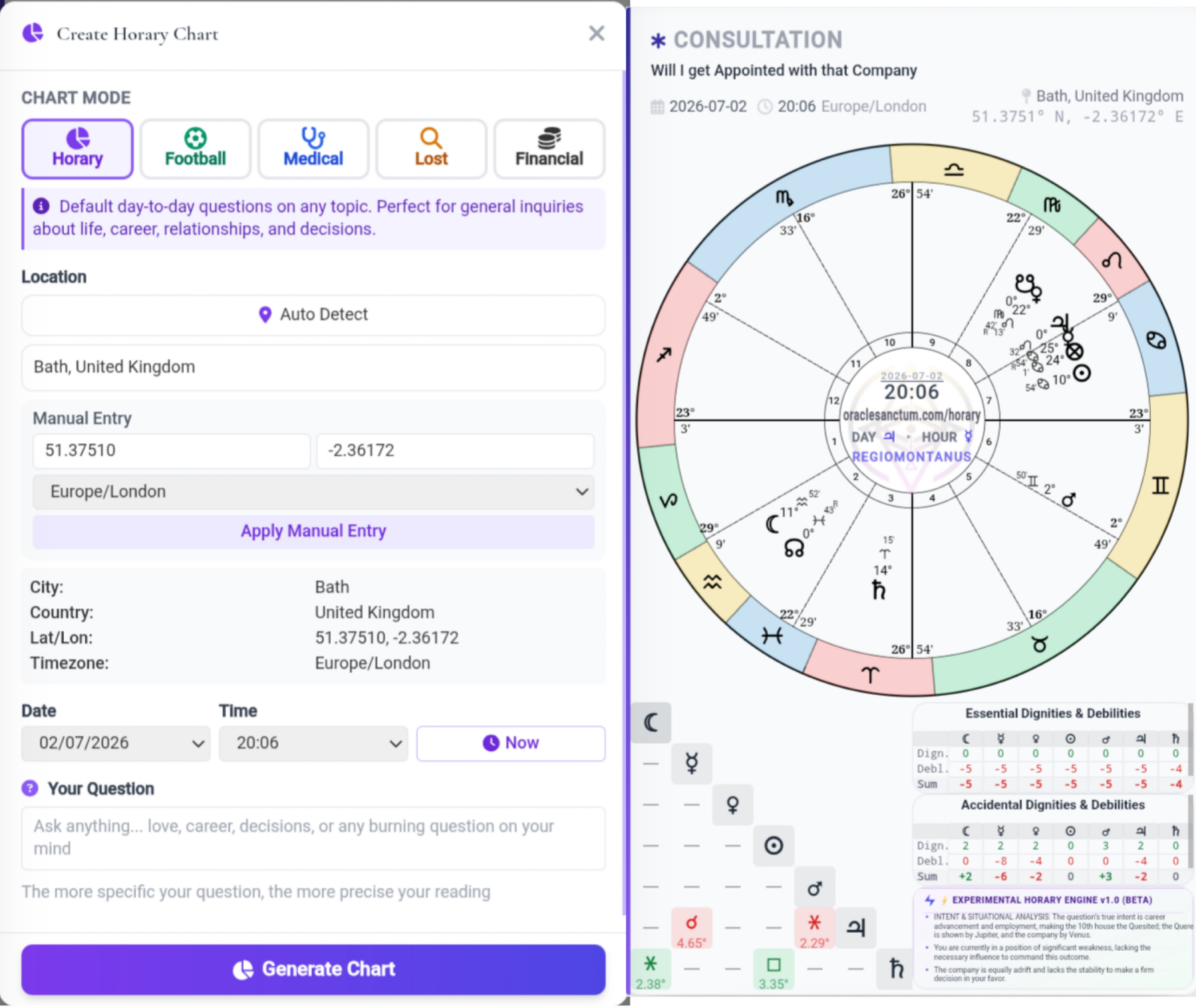
You don't need to already know the rules to start. You just need the question, and the exact moment it's asked. That's how horary has always worked, and it's still the most direct way I know to find out whether the chart has a real answer for you.
If you want to go deeper into the method before casting, my 5 Golden Rules of Horary Astrology walks you through the full framework, or explore the guide to the twelve houses to understand the house assignments behind every judgment on this page.
No comments yet.