Table of Contents
The Second House in Horary: Money, Possessions, and Self-Worth
Ask someone new to horary astrology what the 2nd house means, and they'll usually say "money." That's correct, as far as it goes. But it goes nowhere near far enough, and the gap between "money" and what the 2nd house actually governs is exactly where beginner judgments tend to go wrong.
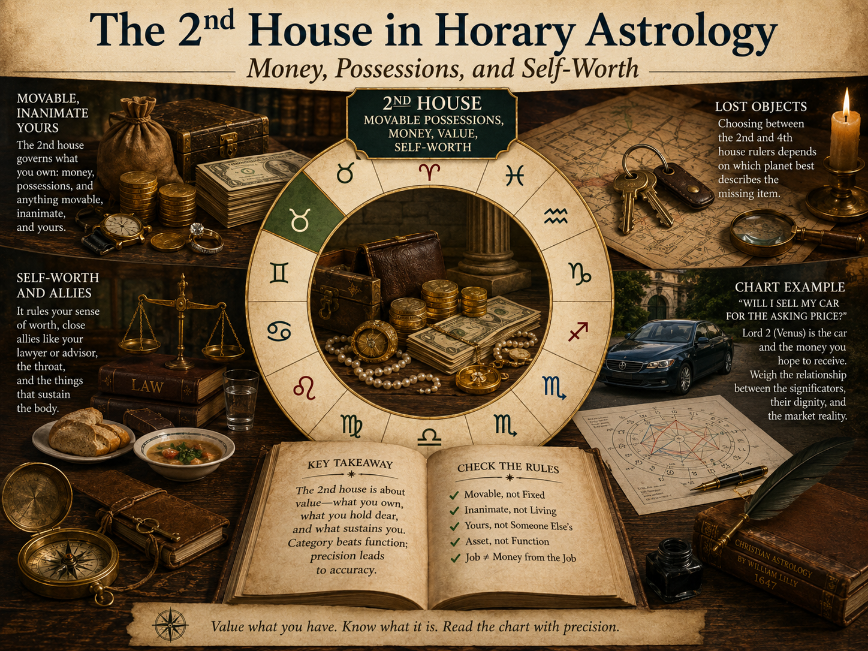
The 2nd house is the house of the querent's movable possessions — a word doing more work than it looks like at first glance. Get that one qualifier wrong, and you'll find yourself reading the wrong house entirely for questions that seem, on the surface, to obviously belong here.
Movable, Inanimate, Yours
The 2nd house governs what the querent owns, under three conditions at once: the thing has to be movable, it has to be inanimate, and it has to belong to the querent. Drop any one of those three conditions and the house assignment changes.
Your car is 2nd house — when you're asking about it as a possession. It's yours, it's inanimate, and you could, in principle, move it or sell it. Your money, in any form — physical cash, a bank balance, stocks, bonds — lives here too. So does anything else you own that could reasonably be picked up or driven away: furniture, a piano, jewelry, whatever fits the category of "things I have."
But change any one of the three conditions, and you're in a different house. If the possession isn't movable — your house, your land, any real estate — that belongs to the 4th house instead, the house of fixed and buried things. If the "possession" is alive — a pet, an employee, another person — it stops being a possession at all in any meaningful astrological sense, and you assign it to whichever house actually governs that relationship. A pet dog is 6th house. A spouse is 7th. Nothing living stays in the 2nd, no matter how attached the querent feels to it.
This is worth sitting with, because the temptation to let function override category is strong, and it's wrong. A car used for a school run doesn't become a 3rd house matter just because its function that day was a short journey. What the thing is — a movable, inanimate possession — decides its house. What it's doing in a particular moment doesn't override that. The one genuine exception is a question that specifically asks about the vehicle's function as a vehicle rather than its value as a possession — "will it get me there safely" is 1st house, not 2nd, precisely because the question has shifted from ownership to function. But "will someone buy my car" stays firmly 2nd house, because that question is about the car as an asset.
Where the 2nd House Gets Complicated: Lost Objects
The single most common real-world use of the 2nd house in horary practice is the lost-object question, and it's also where the house's logic gets genuinely difficult — not because the rule is unclear, but because translating a planet's symbolism into an actual physical location is hard no matter how experienced you are.
John Frawley is candid about this in his own teaching: his success rate finding lost objects is well below his success rate with horary questions generally, and he attributes this honestly to the nature of the problem rather than any flaw in the method. Most questions have a limited range of possible answers — yes or no, at the simplest. A lost object could be anywhere, and because you're usually dealing with a location you've never seen, you have very little to work with when deciding what a given planet actually represents in that specific room. Mars might be the fireplace in one house and the gun cabinet in another. There is no way to know in advance which it is.
For an inanimate lost object, your first task is choosing between the 2nd house and the 4th. Frawley's rule is straightforward: look to the rulers of both houses and use whichever one actually describes the object. Some modern authors draw a sharp line between "lost" objects (2nd house) and "mislaid" ones (4th house). Frawley is skeptical that this distinction is meaningful in practice, and treats it as unnecessary hair-splitting — what matters is which planet's nature and sign genuinely fit the missing thing, not which word the querent used to describe losing it.
A worked example makes this concrete. Suppose the question is "where are my keys?", and the chart shows Cancer on the 2nd house cusp, Virgo on the 4th. You have two candidate rulers: the Moon (Cancer, 2nd house) and Mercury (Virgo, 4th house). Mercury is also the natural ruler of keys, regardless of which house happens to rule them in this particular chart. That natural rulership breaks the tie — Mercury becomes the significator, not because of a rigid 2nd-vs-4th rule, but because Mercury is simply the planet that best describes a key.
Self-Worth: The 2nd House Beyond Money
The 2nd house's meaning doesn't stop at physical possessions. It extends to value in a broader sense — including the querent's sense of their own worth, their confidence, and even how much value they place on people close to them, such as a romantic partner. Think of the 2nd house as governing what the querent holds dear, whether that's cash in a bank account or a felt sense of personal value.
This same house also governs a specific kind of ally: people who act as an extension of the querent's own interests in a defined situation. In a duel, this is your second — the person standing behind you. In a legal matter, it's your lawyer, but only while they're actively representing you in that specific case; a lawyer you consult in general, or any learned professional you turn to for expertise rather than active representation, belongs to the 9th house instead. Close, private advisors — the people who speak into your ear, whose value to you is personal and immediate — sit here too.
And the 2nd house rules the throat, and by extension, food — everything that nourishes and sustains the 1st house, the body itself. In a medical chart, a question about the throat or about appetite is read through the 2nd.
A Chart Example: "Will I Sell My Car for the Asking Price?"
Many people assume that a horary question about a job belongs to the 2nd house because a job brings in money. But that is a misconception that collapses under logical examination. A job is a position of career and status — a 10th house matter. The 2nd house only enters the frame if you are asking specifically about the salary attached to it.
To see the 2nd house working in its pure, disciplined form, we must look at a question entirely about personal liquid assets: "Will I sell my car for the asking price?" Here, the car isn't a mode of transport; it is explicitly a movable, inanimate asset the querent wants to liquidate into cash.
This brings us to a fundamental rule of traditional horary astrology, one practiced deeply by 17th-century master William Lilly. In his seminal text, Christian Astrology, Lilly laid down the structural blueprint for judging the sale of commodities and assets. To find the truth of the matter, we don't look for vague, mystical energies; we weigh the precise relationship between the significators.
Consider this real chart cast through the OracleSanctum horary tool for a transaction that had completely stalled:
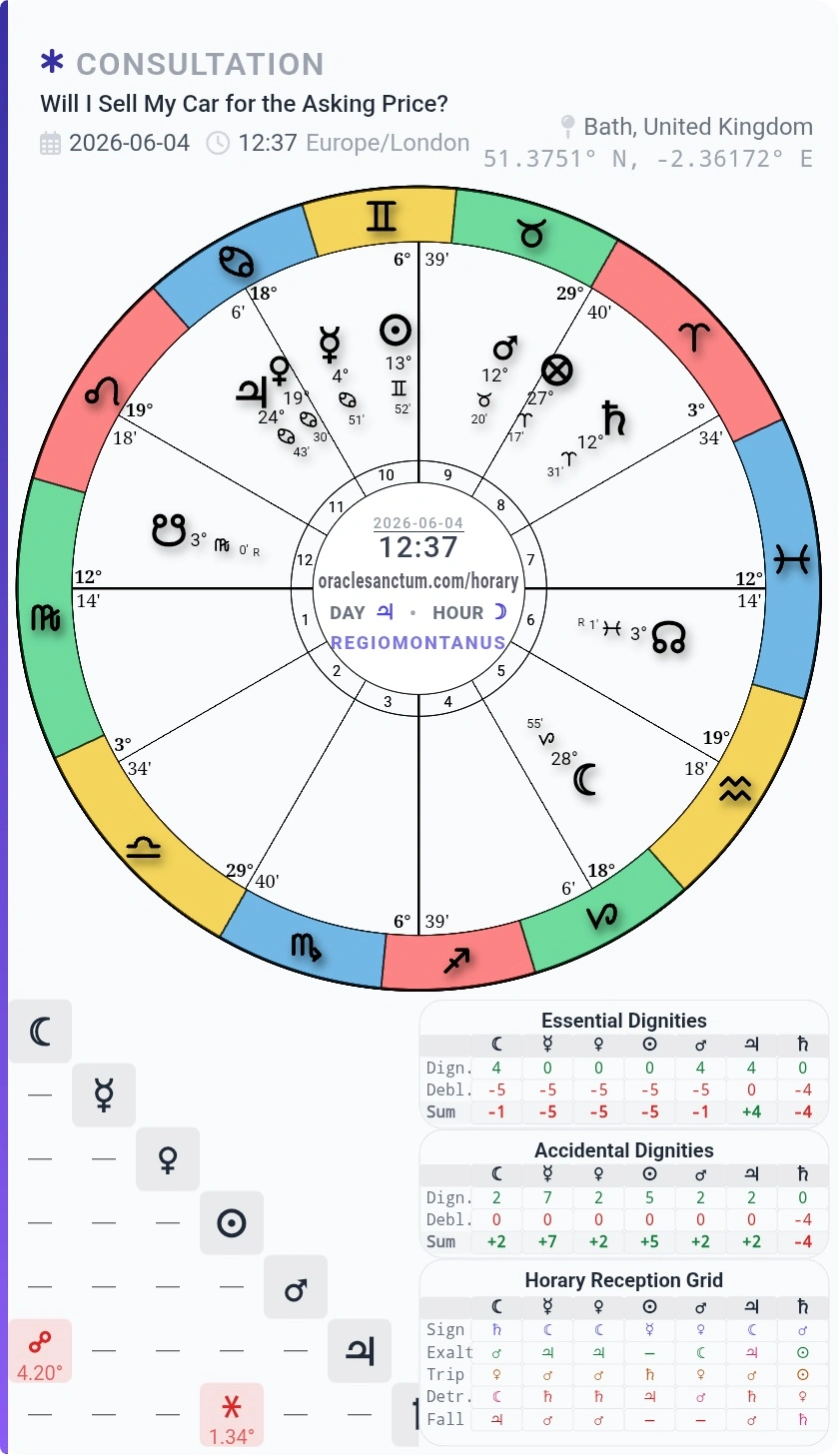
View the Live Horary Chart on OracleSanctum
When analyzing an asset sale using Lilly's methods, we isolate the specific house dynamics:
- Lord 1 (Mercury): Represents the querent selling the car.
- Lord 2 (Venus): Represents the car itself as a movable possession, and the money the querent hopes to pocket.
- Lord 7 (Jupiter): Represents the prospective buyer.
- Lord 8 (The Buyer's Money): This is the 2nd house from the 7th, showing the financial capacity of the person across the table.
The Underlying Logic of the Judgment
Look at the reality of the chart configuration. The querent is represented by Mercury in the 10th house. Mercury is peregrine — it possesses no essential dignity, meaning the seller lacks the inherent power to force this transaction to happen on their own terms.
The buyer is represented by Jupiter in Cancer, sitting in its sign of exaltation. This tells us something vital: the buyer genuinely values the car and holds it in high esteem. But love for an object does not equal cash in hand. Jupiter sits in the sign of the Moon, and the Moon is in its detriment in Capricorn. In the practical, unyielding language of horary, this reveals that while the buyer's interest is genuine, they are fundamentally dissatisfied with or strained by the financial reality of the purchase.
To see if a deal happens, William Lilly instructs us to look for an applying aspect between the primary significators. Here, Mercury and Jupiter have no applying aspect. Even checking the antiscia — the hidden shadows of the planets — reveals no connection to bridge the gap. Furthermore, the Moon (the querent's co-significator) is separating from an opposition to Jupiter, confirming that the window for a deal has already shut.
The final blow comes from Saturn, ruling the 5th house (the profit or asking price from the sale). Saturn is in its fall in Aries. The chart is screaming that the asking price is completely unsupported by the current market conditions.
The verdict becomes clear: The car will not sell for the asking price. The buyer is financially constrained, and the seller is acting as if they can dictate the market without the essential dignity to back it up.
Try It Yourself
Once you understand the rules, the system works with beautiful, geometric precision. There is no room for guesswork. If you are facing a financial dilemma or trying to locate an asset, try it yourself. Run your situation through the OracleSanctum Horary Chart Calculator, apply these exact principles of dignity and reception, and see how clearly the chart speaks.
The Rule Beneath the Rule
If there's one idea worth carrying away from the 2nd house specifically, it's this: category beats function, and precision about categories is what separates a correct house assignment from a plausible-sounding wrong one. Movable versus fixed. Inanimate versus living. Yours versus someone else's. The job versus the money from the job. Each of these distinctions looks minor until you apply it to a real question and realize it changes which planet you should be watching.
That precision is learnable, and it gets easier with repetition — not because the rules multiply, but because you start recognizing the same handful of distinctions showing up again and again in different clothing.
For the underlying method that ties house assignment to significators, dignity, and timing, see the 5 Golden Rules of Horary Astrology. For a quick-reference summary of all twelve houses side by side, Master the 12 Houses of Horary Astrology is worth bookmarking. And if you're specifically dealing with something missing, Can Horary Astrology Really Find Lost Objects, Missing People, or Answer "Will They Contact Me?" goes deeper into the search methods this house feeds into.
No comments yet.