Table of Contents
The Twelfth House in Horary: Secret Enemies, Self-Undoing, and Imprisonment
Not every enemy announces themselves. Some work through whispers, through a story quietly reshaped behind your back, through a decision made against you by someone you never even suspected. The seventh house shows the enemy who confronts you openly. The twelfth house shows the one who doesn't.
This is the house of what is hidden — from secret enemies to hidden knowledge to the ways we, without meaning to, work against our own interests.
What Actually Makes an Enemy "Twelfth House"
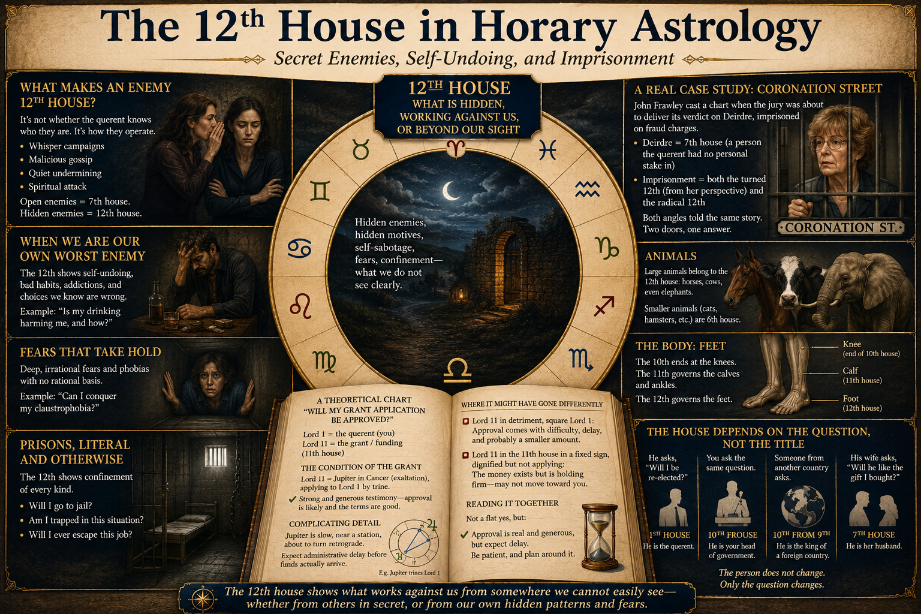
The distinguishing feature here isn't whether the querent knows who the enemy is. It's how that enemy operates. A whisper campaign. Malicious gossip. A colleague undermining you quietly rather than to your face. Even a spiritual attack, in traditions where that concept is taken seriously.
Even if the person behind it is perfectly well known to the querent, it's the secretive, undermining method that places them here rather than in the seventh. Two people can dislike you in identical measure — one who says so to your face belongs to the seventh house; one who works against you in the shadows belongs to the twelfth. Same feeling, different house, because horary cares about how something operates, not merely what it is.
This same house governs everything else hidden from the querent's view: hidden motives, hidden obstacles, hidden knowledge.
When We Are Our Own Worst Enemy
Just as often, though, the enemy in question is the querent themselves. This is the house of self-undoing — the daft, self-sabotaging patterns that make a life harder than it needs to be. Addictions live here. So do old vices, the poor choices made despite knowing better, the quiet ways a person gets in their own way.
If a querent asks something like "is my drinking harming me, and how?" — that's a twelfth-house matter, full stop. It might be tempting to file it under the fifth house instead, since drinking can look like pleasure on the surface. But the question itself, framed around harm rather than enjoyment, settles the matter. The house follows the real shape of the question, not the surface activity.
Fears That Take Hold
Deep, irrational fears — the kind that paralyse rather than simply worry — belong here too. "Can I conquer my claustrophobia?" is a twelfth-house question. So is any question about a phobia with genuinely no rational basis behind it. This is a distinct category from ordinary anxiety about a real, present concern; it's specifically the fear that has taken on a life of its own, disconnected from anything the querent can point to and explain.
Prisons, Literal and Otherwise
The twelfth is also the house of confinement — and this stretches further than iron bars. A literal question, "will I go to jail?", belongs here in the most direct sense. But so does a metaphorical one: "am I trapped in this situation?" or "will I ever escape this dead-end job?" Sometimes the prison is a place. Sometimes it's a state of mind the querent can't seem to find the door out of.
A Real Case Study: Reading the Twelfth Alongside the Seventh
One of the clearest illustrations of this house at work comes from horary astrologer John Frawley, who once cast a chart for a rather unusual reason: a British soap opera cliffhanger. In Coronation Street, a character named Deirdre had been imprisoned on fraud charges after falling for a con artist, and — rather than wait to find out how the storyline resolved — Frawley set a chart the moment the jury stood to deliver its verdict.
The teaching point in that reading is worth pulling out on its own, separate from the specific chart details, because it applies well beyond soap operas: when the question concerns someone the querent has no personal stake in — "any old person," as Frawley puts it — that person is read from the seventh house, not the first. Only if the querent strongly identifies with them, having lived through something similar themselves, would that person shift to the first house, as though the question had become "will we be sent down?"
And because the question concerned imprisonment specifically, Frawley looked to both the turned twelfth house (from that person's own perspective) and the radical twelfth — precisely the double-check this article's companion piece on turning the chart recommends for matters as serious as imprisonment or death. In his account, both angles told the same underlying story, arriving at the same answer from two different directions — which he notes is itself a meaningful piece of testimony: when a matter is genuinely significant, the chart often confirms itself this way, regardless of which valid angle you approach it from.
(Full credit to John Frawley for this case study and its method — read the complete original working, with the actual chart and full technical detail, in his own writing.)
Large Animals and the Body
Practically speaking, this house also governs animals larger than a goat — horses, cows, and yes, even an elephant, should you ever find yourself asking after one. Smaller domestic animals, cats and hamsters among them, stay with the sixth house.
Physically, the twelfth governs the feet — the final stop in the body's journey through the houses, from the head at the first house down through the knees, ankles, and finally here.
The House Depends on the Question, Never the Title
It's worth closing on a principle that runs through every house, but shows up especially clearly here: it is the question, not the person's title, that determines the house.
Take a single figure — a prime minister, say — and watch the house shift depending purely on who's asking and how:
- He asks, "Will I be re-elected?" — he's the querent. First house.
- You ask the same question about him — he's your head of government. Tenth house.
- Someone from a different country asks it — he's now the king of a foreign country: tenth from the ninth, which resolves to a different house entirely.
- His wife asks, "Will he like the gift I bought him?" — he's her husband. Seventh house.
Nothing about the man changed across those four questions. What changed, every time, was the frame the question placed around him. Never assign a house from a title alone. Always look at what the question is actually asking.
The Practical Takeaway
The twelfth house keeps circling back to one idea: things working against us from somewhere we can't easily see — whether that's another person operating in shadow, or our own habits working against us from somewhere we'd rather not look. A hidden enemy, a private vice, an irrational fear, a literal cell — different faces of the same underlying pattern.
When you meet a question that has this shape — something the querent senses is working against them, but can't quite name or see clearly — that instinct is usually the surest sign you're standing in twelfth-house territory. Trust it, and look there first.
For the complete method these house judgments plug into, see the 5 Golden Rules of Horary Astrology. For how all twelve houses relate to each other at a glance, Master the 12 Houses of Horary Astrology is the reference page to keep close by.
No comments yet.