Table of Contents
- Illness: The Chief Business of the Sixth House
- Servants — In the Classical Sense, Not the Literal One
- Small Animals — and the Line at "Too Small to Ride"
- Extended Family: Aunts and Uncles, With a Careful Distinction
- The Body: Lower Belly, Intestines, and Bowels
- A Worked Example, in the Traditional Method
- The Practical Takeaway
The Sixth House in Horary: Health, Servants, and Daily Work
Every chart has a house or two that people assume they understand simply because the word sounds familiar. The 6th is one of them. Modern astrology has trained most of us to associate the 6th house with "our job" — daily routine, the nine-to-five, the grind. In horary astrology, that assumption is not just imprecise. It's a direct misreading, and one of the most common ones a beginner will make.
The 6th house has a real, coherent identity in the traditional system, and once you set aside the modern shorthand, it becomes one of the more practically useful houses in everyday horary work — precisely because so many real questions concern illness, hired help, and small creatures, and comparatively few concern the grand sweep of "career."
Illness: The Chief Business of the Sixth House
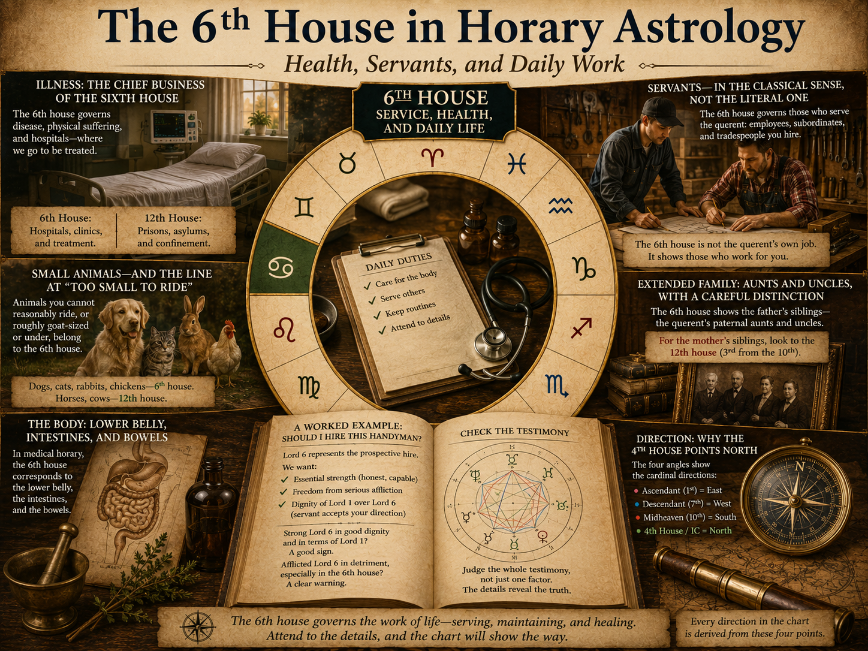
If there's one signification that anchors the entire house, it's illness. The 6th rules disease, physical suffering, and the day-to-day experience of being unwell. It also governs hospitals — the "houses of illness," in the most literal sense the phrase can carry.
It's worth being precise here, because two houses in the chart deal with confinement of different kinds, and it's easy to blur them:
- The 6th house is where we go to be treated — hospitals, clinics, the places illness is addressed.
- The 12th house is where we are hidden away or restricted — prisons, asylums, retreats.
Both involve a kind of removal from ordinary life. But one is about treatment and the other is about confinement, and mixing them up will send your judgement in entirely the wrong direction.
Servants — In the Classical Sense, Not the Literal One
The 6th house governs servants, but the word needs unpacking for a modern reader, because almost nobody today employs a household servant in the older sense. In practice, this signification covers:
- Employees and subordinates at work
- Tradespeople the querent hires — a builder, a plumber, a mechanic
If a querent asks "Should I hire this contractor?" or "Is this new hire going to work out?", you're in 6th house territory.
Here's the point worth underlining, precisely because it contradicts the modern assumption mentioned earlier: the 6th house does not describe the querent's own job. Not even if that job is unpleasant, poorly paid, or menial. The 6th shows those who serve the querent — not the work the querent does for someone else. This is a genuinely common misreading in casual modern astrology, and it's worth correcting early, because building a house judgement on the wrong foundation tends to produce a confident answer to the wrong question.
A brief note on an older complication: some traditional texts, including Lilly's, treat tenants as 6th house figures. That reflects a historical social hierarchy in which a tenant was, functionally, a kind of servant to the landowner. That framing rarely holds today. If someone rents your flat, the relationship is a 7th house one — a contract between two parties, not a service hierarchy. Traditional technique deserves respect, but it also deserves the judgement to know when a social assumption behind a rule has genuinely changed.
Small Animals — and the Line at "Too Small to Ride"
The 6th house governs small animals, and traditional horary offers a genuinely practical way to draw that line: could a person reasonably ride it, or is it roughly goat-sized or under? If the answer is no, it's a 6th house creature. Dogs, cats, rabbits, chickens — all fall comfortably within that boundary.
This matters practically, because "will I find my lost cat?" is a genuinely common horary question, and it belongs here. Large animals, by contrast — horses, cows, anything you could ride or that carries real working weight — fall under the 12th house instead.
Extended Family: Aunts and Uncles, With a Careful Distinction
By house derivation, the 6th is the 3rd house from the 4th — and since the 3rd governs siblings, the 6th extends to the siblings of the parent shown by the 4th. In practice, this signification is specifically for the father's siblings — the querent's paternal aunts and uncles.
For the mother's siblings, you'd look instead to the 12th house — the 3rd from the 10th, since the 10th traditionally carries the mother's signification in this kind of derivation. It's a small technical distinction, but it's exactly the kind of distinction that separates careful traditional practice from a rough, "close enough" approximation.
The Body: Lower Belly, Intestines, and Bowels
In medical horary, the 6th house governs the lower abdomen, the intestines, and the bowels — the areas of the body most directly tied to digestion and elimination. As with the other houses, there's a logic underneath the list: the 6th is fundamentally about the unglamorous, day-to-day maintenance of the body and of life, and its medical rulership reflects exactly that.
A Worked Example, in the Traditional Method
Consider a querent who asks: "Should I hire this handyman to fix my roof?"
Following the method set out by John Frawley in The Horary Textbook, the prospective hire is signified by the 6th house and its ruler, since he is being brought in to serve the querent in a specific, contracted capacity. Ideally, we would want Lord 6 to show three things: essential strength (the person is honest and genuinely capable), freedom from serious accidental affliction (nothing standing in the way of using that skill), and — importantly — dignity of Lord 1 over Lord 6, meaning the querent's own significator holds some rulership over the tradesman's.
That last point deserves emphasis, because it's counterintuitive to most beginners. It is not ideal for Lord 1 to be strongly placed in the dignities of Lord 6. That configuration tends to show the querent simply liking the tradesman — which is not, on its own, a sound reason to hire someone. What we actually want is closer to the reverse: the servant accepting direction from the querent, described by Lord 6 sitting in dignity of Lord 1.
Suppose, in this chart, Lord 6 is found in its own triplicity — a real, if modest, essential strength — and is additionally placed in the terms of Lord 1. That's a promising picture: competent, and inclined to work under the querent's direction. Now suppose instead Lord 6 were found in its detriment, closely afflicted by the South Node in the 6th house itself. That combination is a serious warning sign — poor character or poor workmanship, compounded by an affliction sitting directly in the house of the hire itself. The judgement here would lean firmly toward No, regardless of how eager the querent might be to proceed.
The Practical Takeaway
The 6th house is easy to misjudge precisely because its modern reputation — "the house of work" — is close enough to sound plausible while being wrong in exactly the way that matters. Illness, hired help, small animals, daily maintenance of body and household: that's the actual territory. The querent's own career belongs elsewhere in the chart, most often to the 10th house.
If you take one thing from this house, let it be the habit of checking your assumptions against the tradition rather than against the nearest modern shorthand. The 6th rewards that habit more than most houses do — and the mistake it corrects is common enough that catching it will noticeably sharpen your reading of real charts.
Continue with The Seventh House in Horary: the house of partners, contracts, and the people we meet directly across the table — whether in love, business, or open conflict.
For the complete method these house judgments plug into, see the 5 Golden Rules of Horary Astrology. For how all twelve houses relate to each other at a glance, Master the 12 Houses of Horary Astrology is the reference page to keep close by.
No comments yet.