Table of Contents
How Horary Houses "Turn": Reading a Chart Through Someone Else's Eyes
Ask yourself this: if a question is about your daughter's career, why would you ever look at the tenth house of your own chart? The tenth house of your chart is your career. It has nothing to do with hers.
This is the problem that "turning the chart" was built to solve. And once you understand it, an entire category of question — questions about other people's lives, told through your chart — opens up.
The Core Idea
Turning the chart means taking whichever house represents a person (or a thing) and treating that house as though it were a fresh Ascendant. From that new starting point, you count forward exactly as you would from the real first house, to locate whatever you're actually trying to find.
You never leave the original chart to do this. The birth chart of the question — what's properly called the radical chart, from the Latin root meaning "root" — stays exactly as cast. You're not redrawing anything. You're simply choosing to view part of it from a different vantage point.
The one rule that makes this work cleanly: when you turn, the house you're starting from always becomes house number 1. Not house 2. Not house 0. Number 1, exactly as the real Ascendant is.
A Full Worked Example, Turn by Turn
Let's build this from scratch and walk it all the way through, so you can see exactly how the counting works and where it lands.
The question: "Will my son-in-law's new business succeed?"
This is a genuinely useful example precisely because it requires more than one turn, and because it's easy to make a wrong assumption along the way if you're not careful about what "belongs" to whom.
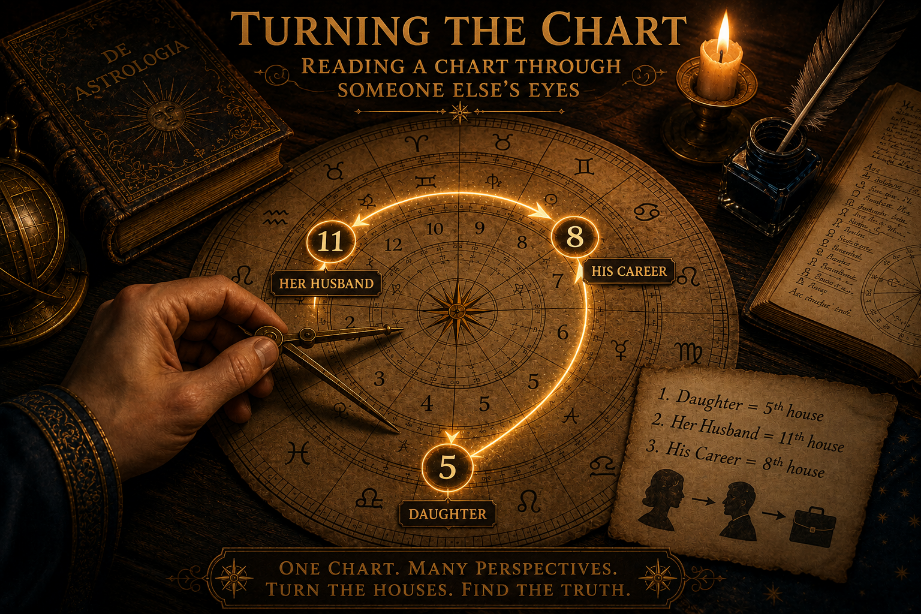
Step one: find the daughter. In the radical chart, your daughter is the 5th house — the house of children.
Step two: find her husband, from her perspective. Your son-in-law is her husband, not yours. So we turn the chart, treating the 5th house as her personal 1st house, and count forward to her 7th house — the house of marriage and spouse. Counting from the 5th as "1": the 6th house becomes her 2nd, the 7th becomes her 3rd, the 8th becomes her 4th, the 9th becomes her 5th, the 10th becomes her 6th, and the 11th becomes her 7th. Her husband, then, is shown by the radical 11th house.
Step three: find his business, from his perspective. Now we need to turn a second time. His business is his career — the tenth house from his own position, not from hers, and not from the radical chart either. So we treat the radical 11th house (his position) as a fresh "1," and count 10 houses forward from there.
Counting: 11th = his 1st, 12th = his 2nd, 1st (radical) = his 3rd, 2nd = his 4th, 3rd = his 5th, 4th = his 6th, 5th = his 7th, 6th = his 8th, 7th = his 9th, 8th = his 10th.
His business, then, is shown by the radical 8th house.
Two turns, and we've gone from "daughter" to "her husband" to "his career" — arriving somewhere far from the original 5th house we started at, and nowhere near the radical 10th house, which would only be correct for asking about your own career, not his.
Reading the result. From here, judgement proceeds exactly as it would for any career question — look at the ruler of that radical 8th house (now standing in as "his 10th"), its essential dignity, its accidental condition, and any aspect it makes toward the significator you're using for him. If, say, that ruler were found strongly placed and applying by trine to his own significator (the ruler of the radical 11th), that would speak to real, comfortable success. If instead it were debilitated and separating rather than applying, the picture would tilt toward struggle or an ending rather than a beginning. The turning only gets you to the right house to examine — the actual yes-or-no still comes from the ordinary tools of dignity, aspect, and reception once you're there.
When Not to Turn: The Shortcut Rule
Here's where many students overcomplicate things. Turning as many times as needed is technically always possible — but the further you turn, the more a reading loses focus. If there's a shorter, more direct path to the same person or thing, take it.
A clean example: your daughter's mother is never found by turning "10th from the 5th." She's simply your wife — the radical 7th house — full stop, regardless of how many turns some mechanical counting might suggest. The relationship is already direct. Turning here would be solving a problem that doesn't exist.
The same applies to your daughter's father: he isn't the 4th house counted from the 5th. He's you — the querent, radical first house, because that's simply who he is in relation to her, directly and without any counting required.
The Deeper Rule: Does It Belong to Them?
Turning implies a real sense of belonging — this house is asking "what is this person's version of X." So before turning, ask: does the thing in question genuinely belong to this person, in a real sense?
Compare two questions about the same brother:
- "Is my brother settling in well at his new workplace?" His job genuinely belongs to him. Turn the chart: his job is the 10th from his house, and proceed from there.
- "Will my brother win Olympic gold?" An Olympic medal does not belong to him in the same sense a job does — it belongs to the world's judgement of him, to fortune and fame more broadly. For this, look to the radical tenth house directly, not his turned tenth.
The test isn't whether a topic falls in a house that could theoretically be reached by turning. It's whether the thing genuinely belongs to that individual, personally, in the way a job or a spouse does — or whether it's really a broader-world matter that only happens to involve them.
The One House That Can Cause Real Trouble: Double Duty
Occasionally, straightforward counting will land you on a house that's already busy doing something else in the same chart — and this is exactly when a second turn becomes genuinely necessary, not optional.
Consider: "Will my grandson get into university?" Your grandson is your daughter's child — the 5th house from your daughter's 5th house (the child of the child). Counting from the radical 5th as her "1st," her own 5th house lands on the radical 9th. So your grandson, in the radical chart, is shown by the ninth house.
But university is also, ordinarily, a ninth-house matter. You cannot use the same house to represent both the person and the thing they're asking about — the chart would have no way to distinguish "the grandson" from "his university" if both sat in the same place. This is precisely the situation that forces a second turn: take the ninth house from the ninth house (treating the grandson's ninth as a fresh "1," and counting his ninth from there) to arrive at his personal university house, distinct from his own house as a person.
This is the clearest possible illustration of why turning exists at all: not as a neat party trick, but as the tool that resolves exactly this kind of collision, when a single house would otherwise have to represent two different things at once.
For the Most Serious Questions, Check Both
For matters as weighty as death or imprisonment, it's worth checking both the turned house and the radical house rather than committing to just one. Often, one clearly stands out as the real answer. Sometimes both echo the same conclusion — and when that happens, take it as meaningful in itself: a serious question, confirmed from two independent angles, carries more weight than one angle alone.
The Practical Takeaway
Turning the chart is really just one instruction, applied patiently: whatever house represents the person you're asking about, treat that house as their personal Ascendant, and count from there exactly as you would from your own. Do it only when the thing you're chasing genuinely belongs to that person. Take the shortcut when a direct relationship already exists. And when a single turn would leave two different things sharing one house, don't hesitate to turn a second time.
The best way to learn this is not to read about it, but to do it. Take any chart in front of you, put a finger on the house of the person you're interested in, and count forward out loud. Do it slowly enough to feel each house shift meaning as you pass it. That physical habit, more than any explanation, is what makes turning the chart feel natural rather than mechanical.
For the complete method these house judgments plug into, see the 5 Golden Rules of Horary Astrology. For how all twelve houses relate to each other at a glance, Master the 12 Houses of Horary Astrology is the reference page to keep close by.
No comments yet.