Table of Contents
The Fourth House in Horary: Home, Land, Property, and Endings
Most people who come to horary astrology already know, in a rough way, what the first few houses are for. The 1st is you. The 7th is the other person. But ask a student what the 4th house governs and you tend to get a shrug, or a half-remembered line about "home and family" borrowed from natal astrology. That answer isn't wrong. It's just far too small.
In horary, the 4th house is one of the quiet workhorses of the chart. It rarely announces itself the way the 7th does in a relationship question, or the 8th does in a question about death. But once you understand what it actually rules — and why — you'll find it turning up in charts you didn't expect, answering parts of the question you hadn't thought to ask.
The Father, and the Family as a Whole
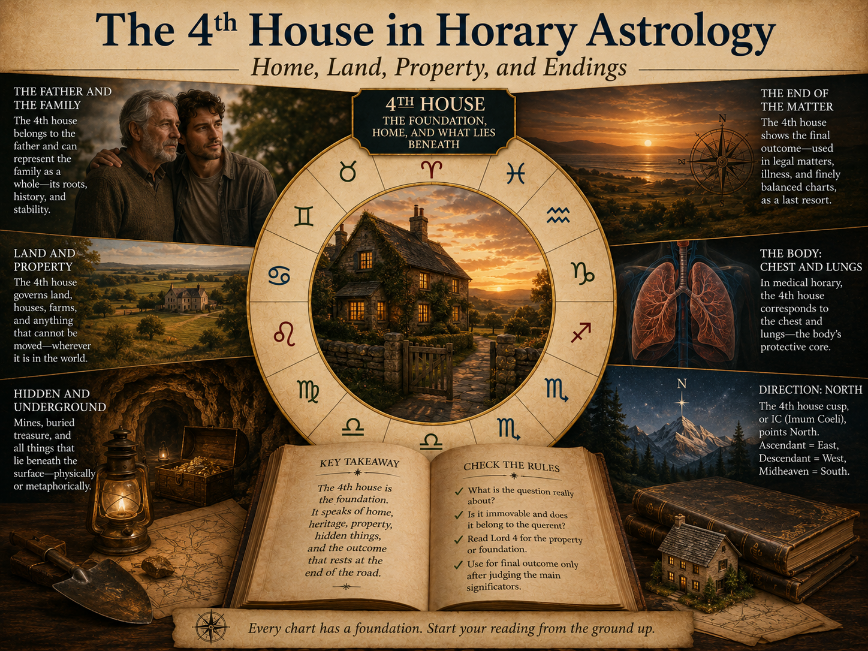
Traditionally, the 4th house belongs to the father. That's the core signification, and it's worth taking seriously rather than treating as an old convention we've quietly replaced. If a querent asks about their father specifically, this is where you look.
In practice, though, working horary astrologers extend this a little further. When a question concerns the family as a single unit — its stability, its history, its collective fortunes — the 4th often carries that weight too, alongside whatever specific house belongs to the family member being asked about. Think of it as the house of the family's foundation, not just the house of one parent.
The 4th also shows the querent's ancestry and lineage — where they come from, in the most literal sense. This is why the 4th sits at the bottom of the chart. It's the root, not the branch.
Land, Property, and Anything That Cannot Be Moved
Here is where the 4th house becomes genuinely useful in day-to-day practice, and where a lot of beginners get tripped up.
The governing question for 4th house property is simple: can it be moved? If the querent owns something that cannot be relocated — and it belongs to them outright — it falls under the 4th. That includes:
- A house
- A farm
- An orchard
- Even a potted plant, if we're being strict about "immovable" versus "movable" possessions
What trips people up is location. If a querent owns a holiday home abroad, the instinct is to reach for the 9th house, since the 9th traditionally governs foreign lands and distant travel. Resist that instinct. The house a possession belongs to is determined by what it is, not where it is. A property is a property, whether it sits down the road or across an ocean. It stays 4th house.
This distinction — asking what something is rather than where it happens to be sitting — is one of the more useful habits horary teaches you, and it shows up again and again once you start applying it elsewhere in the chart.
"The End of the Matter"
One of the older, more evocative names for the 4th house is the end of the matter. This refers to the final outcome of whatever is being asked about, and it's a signification worth understanding correctly, because it's easy to either overuse it or ignore it entirely.
The 4th as final outcome is not something you consult in every chart. Most questions are answered perfectly well by their proper significators — Lord 1 and Lord 7 in a relationship question, Lord 1 and Lord 10 in a career question, and so on. Reaching for the 4th house as a tiebreaker before you've properly worked the main testimony is a shortcut, and shortcuts in horary tend to produce wrong answers dressed up as confident ones.
Where the 4th genuinely earns its keep as "end of the matter" is in situations like these:
- Legal questions, where it can indicate the eventual verdict
- Illness, where it can point toward the likely prognosis
- Finely balanced charts, where the primary significators are so evenly matched that you need something to tip the scale
Even then, treat it as a last resort. Find your judgement from the main significators first. Let the 4th confirm or nuance a conclusion you've already reached — not manufacture one you couldn't find elsewhere.
What Lies Beneath: Hidden and Underground Things
Because the 4th sits at the very bottom of the chart wheel, it naturally extends to everything beneath the surface — literally and otherwise. This includes:
- Mines
- Buried treasure
- Anything physically underground
- By extension, anything metaphorically hidden from view
There's a pleasing logic to this once you see it. The 4th is the foundation, the root, the part of the chart furthest from the visible, public 10th house at the top. What's buried belongs at the bottom.
The Body: Chest and Lungs
In medical horary, the 4th house corresponds to the chest and lungs — the protective core of the body, much as the 4th itself is the protective, foundational core of the chart. Questions about respiratory or chest-related concerns will often bring the 4th into play as a relevant house, alongside whatever house signifies the querent or patient directly.
Direction: Why the 4th House Points North
Horary astrology has its own convention for reading direction from a chart, and it surprises people the first time they encounter it, because it doesn't map neatly onto a standard map.
The four angles give us the four cardinal directions:
- The Ascendant (1st house cusp) is East
- The Descendant (7th house cusp) is West
- The Midheaven (10th house cusp) is South
- The 4th house cusp — also called the IC, or Imum Coeli — is North
Every intermediate direction is derived from these four anchor points. So if a question involves locating something — a lost item, a missing person, a direction of travel — the 4th house cusp is your fixed reference point for "north" within the chart. It's a small, technical detail, but it's the kind of detail that separates a student who has memorised house meanings from one who can actually use them.
A Worked Example, in the Traditional Method
Consider a querent who asks: "Should I buy this particular piece of land?"
Following the method set out by John Frawley in The Horary Textbook, we would begin, as always, with the querent's own significator — Lord 1 — and then turn to the house that properly governs the thing being asked about. Since the question concerns a specific, immovable piece of property the querent hopes to acquire, that's the 4th house and its ruler.
Suppose Lord 1 is found applying to a favourable aspect with Lord 4, the two planets in reception with one another. That's a promising picture: the querent and the property are drawn toward each other, and each regards the other well. Now suppose Lord 4 itself is essentially strong — well-dignified, not afflicted by a hard aspect from a malefic, not combust. That strength describes the land itself: solid, sound, worth having.
Contrast that with a chart where Lord 4 is peregrine and closely afflicted by Saturn. Even if Lord 1 wants the purchase — even if the aspect between the two significators is present — a badly afflicted Lord 4 is telling you something about the property itself: a problem with the land, a defect in the title, a foundation (quite literally) that isn't sound. The event might still happen. Whether it should is a separate question, and this is exactly the kind of nuance the 4th house was built to reveal.
Notice what this example does not do: it does not reach for the 4th house as "end of the matter" to settle the question. The 4th here is doing its primary job — signifying the land itself — not its secondary, last-resort job as final outcome. Keeping those two roles separate in your own mind is the difference between using the 4th house correctly and using it as a crutch.
The Practical Takeaway
The 4th house rewards patience more than most. It won't dominate a chart the way the 7th or the 10th often does, but it quietly answers questions about origin, foundation, and what's beneath the surface — questions that matter more than their low profile suggests.
If you're new to reading horary charts, try this: the next time you cast a chart involving property, a parent, or something hidden, resist the pull toward the more "obvious" houses first. Start with the 4th. Ask what it's telling you about the foundation of the matter before you look anywhere else. You may find the rest of the chart makes a great deal more sense once you do.
Continue building your understanding of the chart with The Fifth House in Horary: the house of children, pleasure, and creative pursuits.
For the complete method these house judgments plug into, see the 5 Golden Rules of Horary Astrology. For how all twelve houses relate to each other at a glance, Master the 12 Houses of Horary Astrology is the reference page to keep close by.
No comments yet.