Table of Contents
- Death, Taken Literally
- The Money That Isn't the Querent's
- Wills and Legacies — With an Important Boundary
- Fear, Anguish, and the Querent's Own State
- The Body: Organs of Excretion
- A Necessary Correction: Sex Belongs to the Fifth House
- A Worked Example, in the Traditional Method
- The Practical Takeaway
The Eighth House in Horary: Death, Inheritance, Shared Resources
Of all twelve houses, the 8th is the one students approach most warily. It has a reputation, and not an unearned one — this is the house of death. But if you let that single, heaviest signification define your entire understanding of the 8th, you'll miss most of what it actually does in day-to-day horary practice. Far more often than questions about mortality, the 8th house shows up quietly in questions about money, inheritance, and something subtler: how much another person values us.
Let's take this house seriously, in every sense of the phrase — including the sense that requires precision rather than superstition.
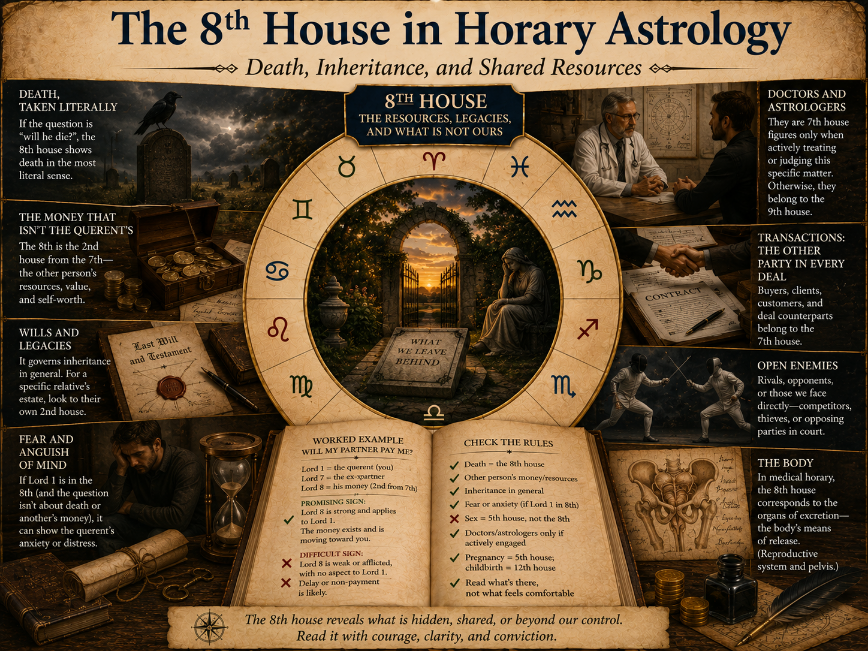
Death, Taken Literally
If the question a querent brings you is "will he die?", the 8th house is where you look. This deserves to be said plainly, because traditional horary treats death as literally as it treats any other signification. There is no symbolic reading available here — no framing of the 8th as a house of "transformation" or "rebirth" in the softened, modern sense. In a horary chart, death means death, and the discipline of the tradition is to say so clearly when the testimony calls for it, rather than reaching for gentler language that isn't actually what the chart is showing.
That clarity matters. Horary earns trust by being precise, not by being comfortable.
The Money That Isn't the Querent's
Set death aside, and the far more common role of the 8th house in real charts is money — specifically, money that does not belong to the querent.
By house derivation, the 8th is the 2nd house from the 7th. Since the 2nd governs possessions and the 7th governs the "other person" in any given question, the 8th naturally becomes the house of that other person's resources. This covers a wide range of situations:
- A spouse's finances — "has my partner really got as much money as they claim?"
- A business associate's ability to pay — "will he pay me what he owes?"
- Even an opponent's resources in a wager — "will I win this bet?", where the 8th shows the bookmaker's money
Just as the 2nd house reflects the querent's own sense of self-worth, the 8th reflects how much the other person values themselves — their own resources, their own worth, as distinct from the querent's.
This produces one of the more psychologically interesting uses of the 8th house in practice. If the querent's own significator shows a strong pull toward Lord 8, it can indicate that what the querent is really seeking isn't love, or money, or whatever the surface question suggests — it's the other person's esteem. A question that looks like it's about a relationship, or a deal, can sometimes reveal itself as a question about needing to feel valued by someone else. That's not a judgement you'd force onto every chart, but it's worth having in your toolkit for the ones where it fits.
Wills and Legacies — With an Important Boundary
The 8th house governs wills and inheritance, but only at the general level: "will I ever receive an inheritance?" belongs here comfortably.
Where it gets more specific, the 8th house needs to hand off responsibility. If the question is "will I inherit my aunt's estate?", you don't look to the querent's own 8th house — you look to the aunt's own 2nd house, since her estate is her possession, governed by her own chart position, not the querent's. This is a small but important discipline: the 8th house shows the querent's relationship to inheritance in general, not a direct window into a specific relative's specific assets. For that, you need to identify the relevant person's own house and count from there.
Fear, Anguish, and the Querent's Own State
William Lilly described the 8th as signifying "fear and anguish of mind" — a phrase worth sitting with carefully, because it's easy to misapply.
This does not mean the 8th house rules fear as a general topic. That territory belongs to the 12th house instead. What Lilly's description actually points to is this: if the querent's own significator is found placed in the 8th house, and the question is not fundamentally about death or about someone else's money, that placement can show something about the querent's internal state. Specifically, it can indicate that the querent is anxious, distressed, or deeply unsettled about the matter they're asking after — a sign not of the outcome, but of what's happening inside the person asking.
It's a subtle distinction, but it's the kind of subtlety that separates a mechanical house-lookup from real horary judgement: the same house placement can describe an external circumstance in one chart and an internal emotional state in another, depending on what else is present.
The Body: Organs of Excretion
In medical horary, the 8th house governs the organs of excretion — the body's means of release and disposal. There's a certain grim coherence to this: a house concerned with endings and loss finds its anatomical counterpart in the processes of letting go.
A Necessary Correction: Sex Belongs to the Fifth House
This needs to be stated without ambiguity, because it's one of the more persistent misconceptions floating around modern astrological writing: sex is not ruled by the 8th house. That association has no real place in traditional horary. It's a modern accretion, likely borrowed from natal astrology's more psychological, symbolic treatment of the 8th — but horary doesn't work that way.
Sex belongs to the 5th house, alongside pregnancy and pleasure generally, exactly as covered in that house's own signification. This holds true even when the act in question is entangled with intimacy, power dynamics, or trust. Those emotional layers don't relocate the signification. The act itself stays 5th house.
A Worked Example, in the Traditional Method
Consider a querent who asks: "Will my ex-business partner actually pay me the money he owes?"
Following the method set out by John Frawley in The Horary Textbook, the querent takes Lord 1, and the former partner — as the "other person" in this dispute — takes Lord 7. But the specific thing being asked about isn't the partner himself; it's his money, owed to the querent. That places the real focus of the question on the 8th house and its ruler, since the 8th is the 2nd house from the 7th: the partner's own resources.
Suppose Lord 8 is found essentially strong, sitting in its own sign, and applying to a favourable aspect with Lord 1. That's a promising picture on two counts: the money genuinely exists in some real, substantial form, and it is moving toward the querent. Now suppose instead Lord 8 is found peregrine and in its fall, with no aspect forming to Lord 1 at all before the Moon — separately — moves to a difficult aspect with Saturn, the natural significator of delay and obstruction. That combination tells a very different story: the money may be thin or genuinely unavailable, and even if some payment eventually occurs, delay and difficulty stand squarely in its path.
Notice what this example carefully avoids: it does not treat Lord 8 as "the ex-partner's character" or fold in unrelated judgements about whether he's a good or bad person. The 8th house here does one specific job — his money, and only his money. Keeping the signification that narrow is exactly what traditional method demands, and exactly what keeps a judgement honest rather than speculative.
The Practical Takeaway
The 8th house deserves less fear and more precision. Yes, it is the house of death, and that signification should never be softened into something it isn't. But in the great majority of real charts, the 8th is quietly doing something else entirely: showing you someone else's money, someone else's estate, or the querent's own hidden anxiety about a matter that has nothing to do with dying at all.
The discipline this house teaches is worth carrying into every other part of the chart: read what's actually there, not what feels comfortable to read. That's a harder habit than it sounds — and the 8th house, more than most, will test whether you've built it.
Continue with The Ninth House in Horary: the house of religion, higher learning, and long journeys — where the chart turns from what is owed and owned to what is sought and believed.
For the complete method these house judgments plug into, see the 5 Golden Rules of Horary Astrology. For how all twelve houses relate to each other at a glance, Master the 12 Houses of Horary Astrology is the reference page to keep close by.
No comments yet.