Table of Contents
- Pleasure, Leisure, and Where We Go to Enjoy Ourselves
- Children and Pregnancy — With an Important Clarification
- Sex, and Why the 7th House Still Owns the Relationship
- Creative Expression: Your "Intellectual Children"
- The Father's Money, and Profit from Property
- A Lesser-Known Role: Messengers and Ambassadors
- The Body: Heart, Liver, Stomach, Sides, and Back
- Pregnancy Is 5th House. Childbirth Is Not.
- A Worked Example, in the Traditional Method
- The Practical Takeaway
The Fifth House in Horary: Children, Pleasure, and Creative Pursuits
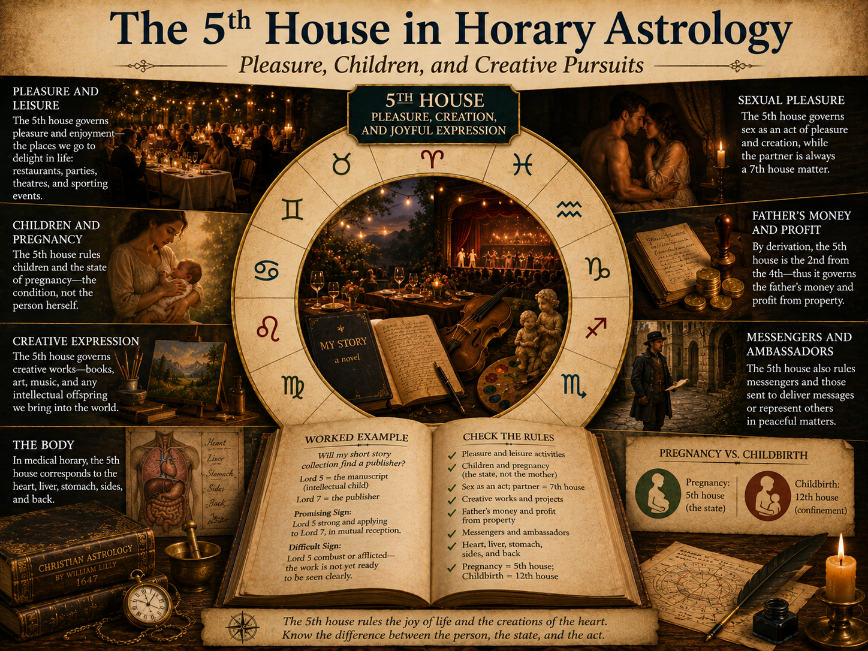
Ask most people what the 5th house is about and you'll get one word back almost immediately: children. That's not wrong. But it's a bit like describing a novel by its first chapter. The 5th house is the house of joy in the broadest sense — of pleasure, creation, and every way we express something of ourselves into the world, whether that expression is a child, a painting, or an evening at a restaurant with friends.
Understanding the 5th properly means understanding a principle that runs through all of horary astrology: the difference between a thing and its function. Nowhere is that principle more useful — or more commonly misapplied — than here.
Pleasure, Leisure, and Where We Go to Enjoy Ourselves
At its simplest, the 5th house rules pleasure and enjoyment. Not vaguely — specifically. It governs the places we go seeking delight: restaurants, banquets, parties, theatres, and, in an older but still valid signification, ale-houses, taverns, and sporting events. William Lilly himself described the 5th as the house of "banquets, ale-houses, and taverns" — a phrase that has aged remarkably well, once you swap taverns for whatever your querent's modern equivalent happens to be.
If a querent asks whether a party will go well, whether a restaurant is worth booking, or whether a particular night out is likely to be enjoyable, you're squarely in 5th house territory.
Children and Pregnancy — With an Important Clarification
This is the house of children and of pregnancy, but the distinction between the two deserves real care, because it trips up more students than almost any other point in this part of the chart.
A pregnant woman herself is not described by the 5th house. She remains exactly where she'd normally be signified — the 3rd house if she's the querent's sister, the 7th if she's the querent's wife, and so on. What belongs to the 5th is the state of being pregnant — the pregnancy as a condition, not the person carrying it.
This is the thing-versus-function principle in its purest form. The woman is a person, and people are always shown by their proper house. The pregnancy is a condition attached to that person, and conditions can belong to a different house entirely.
Sex, and Why the 7th House Still Owns the Relationship
The 5th also governs sex — but only as an act, only as a function of pleasure and creation. It does not govern the relationship within which that act occurs.
The partner, however casual the connection, is a person — and people always belong to the 7th house. This holds even in situations that might feel, socially, like they deserve a different label. A man's mistress is still a 7th house matter, exactly as a wife would be. What he does with her — the pleasurable, creative act itself — is 5th house.
This is worth sitting with for a moment, because it's a genuinely useful piece of technique, not just a rule to memorise. Horary keeps asking you to separate the person from what that person does, or from the state they happen to be in. Once that habit is built, it starts clarifying questions all over the chart — not just here.
Creative Expression: Your "Intellectual Children"
The 5th house extends naturally to creative work. A book you've written, a painting you've made, a film you've directed — traditional horary treats these as a kind of intellectual offspring, and assigns them to the 5th house on that basis. If a querent asks whether their manuscript will find a publisher, or whether a creative project will succeed, the 5th is very much in play.
The Father's Money, and Profit from Property
By house derivation — counting houses from one another rather than from the Ascendant — the 5th is the 2nd house from the 4th. Since the 4th governs the father, and the 2nd governs money and possessions, the 5th becomes, by extension, the house of the father's money.
The same logic extends to profit generated from the querent's own land or property. If someone is asking about income from a rental property, or profit from land they own, the 5th house often has a role to play in that judgement, working alongside the 4th house that governs the land itself.
A Lesser-Known Role: Messengers and Ambassadors
One of the more obscure but genuinely useful significations of the 5th is as the house of messengers and ambassadors — anyone sent to deliver a message, or to represent someone else in a non-combative capacity. This comes down to us from classical tradition, and while it won't come up in every reading, it's worth having in your toolkit for the charts where it does.
The Body: Heart, Liver, Stomach, Sides, and Back
In medical horary, the 5th house governs the heart, liver, stomach, sides, and back. There's a coherence to this list once you notice it — these are all areas associated with vitality, internal nourishment, and the kind of quiet joy the 5th house represents throughout the rest of the chart. The 5th isn't an arbitrary grab-bag of body parts. Its medical rulership mirrors its broader character.
Pregnancy Is 5th House. Childbirth Is Not.
Here is the clarification that catches out even students who've absorbed everything above. While the 5th house rules the condition of pregnancy, the actual event of childbirth — labour and delivery — belongs to the 12th house, traditionally known as the house of "confinement."
Being pregnant: 5th house. Giving birth: 12th house.
It's a small distinction, but it's exactly the kind of small distinction that traditional horary insists on, and that modern shortcuts tend to blur. Precision here isn't pedantry. It's the difference between a correct judgement and a plausible-sounding wrong one.
A Worked Example, in the Traditional Method
Take a querent who asks: "Will my short story collection find a publisher?"
Following the method set out by John Frawley in The Horary Textbook, the manuscript itself — as a piece of creative output, an "intellectual child" — is signified by the 5th house and its ruler. The publisher, as the other party in a transaction, belongs to the 7th house.
Suppose Lord 5 is found in good essential dignity, perhaps in its own sign, and it applies to a favourable aspect with Lord 7. That's a strong picture: the work itself is sound, and it is moving toward genuine, well-disposed interest from the party who might publish it. If the two planets are additionally in mutual reception — each regarding the other favourably — the testimony strengthens further, since reception shows not just contact but goodwill.
Now suppose instead that Lord 5 is found combust, buried too close to the Sun to be seen clearly. Whatever the querent's hopes, this is a difficult signification: the work, as it currently stands, is not visible enough — not ready to be seen and judged fairly. That doesn't necessarily mean "never." It may mean the manuscript needs revision before it can be shown to full advantage, which is a different and often more useful answer than a flat no.
Notice, too, what this example deliberately avoids: nowhere does Lord 5 stand in for the manuscript's success as a book on shelves in the way it might for a natal chart's storyline. Horary stays narrow and specific — this chart answers this question, about this manuscript, at this moment. That discipline is what keeps horary judgement honest.
The Practical Takeaway
The 5th house asks you to separate things that our ordinary language tends to fuse together — the person from the pleasure, the pregnancy from the woman carrying it, the labour from the state that preceded it. Once you internalise that discipline, you'll find it sharpening your reading of houses well beyond this one.
Next time you're faced with a question that seems to blend a person with a condition or an activity, pause and ask: which house governs the person, and which governs what's happening to or through them? More often than not, you'll find the 5th house sitting quietly at the centre of that distinction.
Next in this series: The Sixth House in Horary — the house of illness, servants, and the daily obligations we rarely think to ask about until something goes wrong.
For the complete method these house judgments plug into, see the 5 Golden Rules of Horary Astrology. For how all twelve houses relate to each other at a glance, Master the 12 Houses of Horary Astrology is the reference page to keep close by.
No comments yet.