Table of Contents
The First House in Horary: The Querent, Health, and Personal Matters
Every horary chart begins in the same place. Before you look at the Moon, before you check a single aspect, before you even think about the question being asked — you start with the 1st house. It is the one house whose meaning never changes from chart to chart, and that makes it the safest place to build your understanding of how the houses actually work.
Many people assume the 1st house needs interpreting, the way the other eleven houses do. It doesn't. It always represents the querent — the person asking the question. What changes, chart to chart, question to question, is how much the 1st house is doing. Sometimes it carries only the querent's identity. Sometimes it carries their body. Sometimes, depending on how the question is phrased, it carries an entire group of people the querent identifies with. Understanding which of these is in play is where real horary judgment begins.
The Querent, Always
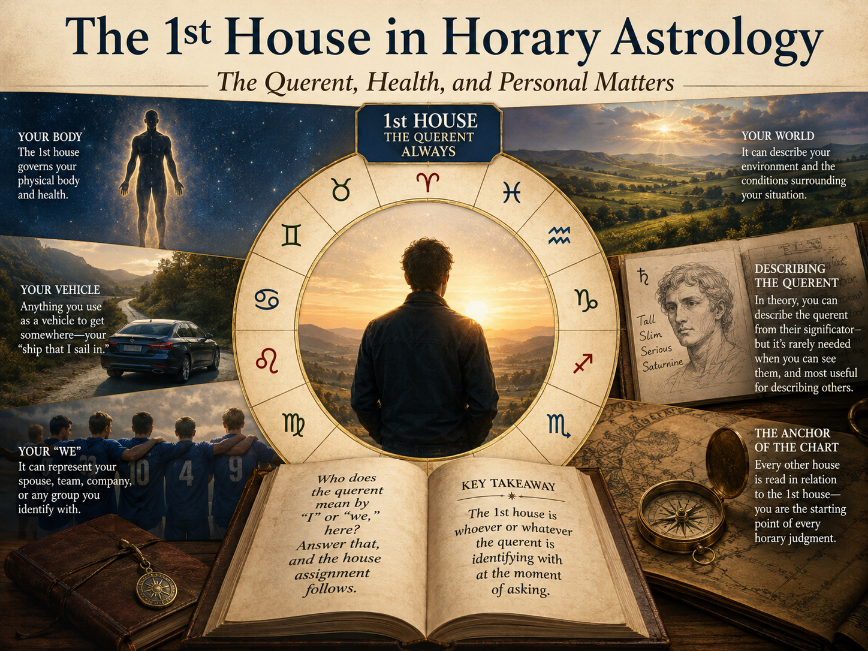
Start with the fact that doesn't move: the 1st house is the querent. Not sometimes, not usually — always. The planet ruling whatever sign sits on the 1st house cusp becomes Lord 1, the querent's primary significator, and the Moon rides alongside it as co-significator in nearly every chart regardless of where the Moon happens to sit.
This is the anchor point of the entire chart. Every other house is read in relation to this one. When you ask "will I get the job," the 1st house is you, asking. When you ask "is my flight going to arrive safely," the 1st house is still you — even though you're asking about a plane, not your own body. The reasoning behind that second example is worth sitting with, because it trips up a lot of learners.
The Body You're Traveling In
Here's a distinction that separates a careful horary reading from a sloppy one: the 1st house governs the querent's physical body, but it also governs anything the querent is using as a body — as a vehicle for getting somewhere.
John Frawley describes this using Lilly's own phrase: "the ship that I sail in." If you ask about your car — "will it get me to Glasgow safely?" — you are not asking about a possession. You are asking about the thing carrying you, the way your physical body carries your consciousness. That question belongs to the 1st house, not the 2nd, even though a car is obviously something you own.
The distinction is entirely about function, not ownership. Ask "will someone buy my car?" and you're now asking about the car as a possession — a thing with monetary value that might change hands. That's a 2nd house question. Ask "will it get me there safely?" and the same car has become your vehicle, your ship, your extended body. Same object. Different question. Different house.
This extends further than you might expect. Frawley notes that you don't need to be physically present in the vehicle at the time of the question for this rule to apply. Ask "will my treasure-ship reach port safely?" and the 1st house governs that ship even if you've never once set foot on it — because it's still functioning as your body's stand-in, carrying out an errand on your behalf, the way you might send an arm to reach for something instead of moving your whole self.
For questions about safety and danger to whatever the 1st house is carrying — a body, a vehicle, a voyage — the judgment is straightforward. Take Lord 1 and look for anything threatening aspecting it. An aspect from a debilitated Mars or Saturn is a serious warning. So is combustion, or a conjunction with the South Node. Gentler afflictions — an aspect from a weakened Venus or Jupiter — suggest trouble rather than disaster. No such affliction at all, and the journey or the body in question is likely to come through safely.
When "I" Becomes "We"
The 1st house is the house of "I." But language is rarely that tidy, and horary judgment has to follow how a question is actually meant, not just how it's phrased.
If a married querent asks, "will we be able to buy this house?", the 1st house can reasonably represent both the querent and their spouse together — the shared identity of the couple asking as one unit. If someone asks "will we win the match?" meaning their favorite sports team, and they identify closely enough with that team that the question is really theirs, the 1st house can represent the team itself. The same logic extends to a querent asking on behalf of their company: "will we get the contract?" can put the entire group under the 1st house, if that's genuinely how the querent is experiencing the question.
This isn't a loophole or a special case you memorize separately. It's the same underlying principle — the 1st house is whoever, or whatever, the querent is identifying with at the moment of asking — applied a little more broadly than the simplest version of the rule suggests. The test is always: who does the querent mean by "I" or "we," here, in this specific question? Answer that honestly, and the house assignment follows.
The Querent's World
There's a further extension of the 1st house that surprises newer students: it isn't only about a person, or even a group of people. In certain questions, it describes the querent's general environment — the conditions immediately surrounding them.
Ask "will we have a hot summer?" and you're not asking about your own body or possessions. You're asking about your local situation, and the 1st house becomes the lens for reading that surrounding condition. This is a smaller, less commonly needed application of the house than the querent-as-person reading, but it matters, because it shows the underlying logic clearly: the 1st house is not fundamentally about a category of things. It's about whatever occupies the position closest to the querent's own experience of the moment.
Describing the Querent (and Why You Rarely Need To)
A curious feature of the 1st house shows up in physical description. In principle, you could read a querent's appearance directly from their significator — Saturn suggesting someone tall and slim, Jupiter suggesting a bigger build, Mars suggesting short and muscular, and so on down through each planet's traditional physical signature.
In practice, this is rarely useful, for an obvious reason: if you're speaking with the querent, you're already looking at them. Frawley notes that Lilly used this technique mainly in two specific situations — confirming an early or late-degree Ascendant matched the person sitting in front of him, or convincing a skeptical client of his abilities. Neither situation applies the way it once did. Modern timekeeping already confirms your Ascendant is accurate, and describing someone's marks and scars to prove you "really can do this" is a parlor trick, not a diagnostic tool. As Frawley puts it, you wouldn't ask a surgeon to remove an unrelated organ just to prove they know what they're doing before trusting a heart operation.
Where description genuinely matters is when the question is about someone else — a future spouse, a suspected thief, a missing person. There, you take the description from that person's own significator (found via whichever house governs their relationship to the querent), read the planet's basic physical signature, and let the sign it occupies qualify that signature further. The one caution worth remembering: keep it general. Telling a querent her future husband will be "6 feet 3 inches" and watching her dismiss a perfectly good match because he's an inch taller serves no one.
A Worked Example
Frawley gives a case that shows the 1st house's logic in unusually clean detail. An actress asked whether she'd be more successful reverting to her own name after performing under a stage name — a 1st house matter, since one's name belongs to the querent's identity. Lord 1 signified the name itself, and it was retrograde: moving backward, matching her own idea of reverting to an earlier version of herself.
But retrograde motion alone doesn't answer the question. It has to be read against what the planet is retrograding into. Suppose her significator were Venus, sitting at 2 degrees Gemini, retrograding back into its own sign of Taurus. Going backward here makes Venus stronger — so the answer becomes "yes, change back." Now suppose instead her Venus were at 28 degrees Aries, having only just turned retrograde. It was about to cross into Taurus, its own sign, and would have gained strength doing so — except it turned away right at that threshold and isn't going to make the crossing after all. That's a very different answer: "no, the change would be harmful; staying the course you're already on will bring success."
Notice what's actually happening in this example. The bare fact — "the querent's planet is retrograde" — tells you almost nothing on its own. It's the planet's specific degree, the sign it's leaving, and the sign it's heading toward (or turning away from) that turns a vague impression into an actual judgment. This is the difference between naming a testimony and reading one. Frawley adds that accidental factors can weigh in too: a planet retrograding away from the South Node while applying to a dignified Jupiter tips the answer one way; retrograding out of the angular 1st house into the cadent 12th tips it another, since that shift would remove her from public view rather than restore her to it.
Try It With Your Own Chart
The 1st house is the one part of a horary chart you never have to second-guess — it's always the querent. But "always the querent" is not the same as "always simple." Whether it's carrying a body, a vehicle, a group identity, or the general conditions someone is living in depends entirely on the question in front of you, and reading that correctly is a skill that develops with practice, not memorization.
If you want to see this in action, cast a free horary chart with a real question of your own and find your Ascendant ruler. Ask yourself what, exactly, the 1st house is representing in your specific case — your body, your identity, your circumstances, or something you've extended yourself into, like a vehicle or a voyage. That single question is where every accurate horary judgment starts.
For the full method this house fits into, the 5 Golden Rules of Horary Astrology walks through radicality, significators, dignity, reception, and aspects in sequence. And for a fast-reference summary of how all twelve houses relate to one another, Master the 12 Houses of Horary Astrology is the page to bookmark.
The retrograde stage-name example above is drawn from John Frawley's published horary teaching and is used here with credit to illustrate traditional method.
No comments yet.