Table of Contents
- Introduction
- Why Aspects Alone Aren't Enough
- What Essential Dignity Actually Measures
- The Rule That Changes How You See Every Planet
- Rulership: When a Planet Is at Home
- Exaltation: When a Planet Shines Above Its Station
- Triplicity: Strength Through the Elements
- Terms: Minor Dignity, Modest Strength
- Faces: The Last Flicker of Dignity
- The Full Hierarchy, in One Table
- Context Still Decides the Reading
- Where This Leads Next
- Frequently Asked Questions
- Glossary of Terms Used in This Article
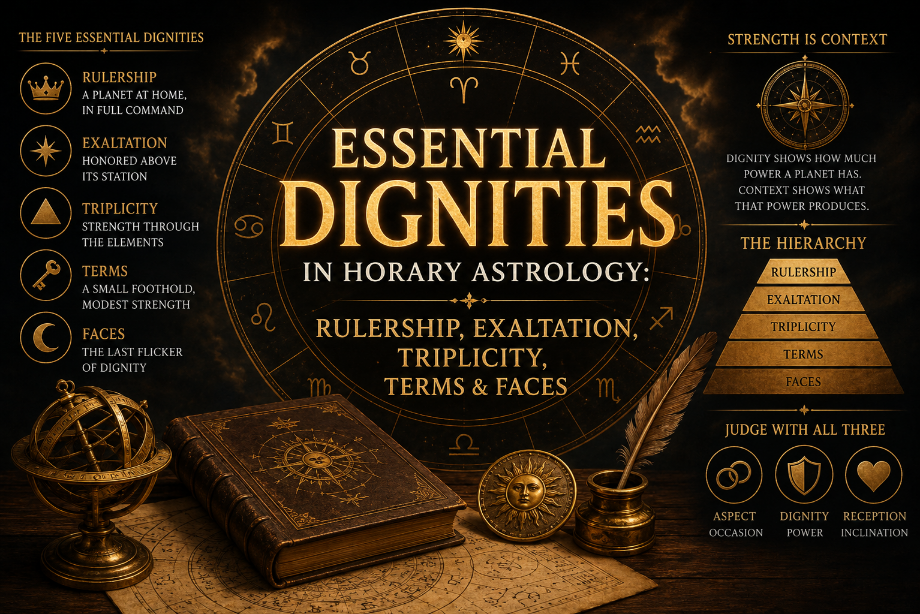
Essential Dignities in Horary Astrology: Rulership, Exaltation, Triplicity, Terms & Faces
Many people learning horary astrology assume the hard work is finding the right significators and checking whether they make an aspect. Find the two planets, watch them meet, read the answer.
But that's simply not true, and relying on it will get you the wrong judgement more often than the right one. An aspect only tells you that something has the occasion to happen. It doesn't tell you whether the planet involved actually has the power to make it happen — or the willingness to. Propose marriage while your significator is applying to a sextile with hers, and you have your occasion. If she genuinely can't stand you, the answer is still no. The chart needs a second layer of information before an aspect means anything at all, and that layer is essential dignity.
Why Aspects Alone Aren't Enough
Think about what an aspect is actually showing you. Two significators move toward each other in the sky — that's the occasion for two people, or two outcomes, to connect. But an occasion isn't a guarantee. In real life, plenty of chances to connect go nowhere, because one side lacks the strength, the standing, or the genuine inclination to follow through.
Horary astrology has a name for each of the three things a judgement actually needs:
- Aspect shows the occasion to act.
- Essential dignity shows the power to act.
- Reception shows the inclination to act.
This article is about the middle one. Reception belongs to its own discussion, but essential dignity is where every serious horary judgement has to start, because you can't weigh a planet's inclination or its opportunity until you know what it's actually capable of in the first place.
What Essential Dignity Actually Measures
Essential dignity is a planet's innate strength — how well it can express its own nature, based purely on the zodiac sign it occupies. The word "essential" means exactly that: about essence. What the planet is, stripped of everything else happening in the chart.
The more essential dignity a planet has, the better it behaves. The more debilitated it is, the worse it behaves. That's the whole principle in one sentence, and it holds regardless of which planet you're looking at.
This has nothing to do with whether you personally like the planet. Mars rules surgery — necessary, but never pleasant. A soft drink might taste sweet, ruled by Venus, but if Venus is in her fall in that chart, the drink could still do you harm. Essential dignity describes strength, not virtue, and the two get confused constantly by students carrying over ideas from natal astrology or pop astrology, where Jupiter and Venus are cast as "the good ones" and Saturn and Mars as "the bad ones."
Horary drops that framing entirely. A planet with essential strength acts well. A planet that's debilitated acts badly. Even Jupiter and Venus can behave like outright malefics when they're essentially weak — and even Saturn and Mars can produce a genuinely good outcome when they're strong. The planet's reputation tells you nothing on its own. Its dignity does.
The Rule That Changes How You See Every Planet
Here's a rule worth sitting with before you read any further, because it will save you from the single most common mistake beginners make with dignity: always judge in context.
A woman asking about a job might show up as Saturn, retrograde, sitting in Aries — Saturn's fall. That placement doesn't make her a bad person. It shows she's likely unqualified for the role, or desperate, or walking into a mess. Another querent asking about love has Venus in Taurus and the Moon in Cancer, both strongly dignified. That doesn't mean she's virtuous. It just means she's genuinely attractive, and she knows it.
Sometimes a placement isn't good or bad at all — it's simply descriptive. A lost umbrella turning up under Saturn in Cancer fits perfectly: Saturn is a barrier, and Cancer is wet. Even though Saturn is in his detriment there, the placement matches the object exactly. Ask about the weather at the beach and find Jupiter in Pisces, and you might assume the dignified benefic promises a lovely day. In this specific context, Jupiter rules rain and Pisces is a water sign — so a strong, dignified Jupiter here is actually describing a washout.
Keep that principle running underneath everything else in this article. Dignity tells you how much power a planet has. What that power actually produces still depends entirely on what the planet is being asked to describe.
Rulership: When a Planet Is at Home
Rulership is the strongest essential dignity a planet can hold, and it's also the simplest to understand. When a planet sits in the sign it rules — Mars in Aries, Jupiter in Pisces — it's in rulership. Think of a man in his own house. Not a house he's borrowed or visiting, but his home, where he makes the rules and nothing is unfamiliar.
The old phrase captures it exactly: an Englishman's home is his castle. A planet in its own sign doesn't need to ask permission or perform for anyone. It simply is what it is — strong, clear, fully itself. Mars in Aries doesn't hesitate; it acts, drives forward, cuts with precision. Jupiter in Pisces expands and inspires. None of this is because Mars or Jupiter are inherently "nice." It's because they're home, and being home lets a planet show its best side.
Remember that every planet is created good, even the traditional malefics. Saturn and Mars simply don't always get the chance to express that goodness — especially outside their own signs. When a significator in your chart is in rulership, take that seriously. It's likely to act with confidence and effectiveness on whatever it represents.
Exaltation: When a Planet Shines Above Its Station
Exaltation is the second-strongest essential dignity, and each traditional planet has exactly one sign where it's exalted — Venus in Pisces, Saturn in Libra, and so on for the rest.
Picture an honored guest in someone else's house. In some ways, that guest gets treated better than the owner: the best seat, the warmest welcome, none of last night's leftovers. But the guest still doesn't control the house. They can't go rummaging through the bedroom. There's a real sense of elevation in exaltation — even a touch of exaggeration. Think of a cat puffing itself up before a fight: fur, tail, posture, all making it look bigger than it actually is. That's exaltation. It doesn't make the cat physically stronger, but it makes it look stronger, and in horary, how a significator presents itself matters.
Exaltation is still a major strength — close to rulership, though not quite as solid. There's one specific case where it can actually outperform rulership: in competitions or contests, a planet in exaltation often beats a planet in rulership, precisely because contests reward looking dominant, not just being tough underneath.
Don't fall into the trap some students do, treating exaltation's touch of illusion as a kind of hidden weakness. It isn't. A querent whose favorite football team was performing unexpectedly well had their team's significator in exaltation — which fit perfectly. The team was shining above its usual level, even if it wasn't quite as unbeatable as it looked from the stands.
One technical note worth knowing: a planet is exalted throughout its entire exaltation sign, but each exaltation also has a specific degree of peak strength — the exaltation degree. If someone asks "will I make the team?" and their significator sits exactly on its exaltation degree, they're not just making the team. They might be captain.
Triplicity: Strength Through the Elements
Triplicity groups the twelve signs into four elemental families of three: Fire (Aries, Leo, Sagittarius), Earth (Taurus, Virgo, Capricorn), Air (Gemini, Libra, Aquarius), and Water (Cancer, Scorpio, Pisces). Each element has two rulers in horary — one for day charts, one for night charts.
To tell which applies, look at the Sun's position. If the Sun sits above the horizon, in houses 7 through 12, it's a day chart. Below the horizon, in houses 1 through 6, it's a night chart. A little flexibility is fine here — if the Sun is only a few degrees below the Ascendant or Descendant, daylight is still technically visible, so treat it as day regardless.
The traditional horary triplicity rulers are:
- Fire signs: the Sun by day, Jupiter by night
- Earth signs: Venus by day, the Moon by night
- Air signs: Saturn by day, Mercury by night
- Water signs: Mars, both day and night
A planet in its own triplicity is in its comfort zone — not as strong as rulership or exaltation, but genuinely capable, moderately happy, and able to do its job without a fight. You'll sometimes hear about a second triplicity system that assigns three rulers per element instead of two. Both systems are genuinely ancient, despite what's sometimes claimed about the three-ruler version being modern. In horary specifically, the two-ruler system above is the one that applies. The three-ruler version has its place in natal astrology, but it isn't used here.
Terms: Minor Dignity, Modest Strength
Terms — sometimes called bounds — divide each zodiac sign into five unequal sections. The word "term" means boundary, the same root you'll recognize from terminus or terminate, and that's precisely what these divisions are: boundary lines within a sign.
Not every planet gets a term. The Sun and Moon rule none. The remaining five — Mercury, Venus, Mars, Jupiter, and Saturn — each rule exactly one term in every sign. A table of essential dignities will list the degree ranges for each sign alongside the planet ruling that specific slice.
Take Aries as the example: Jupiter rules 0°00′ to 5°59′, Venus takes over from 6°00′ to 13°59′, Mercury rules 14°00′ to 20°59′, Mars rules 21°00′ to 25°59′, and Saturn closes out the sign from 26°00′ to 29°59′. As with exaltation degrees, these are ordinal boundaries, not cardinal ones — the Jupiter term "ending at the sixth degree" runs up to but not including 6°00′.
A planet only gains term dignity when it lands inside the exact section it rules. Venus at 7°30′ Taurus is in her own sign, her own triplicity (in a day chart), and her own term — a genuinely strong placement. Venus at 8°30′ Taurus is still in her own sign and triplicity, but she's stepped out of her own term.
Think of term rulers as non-commissioned officers rather than generals — a little authority, not the full command of a major dignity. Being in your own term won't make a planet strong on its own, but it's a real foothold rather than nothing at all. In practice, term dignity matters most when a planet has little else going for it; on its own, it rarely swings a judgement, but it's the difference between a planet with nothing and a planet with a small foothold of support.
Faces: The Last Flicker of Dignity
Faces — also called decans — are the weakest form of essential dignity. Each sign splits into three equal ten-degree sections. Using Aries again: the first face (0°00′–9°59′) belongs to Mars, the second (10°00′–19°59′) to the Sun, the third (20°00′–29°59′) to Venus.
A planet gains face dignity only inside the exact section it rules — and it's worth being honest about how little that dignity actually amounts to. The classic image is a man standing on the porch of his own house, just before being thrown out into the street. Not really inside. Not in charge. Not comfortable. But better than being fully out in the wind and rain with nothing at all.
Face dignity gives a planet the faintest possible footing — barely more than none. It's real, and it belongs in a full dignity count, but don't expect it to carry a judgement on its own.
The Full Hierarchy, in One Table
Here is the complete essential dignity hierarchy, strongest to weakest:
| Dignity | Relative Strength | What It Represents |
|---|---|---|
| Rulership | Strongest | A planet in the sign it rules — fully itself, in full command |
| Exaltation | Very strong (can exceed rulership in contests) | A planet honored above its normal station |
| Triplicity | Moderate | A planet in its elemental comfort zone, day or night ruler |
| Term | Minor | A small foothold — less weak, not genuinely strong |
| Face | Faintest | The barest trace of footing, better than nothing |
Dignities are cumulative — a planet can hold more than one at once, and each one adds to its overall strength. A planet in its own sign, its own triplicity, and its own term at the same time is considerably stronger than a planet holding only one of those three. Weighing exactly how those layers add up — and what happens when a planet holds both a strength and a weakness at once — is the subject of How to Calculate Total Essential Dignity, which walks through a real chart step by step.
It's worth flagging the mirror image of everything above, too. Just as a planet can be strengthened by rulership, exaltation, triplicity, term, or face, it can be weakened by sitting in detriment, in fall, or by holding no dignity at all — a condition called peregrine. Those three debilities are covered in full in Detriment, Fall, and Peregrine Planets: When a Significator Is Weak, which pairs directly with this article as its other half.
Context Still Decides the Reading
It bears repeating, because it's the single detail that separates a mechanical dignity count from an actual judgement: essential dignity tells you how much power a planet has. It does not, by itself, tell you whether that power is good news for the querent.
Go back to the Saturn-in-Cancer umbrella example, or the Jupiter-in-Pisces beach-weather example from earlier in this article. In both cases, the essential dignity reading was accurate — Saturn genuinely was debilitated, Jupiter genuinely was strong — but what that dignity meant depended entirely on what each planet was standing in for. A debilitated significator describing a lost object can fit the object's own nature perfectly. A strong, dignified significator describing an unwanted outcome can be exactly the wrong kind of good news.
This is why essential dignity is a starting layer, not a finishing one. It tells you what a planet is capable of. Reading what that capability actually produces is where the rest of the method — house rulership, accidental dignity, aspect, and reception — comes in.
Where This Leads Next
Essential dignity is the first serious technical skill in horary judgement, and once it's genuinely internalized, every other layer of the method becomes easier to read, because you'll already know how much weight a given significator is actually carrying before you check anything else about it.
From here, there are two natural next steps. If you want to see essential debility covered with the same care as strength — detriment, fall, and the peregrine condition — read Detriment, Fall, and Peregrine Planets: When a Significator Is Weak. If you're ready to see all five dignities added up together in a real chart, with genuine numbers rather than abstractions, How to Calculate Total Essential Dignity walks through William Lilly's own case using OracleSanctum's chart tool.
And if you'd rather see dignity theory tested against a real, documented outcome before you go further, Is Horary Astrology Accurate? A Real Case Study from William Lilly's Casebook walks through the full accidental and essential dignity tally Lilly used to answer a real client's question in 1634 — and what happened afterward.
When you're ready to apply any of this to a real question of your own, cast a free horary chart and look up each significator's sign placement against the hierarchy above. It's the fastest way to make dignity feel like a tool you actually use, rather than a table you've only read about.
Frequently Asked Questions
What is the difference between essential dignity and accidental dignity?
Essential dignity is a planet's strength based purely on its zodiacal sign and degree — independent of the specific chart it appears in. Accidental dignity is a planet's strength based on its actual condition in a particular chart right now: which house it's in, whether it's direct or retrograde, combust or free, swift or slow. Essential dignity asks what the planet is capable of in principle. Accidental dignity asks what it's actually doing at this moment.
Which essential dignity is the strongest?
Rulership is the strongest essential dignity a planet can hold, followed by exaltation, triplicity, term, and face, in that order. Exaltation can occasionally outweigh rulership in the specific case of competitions or contests, where appearing dominant matters more than raw command.
Can a planet have more than one essential dignity at the same time?
Yes. Dignities are cumulative — a planet can be in its own sign, its own triplicity, and its own term simultaneously, and each layer adds to its overall strength. The reverse is also true: a planet can hold a strength and a weakness at once, which is covered in detail in the companion article on calculating total essential dignity.
Does a strong essential dignity always mean a good outcome for the querent?
No, and this is one of the most common misunderstandings beginners carry over from casual astrology. Essential dignity measures a planet's raw strength, not whether that strength is favorable for what the querent is hoping for. A strongly dignified Jupiter describing bad weather, or a debilitated Saturn accurately describing a lost umbrella, both show dignity working exactly as it should — strength and debility read in context, not as automatic good or bad news.
Do the Sun and Moon rule terms or faces like the other planets?
The Sun and Moon rule no terms at all. Mercury, Venus, Mars, Jupiter, and Saturn each rule exactly one term in every sign. Both the Sun and Moon do participate in the face system, however, since faces are assigned to all seven traditional planets in sequence.
Glossary of Terms Used in This Article
- Essential Dignity: A planet's strength based purely on its zodiacal position — sign and degree — independent of any specific chart.
- Rulership: The strongest essential dignity; a planet occupying the sign it governs.
- Exaltation: A planet's honored placement in one specific sign, second in strength only to rulership.
- Triplicity: Dignity gained through a planet's rulership of an elemental group of three signs, assigned separately for day and night charts.
- Terms (Bounds): Five unequal degree divisions within each sign, each ruled by one of five planets, offering minor dignity.
- Faces (Decans): Three equal ten-degree divisions within each sign, the faintest form of essential dignity.
- Peregrine: The condition of a planet holding no essential dignity at all, covered fully in the companion article on detriment and fall.
- Significator: The planet chosen to represent a specific person or matter in the chart, typically through house rulership.
Have a real question you'd like read the traditional way? Book a professional reading, starting from $15, or cast your own free chart and work through the dignity hierarchy above yourself.
No comments yet.