Table of Contents
- What the Sun Actually Represents in a Horary Chart
- Who and What the Sun Rules
- The Sun Well Placed: The Fair Leader
- The Sun Weak or Afflicted: All Crown, No Substance
- The Sun and the Body: Reading Health Questions
- A Worked Example: The Sun as Natural Ruler, Not Automatic Ruler
- When the Sun Sits in a House Without Ruling It
- Reading the Sun in Practice
The Sun in Horary: Vitality, Authority, and Visibility
Most people assume the Sun is the most important planet in any chart, horary included. Ask yourself where that assumption actually comes from. It isn't horary tradition — it's natal astrology, where the Sun anchors your entire identity for a lifetime. Bring that assumption into a horary chart unexamined, and you'll misread charts where the Sun has a small, specific job to do, and misread others where it's quietly running the whole show.
The truth is simpler and more useful: the Sun matters exactly as much as the chart says it does — no more, no less. What the Sun always brings, wherever it appears, is visibility. It doesn't hide.
What the Sun Actually Represents in a Horary Chart
The same rule that governs every planet in horary governs the Sun: its primary meaning comes from the house it rules in this specific chart, not from its general reputation. If the Sun rules your 10th house, it's your career or public standing. If it rules the 7th, it's your partner. The Sun doesn't carry its "royal" character into every role automatically — it carries whatever role the chart assigns, colored by its own nature once that role is established.
And that nature is distinctive. The Sun is hot and dry, a fire planet, masculine, and strongest by day. Where the Moon changes constantly and Saturn withdraws, the Sun does the opposite: it stands in the open, expects to be seen, and rarely apologizes for taking up space. Whatever house the Sun rules, expect that matter to come with some degree of visibility, importance, or public dimension attached — even if the question itself seems ordinary.
Who and What the Sun Rules
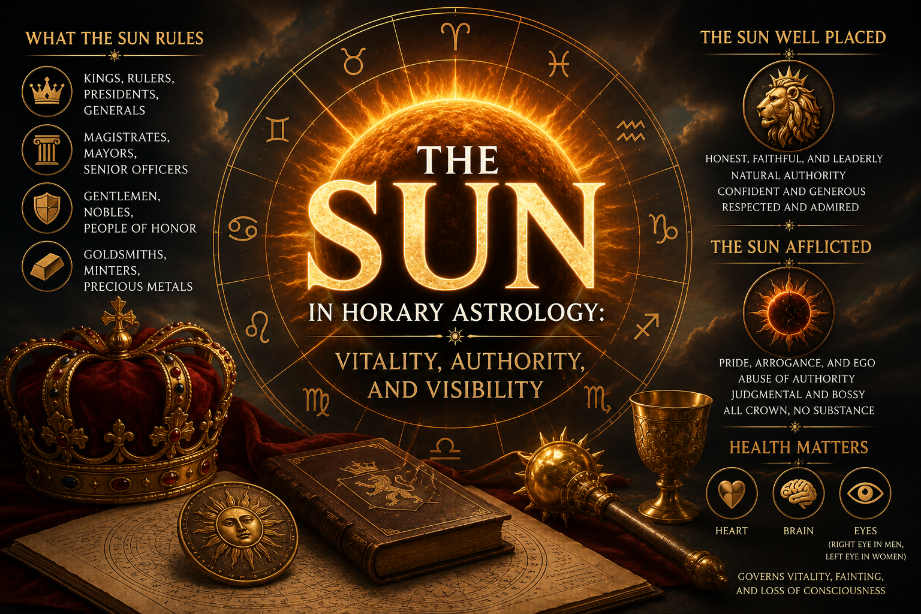
By natural signification, the Sun governs kings, rulers, presidents, and generals. It rules magistrates, mayors, and senior officers — anyone whose authority is a matter of public record, not private influence. It also rules gentlemen and nobles in the older sense: people of honor, whose standing matters to how they're treated. Among tradespeople, the Sun rules goldsmiths and minters — those who work with gold and other precious metals, materials the Sun has always been associated with by nature.
The thread running through all of these: authority that is seen and acknowledged, not authority exercised quietly from behind the scenes. That distinction matters when you're deciding whether the Sun or a more private significator, like Saturn, better fits an authority figure in your question.
The Sun Well Placed: The Fair Leader
A strong, dignified Sun describes exactly the kind of leadership most people hope to encounter. Honest and faithful to their word. A natural pull toward leadership without needing to grab for it. Someone who speaks with real authority because they've earned it, not because they're performing it. Confident without tipping into arrogance, and generally the kind of person who enjoys respect because respect has actually been extended to them, not demanded.
If the Sun rules a significator connected to an authority figure — a boss, a judge, an official — a strong Sun is genuinely reassuring. It suggests someone acting with integrity in the role they hold.
The Sun Weak or Afflicted: All Crown, No Substance
A poorly placed Sun tells a very different story. This is where pride curdles into arrogance — someone who talks about their status without living up to it. Judgmental without the maturity to back it up. Bossy in a way that has nothing to do with real authority. Frawley's image for this fits perfectly: a burnt-out star. All the appearance of importance, none of the depth underneath.
In a horary chart, an afflicted Sun ruling an authority figure can be a real warning. It doesn't necessarily mean the person is malicious — it often means they're overreaching, acting the part of an authority they don't genuinely hold.
The Sun and the Body: Reading Health Questions
When the Sun rules a house connected to health, its natural associations become directly relevant. The Sun governs the vital organs and the center of the body: the heart, the brain, and the eyes specifically — the right eye in men, the left in women, by the older tradition. Health issues linked to the Sun tend to involve the heart, fainting or loss of consciousness, and anything connected to the body's core vitality rather than a peripheral complaint. This tracks with the Sun's essential nature: it's the life-giving planet, so afflictions to it often point toward what sustains life itself, not what's happening at the edges.
A Worked Example: The Sun as Natural Ruler, Not Automatic Ruler
Here's a case where it helps to separate what the Sun naturally suggests from what the chart actually assigns. Say the question is, "Will my father approve of my decision?" By older tradition, the father is a 4th house matter — but the Sun, by natural rulership, is also strongly associated with men of status and authority, which makes it tempting to look at the Sun first out of habit.
Resist that instinct until you've checked the chart itself. If the 4th house cusp falls in a sign the Sun doesn't rule — Capricorn, say — then Saturn is Lord 4, the actual significator of the father in this question, regardless of the Sun's natural association with authority figures. The Sun's natural signification doesn't override the house assignment; at most, it adds a secondary layer if the Sun happens to be involved in the chart some other way — sitting close to the Ascendant, say, or making a notable aspect to Lord 4. Used correctly, this is supplemental insight. Used incorrectly — substituted in place of the actual house ruler because "the Sun means men of authority" — it's exactly the kind of assumption that leads a judgment astray.
The lesson holds for the Sun as much as any planet: check house rulership first, always. Let natural signification add texture once the real significator is already established, never before.
When the Sun Sits in a House Without Ruling It
The Sun doesn't need to rule a house to have something to say about it. If the Sun sits inside a relevant house — the 7th, say, in a partnership question — without ruling that house's cusp, it can still describe something real: a sense of visibility, pride, or a third party with genuine standing involved in the matter. But this only holds if the question actually calls for it. A planet's mere presence in a house isn't automatic significance; it earns a place in the judgment only when the matter genuinely concerns status, authority, or public exposure — not simply because the Sun happened to be passing through.
Reading the Sun in Practice
The next time the Sun turns up as a significator, resist the urge to treat it as automatically important just because it's the Sun. Ask the same question you'd ask of any planet: what house does it rule here, and how well is it placed? A weak, afflicted Sun ruling a minor house tells you far less than a strong, dignified Saturn ruling the house your question actually depends on.
Once you've confirmed the Sun's role, its natural character adds real texture: expect visibility, some form of authority, and a matter that won't stay quiet or hidden. Used this way, the Sun becomes one of the clearest planets to read in the entire chart — not because it dominates by default, but because when it does have a genuine role, it rarely leaves you guessing.
Before you go further with the planets, make sure the foundation is solid: the 5 Golden Rules of Horary Astrology covers the method every significator, the Sun included, depends on. Pair this with my guide to the twelve houses to see exactly which cusps assign the Sun its role in a given chart. And when you're ready to see how it behaves in a real chart, cast a free horary chart and find out exactly what role the Sun is playing in your question today.
This article is part of OracleSanctum's series on the planets in horary astrology — a complete guide to what each planet signifies, how to read it when strong or weak, and how it functions as a significator in any chart.
No comments yet.