Table of Contents
Planetary Rulerships and Natural Significations in Horary Astrology
Many people assume that a planet's meaning in a chart is fixed. Venus is love. Mars is conflict. Saturn is hardship. Learn the list, they think, and you know what the planet is telling you.
That's not how horary astrology works. And once you understand why, you'll read every chart differently.
In this method, planets don't carry one meaning. They carry a role — and that role is assigned fresh in every single chart, based on the specific question being asked. The same planet that represents your boyfriend in one reading can represent a lost dog in the next. This isn't a flaw in the system. It's the entire logic of how horary works.
Two Ways a Planet Gets Its Meaning
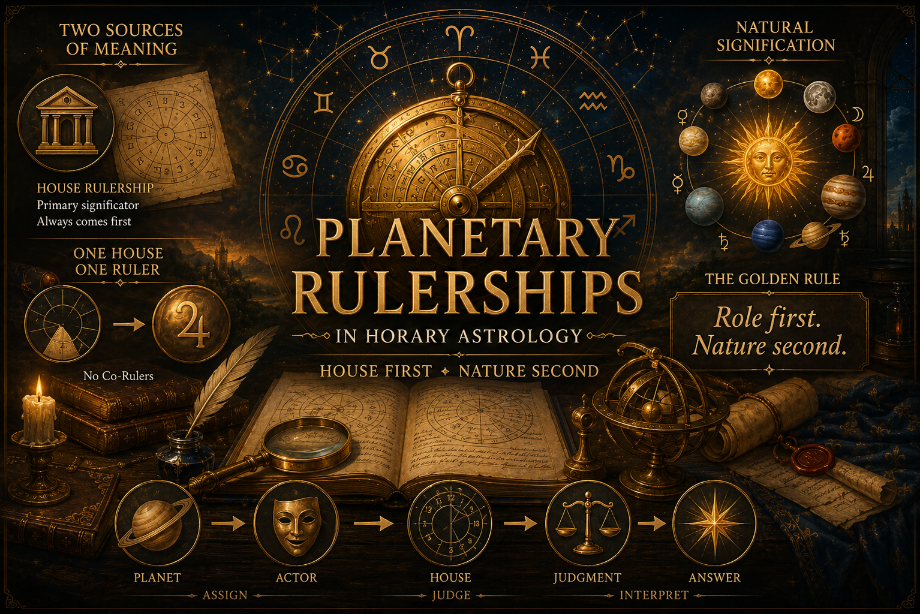
In horary astrology, planets acquire meaning in exactly two ways: through the houses they rule, and through their natural associations. The first of these is, by far, the more important.
House rulership works like this: the planet that rules the sign on a house's cusp is the significator for that house. If the 2nd house cusp falls at 17° Cancer, the Moon — ruler of Cancer — is Lord of the 2nd. If the 4th house cusp falls at 28° Virgo, Mercury is Lord of the 4th. Whatever that planet is doing — its sign, its condition, its aspects — tells you how the matter of that house is unfolding.
Natural signification is secondary. Every planet also carries traditional associations that exist independent of any chart: Venus relates to love and beauty by nature, Mercury to documents and communication, the Sun to men of authority. These associations can add texture to a reading — but only after house rulership has already told you who's playing which part.
Here's why the order matters so much. Say someone asks, "Does my boyfriend truly love me?" If the Ascendant is in Libra, Venus represents the querent — the person asking. If the 7th house cusp is in Capricorn, Saturn represents the boyfriend. Now, Saturn representing him doesn't mean he's cold or distant. It doesn't tell you anything about his personality at all. It simply means the chart handed Saturn that part in this particular drama. The planets are actors, not people — and the casting director doesn't spend much time deciding who plays which role.
This is one of the most important habits to build as a horary student: don't make character assumptions based on which planet ends up as a significator. Focus on that planet's dignity and condition instead. That's where the real information lives.
Every House Has Exactly One Ruler
This is worth stating plainly, because it's one of the most common points of confusion for students coming from modern astrology: a house has one ruler, and only one. The planet ruling the sign on its cusp is that ruler — even if the cusp sits at 29 degrees and 59 minutes of that sign. There is no such thing as a co-ruler in traditional horary. That idea is a modern invention, and the tradition simply doesn't use it.
A planet can sit inside a house without ruling it. That planet may still matter to the reading — but only if the question itself makes it relevant, not merely because it happens to be present. Occupying a house and ruling a house are two different things, and horary keeps them carefully separate.
When One Planet Rules Two Things
Sometimes the same planet ends up ruling both the querent and the thing being asked about. This happens more often than you'd expect, especially in career questions, where the 1st house (the querent) and the 10th house (the position) can easily fall under the same ruler.
Take this example: Virgo rises on the Ascendant, and Gemini sits on the 10th cusp. Mercury rules both signs — which makes Mercury the significator of both the querent and the job. If the question requires judging contact between the querent and the job, you need two separate planets to work with. You can't judge whether two things meet if they're actually the same planet wearing two hats.
The traditional solution is to take the ruler of the next sign along. If Gemini sits on the 10th cusp, the next sign in zodiacal order is Cancer, ruled by the Moon. The Moon can then stand in for the job, freeing Mercury to represent the querent alone. This technique exists specifically for situations where the chart needs two distinct actors and only one planet showed up to the audition.
But notice: this substitution is only necessary when the question actually demands separation. If a freelancer asks, "Will my work pick up next month?", finding the same planet ruling both the 1st and 10th houses isn't a problem to solve — it's simply accurate. They are their business. There's nothing to separate. The question itself tells you whether distinguishing between querent and quesited is even necessary — and this is a theme that runs through the whole of horary practice: let the question guide the method, not the other way around.
There's one more case worth naming. Sometimes the querent barely features in the drama at all. "Where is the lost kitten?" doesn't really depend on the querent's own house — a small animal belongs to the 6th, and if the same planet happens to rule both the 1st and 6th, you simply let it represent the cat. The Moon can still stand in for the querent's emotional interest in the outcome, since the Moon acts as co-significator of the querent in nearly every chart — but the cat doesn't need the querent's house to be found.
Using a Planet That Isn't the Ruler
There is one narrow exception that allows a non-ruling planet to stand in as significator: when the true ruler of a house is already occupied representing something else in the chart, and another planet sits within a degree or two of that house's cusp, in the same sign as the cusp itself. Only under both of those conditions can that planet be borrowed as a substitute significator.
Some traditional astrologers reach for the almuten — the planet holding the most essential dignity at the exact degree of the house cusp — as a further fallback. It has its place, but treat it as a last resort for the rare chart where nothing simpler applies. In genuine practice, you'll rarely need it. The three tools that will serve you in nearly every chart are: rulership by sign, the next-sign technique when two roles collide, and the question itself deciding whether separation is even required.
Natural Signification: What Planets Mean By Nature
Once house rulership is settled, natural signification adds a second, supplementary layer. Every planet has associations it carries simply by what it is, independent of any specific chart.
Think of a rose. It's clearly ruled by Venus — soft, fragrant, beautiful. But it also has thorns: sharp, defensive, decisive. That's Mars. Nearly everything in creation carries a blend of planetary qualities, and part of the astrologer's skill is recognizing which one dominates in a given context.
This is genuinely useful in practice. Mercury is the natural ruler of documents — so if you're searching for lost paperwork, Mercury deserves a look even if it isn't ruling the relevant house. Venus naturally signifies women; the Sun signifies men of status. In a relationship question, these natural rulers can add depth beyond whatever house rulership already established. But the hierarchy never reverses: natural signification supplements the reading. It doesn't replace accidental rulership, and it never overrides what the houses have already told you.
The best way to build fluency here is simple practice. Take an everyday object and ask what its essential nature is. Cornflakes: the Sun, because corn is a staple food; Saturn, because they're crisp and dry; Mercury, because they come in countless small pieces. Milk: the Moon, liquid and white. A camera is a more interesting case — it's a mechanical device (Mercury), it produces beautiful images (Venus), it works through light (the Sun) and mirrors (the Moon). All of that is true. But ask what the camera does, at its core — it captures a fleeting moment and preserves it. That's Saturn. The exercise isn't about listing every surface association. It's about finding the one that describes the thing's essential purpose.
The Habit Worth Building
If you take one principle from this article, let it be this: always ask what house a planet rules before you ask what a planet naturally means. That single habit prevents the most common error in horary judgement — reading a chart through a fixed idea of what a planet "is," instead of reading what role it's actually been assigned.
Try it with your own questions. Before you look at a single natural signification, identify the houses involved and find their rulers. Only once that's settled, bring in the planet's nature as a secondary layer of understanding. Do this consistently, and the chart stops being a puzzle of symbols and starts being what it actually is: a clear, ordered account of a specific question, asked at a specific moment.
This article is part of OracleSanctum's series on the planets in horary astrology — a complete guide to what each planet signifies, how to read it when strong or weak, and how it functions as a significator in any chart.
No comments yet.