Table of Contents
- What Venus Actually Represents in a Horary Chart
- Who and What Venus Rules
- Venus Well Placed: Warmth Worth Having
- Venus Weak or Afflicted: Sweetness Gone Sour
- Venus and the Body: Reading Health Questions
- A Worked Example: When Venus Isn't Signifying Love at All
- When Venus Sits in a House Without Ruling It
- Reading Venus in Practice
Venus in Horary: Love, Harmony, and Attraction
Many people assume Venus is a "soft" planet — pleasant to have in a chart, but not one that carries much real weight. Ask yourself whether that's actually true the next time Venus rules the significator in a relationship question you genuinely care about the outcome of. Venus ruling your significator in a love question isn't just pleasant scenery. It's a direct testimony, and it deserves the same careful reading you'd give Mars or Saturn.
The mistake happens for an understandable reason: Venus is associated with beauty and romance, and it's easy to let that natural charm distract from her actual job in the chart. In horary, Venus is a planet like any other. She takes on meaning from the house she rules first, and her natural sweetness colors that role — it doesn't replace it.
What Venus Actually Represents in a Horary Chart
The rule holds for Venus exactly as it does for every planet in horary: her primary meaning comes from the house she rules in your specific chart. If Venus rules your 7th house cusp, she represents your partner in this question — but if Venus rules your 6th house instead, she's now signifying your employee, your illness, or your servant, depending on what the question is actually about. That's an important distinction to sit with, because it's the exact example given in the horary tradition to make the point: a planet's natural meaning is secondary. House rulership decides the role first.
Once that role is set, Venus's own character shapes how she plays it. Venus is cold and moist, a water planet, feminine, and strongest by night. She's classified as a lesser fortune — generally beneficial wherever she turns up. Wherever Venus has a genuine role in your chart, expect some degree of ease, pleasantness, or natural harmony attached to that matter, even if the surrounding chart is more complicated.
Who and What Venus Rules
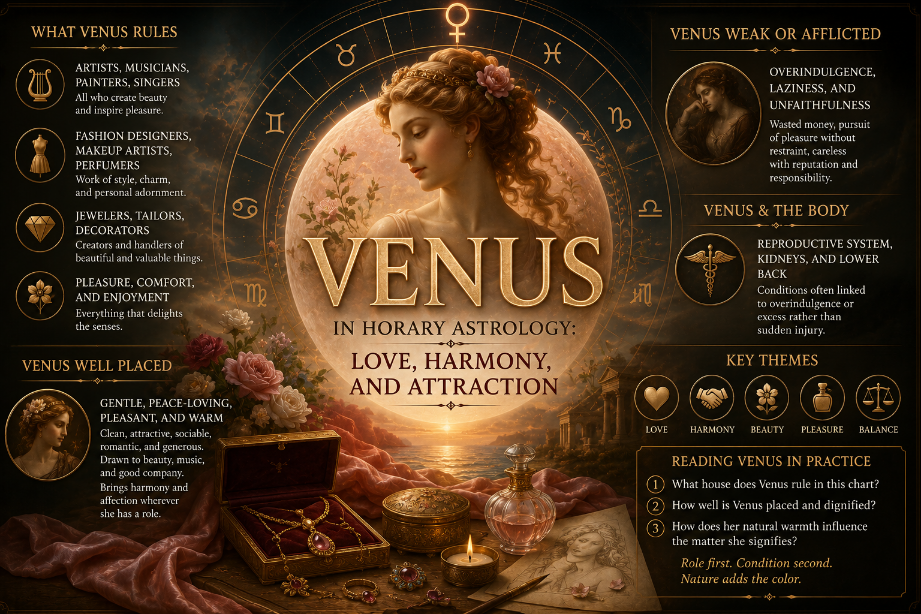
By natural signification, Venus governs artists, musicians, painters, and singers — anyone whose work is fundamentally about beauty. She rules fashion designers, makeup artists, and perfumers. She rules jewelers, tailors, and decorators. Broadly: if the work is about pleasure, style, or the creation of something beautiful, Venus is behind it.
The pattern to notice, the same one that applies to every planet's natural rulerships: Venus rules the function, not the job title. A perfumer and a decorator have almost nothing in common on paper. Both are in the business of making something more pleasant to experience. That's Venus.
Venus Well Placed: Warmth Worth Having
A strong, well-dignified Venus describes someone genuinely pleasant to be around — gentle, peace-loving, quick to laugh and enjoy good company. Clean, put-together, well-groomed without being vain about it. Someone drawn to music, dance, and romantic connection, and generous with warmth rather than guarded with it.
If Venus rules a significator in a relationship question, a strong Venus is a real, positive testimony — not decoration on top of the real answer, but part of the real answer. It suggests genuine affection and goodwill are actually present in the situation, not merely hoped for.
Venus Weak or Afflicted: Sweetness Gone Sour
A poorly placed Venus turns toward the darker side of pleasure-seeking. This is where you see overindulgence, laziness, an unhealthy fixation on physical pleasure at the expense of everything else. Money wasted on parties, drink, or people who don't deserve the trust extended to them. Unfaithfulness. A general carelessness about reputation and responsibility that comes from chasing good feeling without any boundary around it.
An afflicted Venus ruling a significator in a love question is worth taking seriously. It doesn't mean the affection isn't real — but it can point toward instability, indulgence without commitment, or a connection built more on pleasure than on genuine reliability.
Venus and the Body: Reading Health Questions
When Venus rules a house connected to health, her natural associations become directly relevant. Venus governs the reproductive system and conditions linked to pleasure and overindulgence — genital health issues, particularly in women, along with kidney and lower-back complaints. These conditions often trace back to excess rather than sudden injury, which fits Venus's character: her afflictions tend to arrive gradually, through indulgence, rather than suddenly, through force.
A Worked Example: When Venus Isn't Signifying Love at All
This is the clearest way to see why house rulership always comes first. Suppose the question is, "Will my employee finish the project on time?" Venus, ruler of love and beauty by nature, seems like an odd fit for a workplace question — and if you were reading by natural signification alone, you might overlook her entirely.
But suppose the 6th house, which governs employees and servants in horary, has Libra on its cusp. Venus rules Libra, which makes Venus Lord 6 here — the direct significator of the employee, with nothing romantic about the role at all. Her natural sweetness still colors the reading, but it now describes the employee's manner, not a love interest: perhaps someone easy to work with, cooperative, pleasant under pressure if well-dignified; or, if afflicted, someone charming but unreliable, more interested in being liked than in finishing the work.
This is the exact case the horary tradition itself uses to make the point, and it's worth sitting with: Venus doesn't become "not Venus" just because she's ruling something unromantic. She keeps her essential warmth. She simply applies it to whatever the chart has assigned her, which in this case is an employee, not a lover.
When Venus Sits in a House Without Ruling It
Venus doesn't need to rule a house to say something about it. If she sits inside a relevant house — the 5th, say, in a question about a creative project, without ruling that house's cusp — she can still describe something real: an element of pleasure, aesthetic quality, or ease involved in the matter. But only if the question genuinely concerns those things. A planet's presence in a house is not, by itself, significance. It earns its place in the judgment when the matter actually calls for it — not simply because Venus happened to be passing through.
Reading Venus in Practice
The next time Venus shows up as a significator, don't let her reputation for gentleness do the reading for you. Ask what you'd ask of any planet: which house does she rule here, and how well is she placed? A weak, afflicted Venus ruling the wrong house tells you far less than a strong, dignified Venus genuinely ruling your quesited.
Once her role is confirmed, layer in her natural character: warmth, harmony, attraction, and — when poorly placed — indulgence without direction. Read this way, Venus becomes one of the most reliably useful planets for relationship and pleasure-related questions in the entire chart, because she rarely hides what she's actually signifying.
This is worth practicing deliberately. Take a handful of real questions — a friend's love question works well — and before you interpret anything, find Venus, identify what she rules, and check her dignity. Only then ask what her natural warmth adds to that specific role. Do this consistently, and Venus stops being the planet you assume is good news, and starts being a significator you can actually trust.
Before you go further with the planets, make sure the foundation underneath them is solid: the 5 Golden Rules of Horary Astrology covers the method every significator, Venus included, depends on. Pair this with my guide to the twelve houses to see exactly which cusps assign Venus her role in a given chart. And when you're ready to see how she behaves in a real chart, cast a free horary chart and find out exactly what role Venus is playing in your own question today.
This article is part of OracleSanctum's series on the planets in horary astrology — a complete guide to what each planet signifies, how to read it when strong or weak, and how it functions as a significator in any chart.
No comments yet.