Table of Contents
Uranus, Neptune, and Pluto in Horary: Do the Outer Planets Even Apply?
Many people who come to horary astrology already have a background in modern astrology — and one of the first questions they ask is a natural one. What about Uranus, Neptune, and Pluto? Don't these planets matter too?
Here's the honest, traditional answer: not the way you've probably been taught to think about them.
This isn't a matter of taste or preference between schools of astrology. It's a practical finding, repeated by every serious horary practitioner who's tested it: bring the outer planets into a chart the way modern astrology treats them, and you will consistently arrive at the wrong answer. Let's understand why — and where they genuinely do belong.
Seven Planets Are Enough
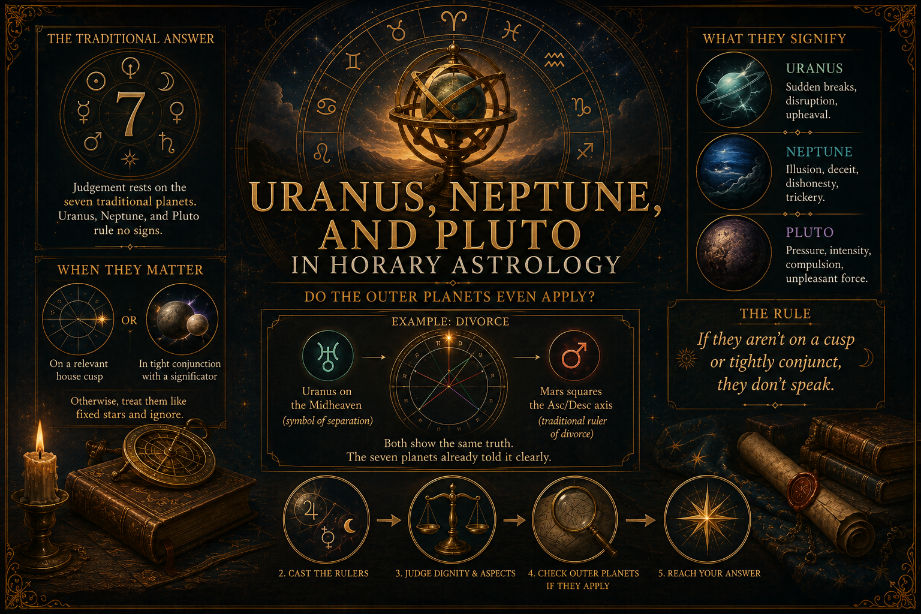
In horary astrology, judgement rests entirely on the seven traditional planets: the Sun, the Moon, Mercury, Venus, Mars, Jupiter, and Saturn. Uranus, Neptune, and Pluto do not rule any signs, and they don't carry the kind of essential symbolism that the classical seven do.
This might sound restrictive if you're coming from a modern framework, where Uranus rules Aquarius, Neptune rules Pisces, and Pluto rules Scorpio. If that's what your previous study has taught you, set it aside while you're learning horary. The traditional rulerships work — reliably, and in a way you can test for yourself, chart after chart.
The reasoning behind excluding them isn't arbitrary. These planets weren't part of the tradition when the method was built, refined, and tested across centuries of recorded judgements. More importantly, they simply don't add anything the seven traditional planets can't already show more precisely. Once you start practicing this way, you'll notice it for yourself: the traditional system carries its own weight.
Treat Them Like Fixed Stars
So do the outer planets mean nothing? Not quite. They have a role — just a much smaller one than most modern astrologers assume, and it comes with a strict condition.
The rule is this: pay attention to Uranus, Neptune, or Pluto only when one of them sits directly on a relevant house cusp, or forms a tight conjunction with a significator that's already central to the question. Otherwise, ignore them entirely. Treat them the way you'd treat a fixed star — largely irrelevant to daily practice, but occasionally significant when they land exactly where it counts.
This single rule resolves almost every question a student has about these planets. You never need to go hunting for them. You never ask, "What is Pluto doing in this chart?" as a starting point. If they matter, they'll make themselves known by sitting exactly where the chart's real action is happening. If they're floating somewhere unrelated, they contribute nothing — and adding them anyway only clouds a judgement that the traditional planets have already made clear.
What Each One Signifies, When It Applies
When the condition above is actually met, each outer planet carries a narrow, specific signification worth knowing.
Uranus signifies sudden breaks and disruption. Picture someone asking, "Do I have a future with this person?" — and Uranus sits exactly on the Ascendant. That placement is a strong testimony that the relationship is heading toward an ending, showing disruption to the querent much like a breakup. But if Uranus is simply floating somewhere in the middle of the 1st house, unconnected to the cusp or the ruling planet, it means nothing at all. The same logic applies to questions about moving house or making a major change — Uranus might echo what's happening, but it won't tell you anything the traditional rulers haven't already shown.
Neptune signifies illusion and deception. Consider a client who keeps asking about selling her business, and in every chart she casts, Neptune sits precisely on the cusp of the 7th house (the buyer) or the 8th (the buyer's money). That's a clear warning sign — dishonesty somewhere in the deal. Neptune, here, is flagging trickery. Again, if Neptune is simply drifting through a house without touching a cusp or a significator, it isn't speaking to the question at all.
Pluto is the least precise of the three. It generally adds pressure, intensity, or a sense of unpleasant force when it's tightly involved in a chart — but it rarely offers the kind of clear, specific testimony that Uranus or Neptune can.
A Real Comparison: The Traditional Ruler Already Knew
Here's an example worth sitting with, because it shows exactly how this works in practice. A client asked about her impending divorce. In her chart, Uranus sat exactly on the Midheaven — symbolically halfway between her own significator (the Ascendant) and her husband's (the 7th house). That placement reads like a clean symbol of separation.
But at the same time, Mars — the traditional planet that rules divorce — made an exact square to the Ascendant/Descendant axis. Both planets were pointing at the same conclusion. Uranus confirmed what Mars had already shown clearly, on its own, using nothing but traditional rulership.
This is the pattern you'll find whenever an outer planet genuinely applies: it echoes a testimony the seven traditional planets were already giving. It rarely, if ever, introduces something the tradition can't otherwise see.
Leave the Rest Alone
The same restraint applies to Chiron, the asteroids, Lilith, Sedna, and every other modern addition to the astrological chart. None of these have a place in horary practice. However attached you might be to them from other kinds of astrological study, bringing them into a horary judgement adds nothing but confusion — and confusion is precisely what leads to wrong answers in a method built for clarity.
Horary astrology is deliberately simple and sharp. The seven traditional planets carry the full weight of the judgement. The outer planets are worth knowing about, worth recognizing when they land somewhere meaningful — and, the rest of the time, worth simply setting aside.
The next time you cast a chart, look at where Uranus, Neptune, and Pluto actually sit before deciding whether they matter at all. More often than not, you'll find the traditional planets have already told you everything you need to know.
This article is part of OracleSanctum's series on the planets in horary astrology — a complete guide to what each planet signifies, how to read it when strong or weak, and how it functions as a significator in any chart.
No comments yet.