Table of Contents
- What Mars Actually Represents in a Horary Chart
- Who and What Mars Rules
- Mars Well Placed: The Courage Without the Chaos
- Mars Weak or Afflicted: Fire Without Direction
- Mars and the Body: Reading Health Questions
- A Worked Example: When Mars Rules the Question Itself
- Mars as Co-Significator: When It Isn't Even Ruling the House
- Reading Mars in Practice
Mars in Horary: Action, Conflict, and Urgency
Most people who study astrology carry one idea about Mars into every chart they read: Mars is the bad planet. The angry one. The one you don't want ruling anything important. Ask yourself whether that idea has ever actually held up once you've watched a real chart play out.
It doesn't. Not in horary. Mars ruling the significator of your surgery, your court case, or your job interview is not automatically a bad sign — sometimes it's exactly what the question needs. Understanding why starts with something I say often on this site: the planets are not people. They're actors, and Mars gets cast in a role by the chart, not by a reputation it carries from pop astrology.
What Mars Actually Represents in a Horary Chart
Start with the rule that governs every significator in horary, Mars included: a planet's primary meaning comes from the house it rules — not from what it "is" in general. If Mars rules the 7th house cusp in your chart, Mars represents your partner in this question. That doesn't mean your partner is violent or hot-tempered. It means the casting director handed Mars that part today, and your job is to read how Mars is doing in the role, not to import assumptions from a textbook description.
Once house rulership is established, Mars carries its own natural character too — the qualities it brings to whatever role it's playing. Mars is hot and dry, which makes it a fire planet. It's masculine, and it works best at night. Where Jupiter expands and Venus softens, Mars acts. It doesn't ask permission first. It moves, then it thinks about what it just did.
This is why Mars shows up so often in questions with real stakes attached — action needed now, conflict already underway, urgency that can't wait. If your question involves confrontation, a deadline, surgery, or a fight you didn't start but have to finish, don't be surprised to find Mars standing in one of the lead roles.
Who and What Mars Rules
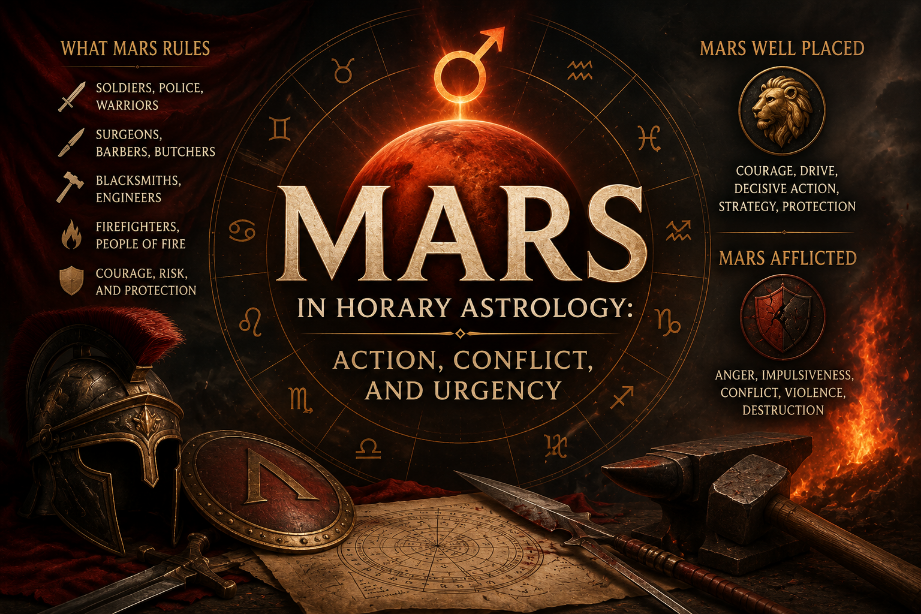
By natural signification, Mars governs people and situations built around risk, force, or heat. In the horary tradition — the same one William Lilly worked from — Mars rules soldiers, fighters, police officers, and surgeons. It rules butchers, barbers, blacksmiths, and firefighters. Anyone whose work involves blades, fire, iron, or genuine physical danger tends to fall under Mars.
Notice the pattern here before you memorize the list: Mars rules the job that involves risk or intensity, not the job title itself. That's the same logic Frawley uses when he talks about finding a planet's essential nature rather than its surface description. A surgeon and a butcher look nothing alike on paper. Both work with blades, both work fast, and both answer to Mars.
Mars Well Placed: The Courage Without the Chaos
When Mars is strong and well-dignified in a chart, it shows something genuinely admirable. Think of the qualities you'd want in someone facing a real crisis: courage, drive, the willingness to act when action is actually required. A well-placed Mars doesn't back down from a fight worth having, and it can describe a bold, decisive presence — someone fearless and strategic rather than reckless.
This is Mars as the protector, not the aggressor. If Mars rules your significator in a legal dispute or a confrontation you didn't choose, a strong, dignified Mars can be genuinely reassuring. It tells you the matter has someone — or something — fighting for it with real conviction.
Mars Weak or Afflicted: Fire Without Direction
The trouble starts when Mars is poorly placed. Weakened or badly aspected, Mars stops representing courage and starts representing aggression with no target worth hitting. This is where you see the reckless, impulsive, or outright destructive side: someone easily angered, prone to conflict for its own sake, lacking the empathy to notice who gets hurt along the way.
An afflicted Mars ruling a significator can be a genuine warning — not that the matter is doomed, but that whatever it represents is running hot and unchecked. In a question about a dispute, this might describe the other party escalating rather than resolving things. In a health question, it can point toward the kind of illness Mars is known for: sudden, sharp, and inflamed rather than slow and creeping.
Mars and the Body: Reading Health Questions
When Mars rules a house connected to health, its natural associations become directly useful. Mars governs conditions that arrive with heat, infection, or injury — burns, cuts, fevers, migraines. It rules wounds from iron or tools, and it's associated with issues involving inflammation or blood. These are not slow illnesses. They tend to appear suddenly and demand attention now, which fits Mars's character perfectly: it doesn't wait, and neither do the conditions it rules.
A Worked Example: When Mars Rules the Question Itself
Here's where the distinction between rulership and reputation actually matters. Say the question is, "Will my surgery go well?" The querent is the 1st house, as always. The surgery — and the surgeon performing it — naturally falls to Mars territory: cutting, blades, physical intervention. But that's natural signification. What actually governs the judgment is which house rules the matter, and how the planet ruling that house is placed.
Suppose the 6th house, which governs the querent's own illness and the treatment of it, has Aries on the cusp. Mars rules Aries, so Mars becomes Lord 6 — the significator of the treatment itself, quite apart from its natural association with surgery. Now the real question isn't "is Mars involved," because Mars is always thematically nearby when blades are. The real question is: how is this Mars actually placed?
Dignified and well-supported, Mars as Lord 6 can show a treatment that moves decisively and resolves the matter — Mars doing what Mars does best, acting instead of lingering. Afflicted and poorly placed, that same natural association becomes a warning: complications, something moving too fast or too aggressively, a process the querent doesn't have full control over.
Notice what this example teaches: Mars showing up naturally in a surgical question doesn't tell you the outcome. Mars ruling the relevant house, and how that Mars is dignified, tells you the outcome. Keep those two things separate, and you'll read Mars correctly every time it appears.
Mars as Co-Significator: When It Isn't Even Ruling the House
One more thing worth understanding before you move on: Mars doesn't need to rule a house to matter in a question. If Mars sits inside a relevant house without ruling it — say, in the 7th house of a partnership question, without ruling the 7th cusp — it may still describe something real about that situation. A quarrelsome element. A source of friction the significators themselves don't fully capture. But only if the question actually calls for it. A planet floating in a house isn't automatically significant just by being there; it earns its place in the judgment when the matter genuinely concerns conflict, urgency, or force, and not otherwise. This is the same discipline that applies to every unassigned planet in a horary chart: let the question decide what matters, not the planet's presence alone.
Reading Mars in Practice
Try this the next time you're working through a chart. Find Mars, and before you interpret anything, ask the same question you'd ask of any significator: what house does it rule here, and how is it placed? Is it strong, dignified, and well-supported — the protector? Or is it weak, afflicted, and unchecked — fire without direction?
Then, and only then, layer in Mars's natural character: urgency, action, conflict, heat. Used this way, Mars becomes one of the most genuinely useful planets in the chart, because it tells you not just what's happening, but how fast, and with how much force.
Once you've practiced reading Mars this way across a handful of real questions, you'll stop seeing it as "the malefic" and start seeing it for what it actually is in horary: the planet that shows you where the pressure is, and whether that pressure is working for the querent or against them.
If you haven't yet, start with the 5 Golden Rules of Horary Astrology — Mars will make far more sense once you understand the framework it operates inside. Pair this with my guide to the twelve houses to see exactly which cusps hand Mars its role in a given chart. And when you're ready to see how it behaves in an actual chart, cast a free horary chart and find out what role Mars is playing in your own question today.
This article is part of OracleSanctum's series on the planets in horary astrology — a complete guide to what each planet signifies, how to read it when strong or weak, and how it functions as a significator in any chart.
No comments yet.