Table of Contents
- Introduction
- Strength Has a Mirror Image
- Detriment: A Planet in Hostile Territory
- Fall: When a Planet Hits Rock Bottom
- How Fall Differs From Detriment
- Peregrine: Wandering Without Power
- Can Mutual Reception Cure a Peregrine Planet?
- When Debility Isn't Bad News
- The Three Debilities, Side by Side
- Where This Leads Next
- Frequently Asked Questions
- Glossary of Terms Used in This Article
Detriment, Fall, and Peregrine Planets: When a Significator Is Weak
Most people learning horary astrology treat weak dignity as a problem to explain away — a planet that "isn't very good" this time, best glossed over on the way to a more flattering testimony. That instinct is understandable, and it's also exactly backward.
A significator's weakness is not an inconvenience to the reading. It is the reading, just as much as strength is. In Essential Dignities in Horary Astrology, I walked through the five ways a planet gains strength — rulership, exaltation, triplicity, term, and face. This article covers the other half of that same picture: the three conditions that weaken a planet instead, and what each one is actually describing when it shows up in a real chart.
Strength Has a Mirror Image
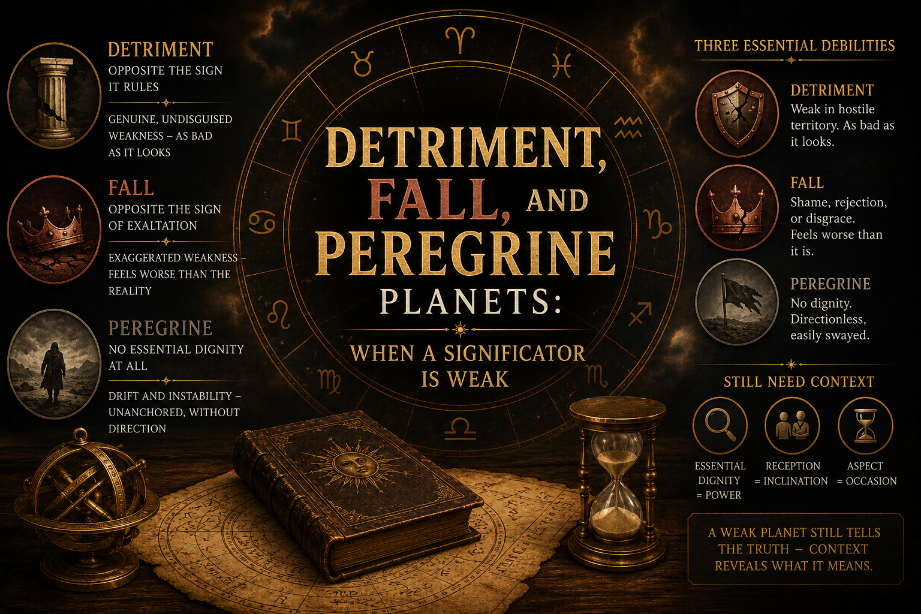
Every dignity in the previous article has a debility that mirrors it. Rulership's opposite is detriment. Exaltation's opposite is fall. And beneath both of those sits a third condition entirely — peregrine — which isn't the opposite of anything specific, but rather the total absence of dignity altogether.
These three conditions aren't identical to each other, and treating them as interchangeable "bad" placements is one of the more common mistakes beginners make. Detriment, fall, and peregrine each describe a genuinely different kind of weakness, and the difference between them changes what you tell a querent.
Detriment: A Planet in Hostile Territory
A planet is in detriment when it sits in the sign directly opposite the one it rules. Mars rules Aries, so Mars in Libra is in detriment. Venus rules Taurus, so Venus in Scorpio is in detriment. The same logic runs through every planet: find the sign it rules, and the sign opposite is where it falls into detriment.
Detriment is one of the strongest essential debilities in the entire system — deeply weakened, struggling to express itself with any real confidence. If rulership is a man in his own house, in full command, detriment is that same man stuck in the house of someone who dislikes him, and whom he probably dislikes right back. He's uncomfortable. He's treated with suspicion. He can't move freely, and he isn't welcome.
What that means in practice: whatever a planet in detriment signifies is in some kind of trouble. If it stands for a person, they may be struggling, unwell, or genuinely weakened in some way. If it stands for a situation, that situation is likely dysfunctional or off balance. But context still governs the reading, exactly as it did with strength. A significator in detriment doesn't mean the person it represents is bad or dishonest — it means whatever they're dealing with is severe. A sick man signified by a planet in detriment isn't wicked. His illness is simply serious. That's a description, not a moral judgement.
It helps to think of detriment as the direct mirror of rulership. Every bit of authority and self-expression a planet enjoys in its own sign, it loses entirely in detriment — the difference between a confident king in his own castle and a captive who isn't sure what's safe to do next.
Fall: When a Planet Hits Rock Bottom
Fall is a different kind of debility, and it's easy to lump together with detriment if you haven't looked closely at what separates them. A planet is in its fall when it sits in the sign directly opposite its exaltation. The Sun is exalted in Aries, so the Sun falls in Libra. Venus is exalted in Pisces, so Venus falls in Virgo. Mars is exalted in Capricorn, so Mars falls in Cancer. As with exaltation itself, each fall also has a specific degree of peak weakness, mirroring the exaltation degree exactly.
Where fall gets interesting is in how its badness actually feels compared to detriment's.
How Fall Differs From Detriment
With a planet in detriment, the trouble is exactly as bad as it looks. Nothing about detriment exaggerates the situation — it's straightforwardly weak, and the chart isn't hiding anything worse or better underneath.
Fall works differently. With a planet in fall, things often feel considerably worse than they actually are. It's an exaggerated badness, not an accurate one. That doesn't mean fall describes something secretly fine — it's still a genuine debility — but the exaggeration matters enormously when you're trying to reassure or prepare a querent honestly.
Take a job interview question where the querent's significator is in its fall. The situation might feel humiliating or hopeless to the querent going through it. But in reality, the outcome may not be nearly as catastrophic as their fear suggests. That gap — between how bad something feels and how bad it actually is — is precisely what fall is built to describe.
It's worth being direct about a phrase you'll hear often: people describe a planet in fall or detriment as simply "weak," and in terms of essential dignity, that's true. The planet has little or no innate authority in that placement. But essential weakness doesn't mean the planet can't act forcefully. A planet in fall might still be angular, direct, or making strong aspects — accidental strengths that let it act, even while acting badly, or from a place of genuine distress. Essential dignity and accidental dignity are two separate layers, and one doesn't cancel the other.
Fall reflects the shadow side of exaltation specifically. Where exaltation lifts a planet above its normal function, fall casts it down below that function — shame, rejection, disgrace, or simply the feeling of being entirely out of place. In many charts this shows up quite literally: a fallen planet can describe someone in genuine humiliation, or someone who has fallen from favor and lost a position they once held. As always, the specific meaning still depends on what the planet is standing in for.
To summarize the distinction plainly: detriment is bad, and it's exactly as bad as it looks. Fall is bad, but it's worse-feeling than it actually is. Planets in fall are unhappy, but that unhappiness doesn't automatically mean they've stopped functioning.
Peregrine: Wandering Without Power
Peregrine is the third essential debility, and it's a genuinely different category from the first two. A planet is peregrine when it has no essential dignity of any kind — not rulership, not exaltation, not triplicity, not term, not face — and also isn't in detriment or fall. It isn't weakened by opposition to a strength. It simply has none of its own to draw on. It's floating.
The classical image is a wanderer with no roots — someone belonging nowhere in particular, without the power to act with confidence or purpose. The 13th-century astrologer Guido Bonatti described a peregrine planet as one that "shall know how to act both good and evil, but be more inclinable to the latter." That's not a claim that the planet is evil. It's a claim that the planet is unanchored — lacking the moral compass essential dignity provides, and lacking even the clarity that comes from an honest debility like detriment or fall. It's a loose cannon, capable of acting either way, without the internal ballast to reliably choose the better path.
The traditional image often used alongside this is a man wandering in a foreign country, with no home, no money, and no map. He can't make strong decisions on his own, and he's easily swayed — often not toward anything good. That's the behavior peregrine describes in a chart: not malice, but drift.
Can Mutual Reception Cure a Peregrine Planet?
This is one of the most common points of confusion for students working through dignity for the first time, so it's worth addressing directly.
Say a planet is peregrine, but it happens to be in mutual reception by sign with another planet — each sitting in a sign the other rules. Does that reception give the peregrine planet any dignity of its own? No. Essential dignity cannot be transferred between planets. Even if the other planet in the reception is sitting comfortably in its own sign, that comfort doesn't extend backward to cure the peregrine planet's own condition. Mutual reception can genuinely help a peregrine planet act — reception softens plenty of otherwise-difficult testimonies — but it doesn't make the planet any less peregrine. The planet remains dignity-less; it just has help nearby.
When Debility Isn't Bad News
Context always matters here, exactly as it did with strength in the companion article. A peregrine planet often signals vulnerability, instability, or a kind of moral drift in whatever it represents. But sometimes that description is precisely accurate to the situation being asked about, rather than a warning sign at all.
Someone on a long journey, moving between homes, or in the middle of a job search may be genuinely well described by a peregrine significator. The condition fits the circumstance rather than contradicting it. So while peregrine is generally a signal of weakness or lack of control, don't skip the step of asking whether that weakness is actually the honest shape of the situation the querent is describing.
The same principle runs through detriment and fall. A lost object signified by a debilitated planet can be an accurate description of the object itself, not a bad omen about finding it. A relationship question where the significator is in detriment may be describing genuine difficulty in the relationship — which is often exactly the information the querent came for, even if it isn't the answer they were hoping to hear.
The Three Debilities, Side by Side
| Debility | Mirrors | What It Actually Describes |
|---|---|---|
| Detriment | Rulership (opposite sign) | Genuine, undisguised weakness — as bad as it looks, no exaggeration |
| Fall | Exaltation (opposite sign) | Exaggerated weakness — feels worse than the underlying reality |
| Peregrine | No dignity at all | Drift and instability — not weak by opposition, but unanchored entirely |
Just as dignities are cumulative, debilities can combine with other conditions in a chart. A planet can be in detriment and also accidentally afflicted — retrograde, combust, cadent — compounding its difficulty. Or a planet in fall can still be angular and direct, giving it accidental strength that partially offsets its essential weakness. Weighing exactly how strengths and weaknesses net out together, using real numbers from a documented chart, is the subject of How to Calculate Total Essential Dignity, the companion piece to both articles in this pair.
Where This Leads Next
Debility is not the part of horary judgement to rush past. A planet in detriment, fall, or peregrine condition is telling you something specific and useful — provided you read which of the three conditions you're actually looking at, rather than lumping them together as generically "bad."
If you haven't already read the companion piece on strength, Essential Dignities in Horary Astrology covers rulership, exaltation, triplicity, terms, and faces with the same level of care given to debility here. And if you want to see strength and weakness weighed together in one real chart — tallied, subtracted, and judged — How to Calculate Total Essential Dignity works through William Lilly's own 1634 case using OracleSanctum's chart tool, showing exactly how a planet can hold both a strength and a weakness at once and what to do when it does.
For a full account of how a chart holding several strong and weak testimonies together was actually judged in practice — and confirmed by the querent afterward — read Is Horary Astrology Accurate? A Real Case Study from William Lilly's Casebook.
Ready to see this in your own chart? Cast a free horary chart and check each significator's sign against both this article and its companion piece on strength. The fastest way to make detriment, fall, and peregrine feel intuitive rather than memorized is to find all three in a real chart and ask, honestly, what each one is describing.
Frequently Asked Questions
What is the difference between detriment and fall?
Detriment occurs when a planet sits in the sign opposite the one it rules, and it describes a weakness that is exactly as severe as it appears — no exaggeration. Fall occurs when a planet sits in the sign opposite its exaltation, and it tends to feel worse than the underlying reality actually is. Both are genuine essential debilities, but fall carries a distorting, exaggerated quality that detriment does not.
Is a peregrine planet the same as a planet in detriment or fall?
No. A peregrine planet holds no essential dignity at all — it isn't in rulership, exaltation, triplicity, term, or face — but it also isn't in detriment or fall. It's a distinct third category: not weakened by sitting opposite a strength, but simply lacking any dignity of its own to draw from, which traditional sources describe as a kind of directionless drift rather than an active weakness.
Can mutual reception fix a peregrine planet's condition?
No. Mutual reception can help a peregrine planet act, since reception softens many otherwise-difficult testimonies in a chart, but it cannot transfer essential dignity from one planet to another. A peregrine planet remains peregrine even while in reception with a strongly-placed planet.
Does a debilitated significator always mean a bad outcome for the querent?
Not automatically. Detriment, fall, and peregrine describe genuine weakness in a planet, but what that weakness means still depends on what the planet stands for in the specific question. A debilitated significator describing a lost object, a difficult relationship, or a genuinely unstable situation can be an accurate, useful description rather than a bad omen — context decides the meaning, the same way it does with strength.
Can a planet be both essentially weak and still act powerfully in a chart?
Yes. Essential dignity and accidental dignity are separate layers. A planet in fall or detriment can still be angular, direct, or swift, or otherwise accidentally strong — meaning it can genuinely act, even while essentially weak, sometimes producing effects from a place of distress or misjudgement rather than lacking effect altogether.
Glossary of Terms Used in This Article
- Detriment: An essential debility where a planet sits in the sign opposite the one it rules; a genuine, undisguised weakness.
- Fall: An essential debility where a planet sits in the sign opposite its exaltation; a weakness that tends to feel more severe than it actually is.
- Peregrine: The condition of holding no essential dignity at all — not rulership, exaltation, triplicity, term, or face — and also not being in detriment or fall.
- Mutual Reception: A condition where two planets each sit in a sign ruled by the other; it can assist a planet's ability to act but cannot transfer essential dignity.
- Essential Dignity: A planet's strength based purely on its zodiacal position, covered in full in the companion article to this one.
- Accidental Dignity: A planet's strength based on its actual placement and condition in a specific chart — house position, speed, and combustion among them — separate from essential dignity.
Have a real question and want to see how a debilitated significator reads in your own chart? Book a professional reading, starting from $15, or cast your own free chart and check each planet against detriment, fall, and peregrine yourself.
No comments yet.