Table of Contents
- Introduction
- Dignities Are Cumulative
- Don't Be Fooled by the Numbers
- Astrology, Not Arithmetic
- A Real Chart: Setting Up the Example
- Reading the Dignity Table Planet by Planet
- What the Sums Actually Tell You
- Handling Contradictions Within a Single Planet
- Use Context Over Counting
- Where This Leads Next
- Frequently Asked Questions
- Glossary of Terms Used in This Article
How to Calculate Total Essential Dignity (With Worked Examples)
By now, if you've read the two companion articles in this pair — Essential Dignities in Horary Astrology and Detriment, Fall, and Peregrine Planets — you already know that planets can be strong or weak depending on exactly where they sit in the zodiac. You know rulership, exaltation, triplicity, terms, and faces on the strength side. You know detriment, fall, and peregrine on the debility side.
So now comes the practical question every student eventually asks: how much dignity does a planet actually have, once you add everything up? And can that really be measured?
Dignities Are Cumulative
The short answer is: yes, but not with the precision a calculator gives you. Dignities genuinely add up. A single planet can hold more than one at the same time.
Take the Sun in Aries as an example. It's exalted there — already a strong placement on its own. But if the chart in question happens to be a day chart, the Sun also rules the fire triplicity by day. So in a day chart, the Sun in Aries carries more total dignity than it would in a night chart, purely because of that added triplicity strength stacking on top of the exaltation. The more dignities a planet holds at once, the more confident, stable, and reliable it becomes as a significator.
This stacking is exactly why a simple "is it dignified, yes or no" question isn't quite the right question. The real question is how much dignity a planet is carrying, once every layer is counted.
Don't Be Fooled by the Numbers
You'll come across scoring systems that assign point values to each dignity — a common one runs sign rulership at 5 points, exaltation at 4, triplicity at 3, term at 2, and face at 1. This kind of system has a genuine use, especially for finding the almuten of a chart, the single planet holding the most overall dignity across a specific set of points.
But don't take those numbers too literally, and don't mistake them for something more precise than they are. In real judgement, sign rulership and exaltation carry vastly more weight than triplicity, and triplicity itself is far more significant than term or face. The gap between these dignities isn't evenly spaced just because the point system makes it look that way. A planet with a dignity "score" of 10 tells you nothing on its own — ten of what, exactly, and what does that number actually mean for the reading?
Astrology, Not Arithmetic
Here's the underlying principle worth holding onto through everything that follows: you are not tallying planets the way you'd tally a bank account. This isn't mathematics, and it isn't engineering. You're reading a chart — a living symbol — and symbols don't operate in exact weights and measures the way a spreadsheet does.
In practice, it's far more useful to ask a simpler question: does this planet have a lot of dignity? Some? Just a little? That framing will take you considerably further than any scoring system, because it keeps you thinking about the planet's actual condition rather than chasing a number that feels more precise than the method really supports.
Two planets can carry similar dignity totals on paper and still behave completely differently in the chart, because context decides more than the count does. Is the planet angular? Retrograde? Combust? Is it the Lord of the Hour? Essential dignity is one layer of a much larger picture — a starting point for judgement, never the final verdict on its own.
With all of that as groundwork, here's what a real dignity tally actually looks like, worked from a genuine historical chart rather than an invented example.
A Real Chart: Setting Up the Example
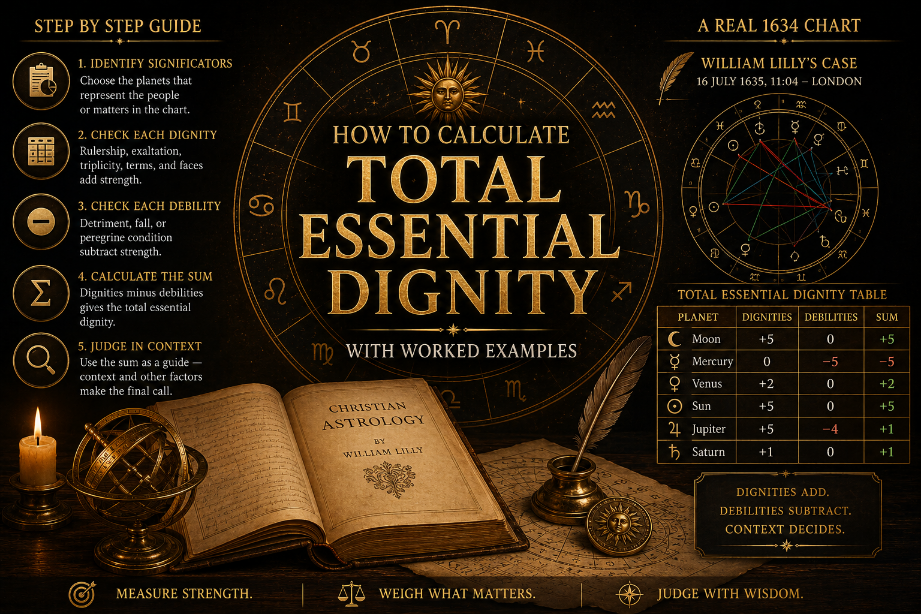
The chart below is William Lilly's own case from 1634 — a London tradesman who came to him with four questions: would he become rich, or be able to support himself without marrying; by what means; when; and whether it would last. Lilly recorded his full reasoning in Christian Astrology, and the case is documented in complete technical detail in Is Horary Astrology Accurate? A Real Case Study from William Lilly's Casebook, which walks through the entire judgement — motion, dignity, timing, and the outcome the querent later confirmed.
This article uses the same chart for a narrower purpose: showing exactly how a total essential dignity tally is built, using OracleSanctum's own chart tool to recast Lilly's original figure and generate its dignity table directly. If you've read the accuracy case study already, this will feel familiar — the difference here is the focus. That article is about whether the judgement held up. This one is about how the underlying dignity math actually works, step by step, so you can run the same process on a chart of your own.
Below is the chart itself, cast for 16 July 1635, 11:04, London, using the Regiomontanus house system — the same house system Lilly himself worked with.

The Essential Dignities table generated by the tool gives a running tally for six of the chart's significators — the Moon, Mercury, Venus, the Sun, Jupiter, and Saturn — broken into three rows: Dignities (total points gained from rulership, exaltation, triplicity, term, or face), Debilities (points lost from detriment or peregrine condition), and the Sum of the two.
Reading the Dignity Table Planet by Planet
Here is the tool's own tally, read straight from the chart:
| Planet | Dignities | Debilities | Sum |
|---|---|---|---|
| Moon | +5 | 0 | +5 |
| Mercury | 0 | −5 | −5 |
| Venus | +2 | 0 | +2 |
| Sun | +5 | 0 | +5 |
| Jupiter | +5 | −4 | +1 |
| Saturn | +1 | 0 | +1 |
Walk through what each row is actually saying, rather than just the final number:
The Moon carries +5 in dignity and no debility at all, for a clean sum of +5 — a genuinely strong placement with nothing pulling against it.
Mercury holds no essential dignity whatsoever here, and carries a −5 debility, landing at a straightforward −5. That's a planet with real essential weakness in this chart, and nothing offsetting it on the essential side.
Venus picks up +2 in dignity with no debility, for a modest but clean +2 — not a major strength, but a genuinely positive placement.
The Sun matches the Moon's pattern exactly: +5 in dignity, no debility, for a strong +5.
Jupiter is where the stacking principle from earlier in this article becomes visible in real numbers. Jupiter carries +5 in dignity — a strong essential placement — but also picks up a −4 debility working against it. Subtract the one from the other, and Jupiter's net essential dignity in this chart comes to +1. That's the same principle covered above: a planet can hold real strength and a real weakness at the same time, and the honest total is what's left after both are counted, not just the more flattering half of the picture.
Saturn shows +1 in dignity and no debility, landing at +1 — the weakest positive total in this table, but still a net positive rather than a net weakness.
What the Sums Actually Tell You
Look at the spread across these six sums: +5, −5, +2, +5, +1, +1. Even without going further into the chart, this table alone tells you something specific and useful about each planet's raw material before you've looked at a single house placement or aspect.
The Moon and the Sun are the strongest essential placements in this set, tied at +5. Venus sits at a modest but genuine +2. Jupiter and Saturn both land at a bare +1 — technically positive, but not placements you'd lean on heavily without checking their accidental condition too. And Mercury, at −5, is the one planet in this table carrying real essential weakness with nothing offsetting it.
This is exactly the kind of table you'd generate for any chart before starting a judgement — a first, honest read of where each planet's raw strength actually stands, before context, house rulership, or aspect gets layered on top.
Handling Contradictions Within a Single Planet
Jupiter's row above is a genuine, real-world example of something worth naming directly: a planet holding both a strength and a weakness in the very same placement. This isn't a contradiction in the sense of the chart disagreeing with itself. It's a nuance, and reading it correctly is part of the skill.
You'll sometimes come across a similar pattern described in traditional texts using signs rather than a chart's own tool-generated numbers — for instance, Mars in his fall in Cancer while also ruling the water triplicity there, or Venus in her fall in Virgo while ruling the earth triplicity in a day chart. The lesson is the same either way: the two testimonies don't cancel each other out. They describe two different layers of the same planet's condition, coexisting rather than competing.
A real-world parallel makes this concrete. Picture a chart where a querent's son is signified by a planet that's both in triplicity — comfortable, familiar — and in its fall — genuinely weakened. Read together rather than against each other, that combination can describe someone who finds real comfort in a habit while that same habit is actively harming them: enjoyed, and simultaneously destructive. Which layer matters more depends on which dignity is stronger. Fall is a heavier negative than triplicity is a positive, so in a case like that, the harm outweighs the comfort even though both testimonies are genuinely present.
The rule to take from this: don't cancel dignities against each other and report only the net effect as if it were the whole story. Read every layer, use the strongest testimony as your anchor, and let the rest fill in the texture — the same way Jupiter's +5 dignity and −4 debility in the table above both remain true and both remain worth naming, even though the net sum is only +1.
Use Context Over Counting
It's worth returning to where this article started, because the temptation to over-trust the arithmetic only grows once you've seen a real table with real numbers in it.
A dignity sum of +1 and a dignity sum of +5 are not simply "both positive, so both fine." Saturn's +1 and Jupiter's +1 in the table above arrived at the same number through completely different combinations — Saturn with a small, uncomplicated dignity and no debility at all, Jupiter with a much larger dignity substantially offset by a real weakness. Treat those two +1s as interchangeable, and you'll miss exactly the kind of nuance the previous section just walked through.
This is the same caution from earlier in this article, now grounded in an actual table rather than an abstract warning: use the sums as a genuine starting point for how much dignity a planet carries, then go back and check what actually produced that number before drawing any conclusion from it. The number is a summary. The planet's actual condition is the real subject of the reading.
Where This Leads Next
Calculating total essential dignity isn't difficult once you've seen it done with real numbers rather than an abstract formula. What takes practice is resisting the pull toward treating the final sum as the whole answer, when the real value is in what that sum is built from.
If you haven't yet read the two companion pieces in this set, Essential Dignities in Horary Astrology covers the five sources of strength this article's dignity column draws from, and Detriment, Fall, and Peregrine Planets covers the debilities behind every negative number here in the same depth.
For the full judgement this exact chart was originally cast to answer — house rulerships, accidental dignity, timing by degree, and the outcome the querent confirmed years later — read Is Horary Astrology Accurate? A Real Case Study from William Lilly's Casebook in full.
When you're ready to run this process yourself, cast a free horary chart for a real question of your own. The tool will generate the same kind of dignity table shown above automatically — the only work left for you is reading what each number is actually made of, the way this article just walked through.
Frequently Asked Questions
Is there an exact formula for calculating total essential dignity?
There's a commonly used point system — rulership at 5, exaltation at 4, triplicity at 3, term at 2, face at 1 — that's genuinely useful for finding a chart's almuten, but it shouldn't be treated as a precise measurement. The gap between dignities isn't evenly spaced in real judgement; rulership and exaltation carry far more practical weight than the numbers alone suggest, so the total is best used as a rough indicator of "a lot, some, or a little," not as an exact score.
Can a planet have a positive total dignity and still be considered weak?
Yes. A small positive total, like the +1 sums shown in the worked example above, can come from very different combinations — a modest dignity with no debility at all, or a much larger dignity substantially offset by a real weakness. Both land on the same final number, but they describe genuinely different planetary conditions, which is why the total alone is never the full picture.
What's the difference between essential dignity totals and accidental dignity?
The tallies in this article measure essential dignity specifically — a planet's strength based on its zodiacal sign and degree alone. Accidental dignity is a separate calculation entirely, based on a planet's actual condition in the chart: house placement, speed, retrograde motion, and combustion among them. A full judgement weighs both, and a planet can score very differently on each.
Why do two planets with the same dignity total sometimes get read completely differently?
Because the total is a summary, not the whole story. Two planets can reach an identical sum through very different combinations of strength and weakness, and those different combinations matter for how each planet actually behaves. Context — house position, aspects, whether the planet is angular or retrograde — always has the final say over what a given total actually means for the judgement.
Do I need to calculate exact numbers to read essential dignity in a chart?
No. The numeric approach in this article is a teaching tool for seeing exactly how strengths and weaknesses combine, but in practice, most experienced horary readers judge dignity qualitatively — asking whether a planet has a lot, some, or a little essential strength, rather than working out an exact score. OracleSanctum's free chart tool generates the numeric table automatically for anyone who wants to see the underlying math directly.
Glossary of Terms Used in This Article
- Essential Dignity: A planet's cumulative strength from rulership, exaltation, triplicity, term, and face, based purely on its zodiacal position.
- Essential Debility: A planet's weakness from detriment, fall, or peregrine condition, subtracted from its total dignity.
- Almuten: The planet holding the most overall dignity across a defined set of points in a chart, often calculated using a numeric point system.
- Regiomontanus: The traditional house system used throughout this example, matching the method William Lilly himself worked with.
- Sum (Dignity Total): The net result of a planet's total dignities minus its total debilities — a useful starting indicator, not a final verdict.
- Significator: The planet chosen to represent a specific person or matter in the chart, typically through house rulership.
Want to see your own chart's dignity table generated automatically? Cast a free horary chart and work through the tally yourself, or book a professional reading, starting from $15, to have the full judgement — dignity, reception, and aspect together — read by hand.
No comments yet.