Table of Contents
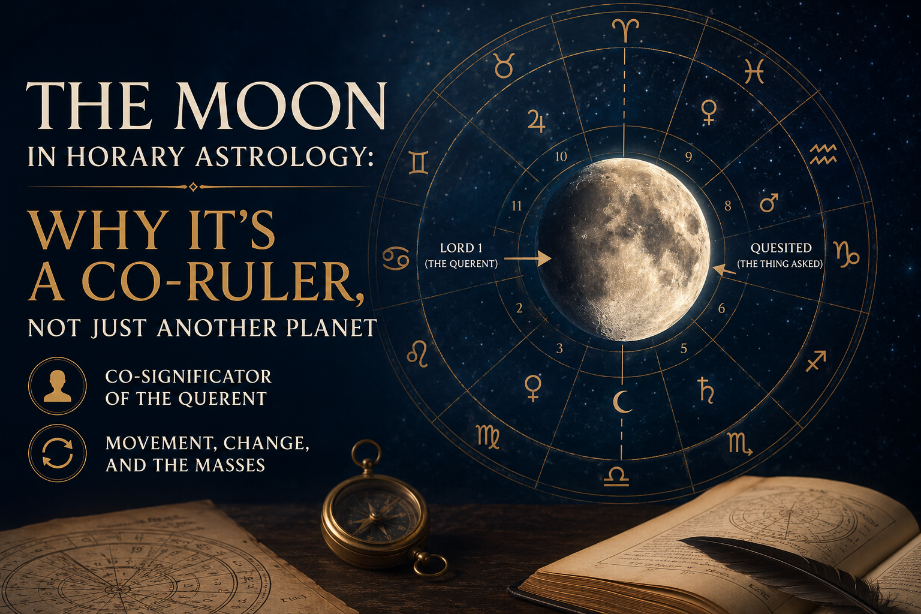
The Moon in Horary Astrology: Why It's a Co-Ruler, Not Just Another Planet
Most people learning horary astrology assume every planet follows the same rule. You find the house it rules, you read its condition, you move on. That assumption works for six of the seven traditional planets. It does not work for the Moon.
The Moon is different. Not because it's mystical, and not because it deserves more reverence than Saturn or Mars. It's different because of a specific, testable rule: the Moon almost always represents the querent, whether or not it rules a single house in the chart.
Understand this one rule, and a whole category of horary confusion disappears.
The Querent Has Two Significators, Not One
In every horary chart, the person asking the question — the querent — is shown by the ruler of the 1st house. That's Lord 1. Most beginners stop there. But traditional horary gives the querent a second significator: the Moon.
This isn't a modern add-on or a personal preference. It's one of the oldest working parts of the method, and it exists because Lord 1 and the Moon don't do the same job. Lord 1 shows the querent's role in the situation — their circumstances, their position, what they're actually dealing with. The Moon shows something else: how the querent feels about it.
Think of it this way. Lord 1 is the querent as a character in the story. The Moon is the querent's pulse.
When the Moon Isn't Available
Here's where the rule gets specific, and where beginners go wrong. The Moon is only free to act as the querent's co-significator when it isn't already busy playing a different role.
If the Moon happens to rule the house that represents the very thing being asked about — the quesited — then the Moon belongs to the quesited, not to the querent.
Say someone asks, "Will I get this job?" If the 10th house cusp (the job) falls in Cancer, the Moon rules the 10th. In that chart, the Moon is not showing you the querent's feelings. It's showing you the job itself — how it's moving, what condition it's in, where it's heading. The querent, in this particular chart, only has Lord 1 to represent them. That's not a flaw in the chart. It's the chart telling you where the Moon's attention is already spoken for.
The principle is simple once you see it: whichever role the Moon takes on first, it keeps. The quesited always has first claim.
The Moon Never Shifts to Someone Else
There's a second place people get confused, and it involves third-party questions.
Suppose the question is, "Will my sister marry this man?" The sister gets her own house. Her potential husband gets his. But the Moon does not move over to represent the sister, and it does not move over to represent him either. The Moon stays with the querent — the person actually asking, standing in front of the chart, however uninvolved they may seem in the outcome.
This matters more than it looks like it does. Even when the querent has no real stake in how the situation resolves, the Moon still tells you where their attention is. It often reveals what part of the story the querent actually cares about, separate from what the chart is technically judging.
Ask yourself: why would a method built on precision still bother tracking the emotional undercurrent of someone who isn't even a direct party to the question? Because horary was never just measuring outcomes. It was built to describe a real person asking a real question, and the Moon is how the chart keeps that person in the room.
Reading the Moon's Aspects Correctly
When the Moon is free to act as co-significator, its aspects to the quesited's ruler matter — but not in the same way Lord 1's aspects matter.
An applying aspect from the Moon to the significator of the thing being asked about is a hopeful sign. In relationship questions especially, the Moon can show longing, hesitation, or hope that the querent hasn't put into words. It adds depth that Lord 1 alone won't give you.
But be careful not to overweight it. A strong applying aspect from Lord 1 to the quesited is always more convincing on its own than the same aspect from the Moon. The Moon's testimony supports a judgment. It rarely carries a judgment by itself.
If the Moon is applying favorably and the rest of the chart agrees — especially if the Moon is well-dignified or making a genuinely close contact — take it as real, supporting evidence. If the Moon is the only thing pointing toward yes and everything else is silent or against it, that's the moment to look again rather than commit to an answer.
Why the Moon Also Rules Change Itself
There's a second layer to the Moon worth understanding, separate from its role as co-significator. The Moon moves faster than any other body in the chart, and in horary, that speed is meaningful. The Moon is naturally cold, moist, feminine, and changeable by temperament — it doesn't hold one shape the way Saturn or the Sun does. That's exactly why it governs anything connected to shifting, flowing, or unfolding: the passage of time within the question itself, the public at large, and any situation defined by movement rather than fixed structure.
This is also where the Moon's natural rulerships show up — the professions and people it signifies by its own nature, separate from whichever house it happens to rule in a given chart. Caretakers, nurses, and midwives. Sailors and anyone whose work involves water. Travelers, messengers, and people whose work has them constantly on the move rather than settled in one place.
When the Moon is dignified, this shows as gentleness, adaptability, and a kind of easy curiosity — someone open to new experience without being anchored by fear. When it's poorly placed, the same changeability turns into restlessness: never settling, never following through, drifting from one thing to the next without direction.
None of this replaces the Moon's role as co-significator of the querent. It sits alongside it. In a chart, always ask first whether the Moon belongs to the querent or the quesited. Once that's settled, its natural character can still add color to whatever it's already representing.
A Practical Way to Train This
The fastest way to make this rule automatic is to stop treating the Moon as background noise and start asking, in every chart you look at, three questions in order:
- Does the Moon rule the quesited? If yes, it belongs there, and the querent works with Lord 1 alone.
- If the Moon is free, what house is it in, and what sign?
- What is it applying to — and is that aspect supported by the rest of the chart, or standing alone?
Do this consistently, and you'll start to notice something practitioners who skip this step never catch: the Moon frequently shows you where the querent's heart actually is, even in charts where they never say it out loud. That's not a small thing to be able to read. It's often the difference between answering the question that was asked and understanding the person who asked it.
No comments yet.