Table of Contents
- Introduction
- What Each System Actually Is
- Where Each One Comes From
- The Core Mechanism: How Each One Actually Works
- Judge, Witnesses, and Significators: Reading the Actual Chart
- Complexity, Tools, and the Learning Curve
- The Mindset Both Systems Actually Demand
- Which One Should You Actually Try First?
- Try It Yourself
- FAQ
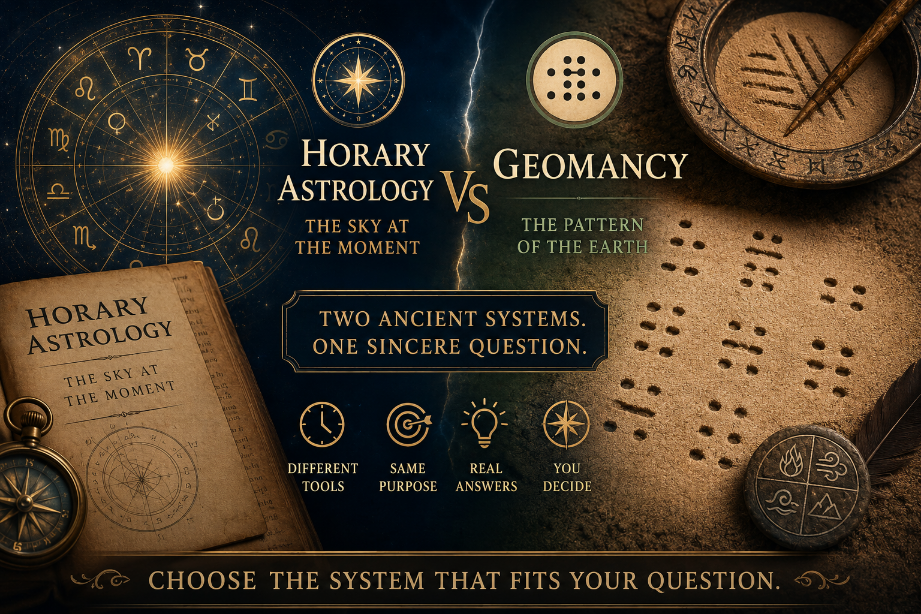
Horary Astrology vs. Geomancy: Which Divination System Actually Fits Your Question?
Many people believe that if you want a real, structured answer to a real question, astrology is the only serious option. Most assume that the alternatives — the simpler systems, the ones that don't need a birth time or an ephemeris — must be lesser somehow. Toys, almost, next to the sky.
But that's simply not true.
There are two systems in the Western esoteric tradition built for exactly the same purpose: answering one sincere question, asked at one moment, with a structured method rather than a vague impression. One reads the sky. The other reads sixteen patterns of dots. Both were practiced for centuries by serious people — physicians, scholars, tradesmen — who needed real answers, not comfort. Both are still free to try today.
This article puts horary astrology and geomancy side by side, so you can understand not just what each one is, but which one actually fits the question sitting in front of you right now.
What Each System Actually Is
Let's start with the foundation, because the two systems are solving the same problem from two different directions.
Horary astrology is the practice of casting an astrological chart for the exact moment a genuine question is asked and understood — not for a birth, but for the birth of the question itself. The word horary comes from the Latin hora, "hour." It is, at its root, the astrology of the moment. The planets, the houses, and the aspects between them at that precise instant become the raw material of the answer. I've covered the full mechanics of how this works in my complete guide to horary astrology.
Geomancy answers the same kind of question through an entirely different mechanism. Instead of the sky, it reads sixteen fixed symbols — called figures — built from random marks and arranged into a chart. The word comes from the Greek geo, "earth," and manteia, "divination": earth-divination, or divination through pattern rather than position. Its older name, inherited from the Arab diviners who developed it, is more direct still — Ilm al-Raml, the Science of the Sand. If the concept is new to you, my introduction to geomancy walks through the full method from the ground up.
Notice what both definitions share. Neither one is about you, in the way a birth chart or a natal reading is about you. Both are about the moment. Horary reads the moment through the heavens. Geomancy reads it through chance, dots, and the four elements. Different instruments, same intention: to catch a true answer at the instant a real question comes into being.
Where Each One Comes From
Both systems are old enough that "is this real?" is a fair question to ask before trusting either one. The history is worth knowing, because it explains why each system is built the way it is.
Horary is one of the oldest branches of Western astrology, used for centuries by scholars and physicians for practical work: locating lost property, judging legal disputes, advising on medical treatment. The 10th-century Persian polymath Al-Biruni worked for years as a court astrologer and wrote a detailed instructional text on the subject, treating it with the same rigor he brought to mathematics. The most complete horary text, though, belongs to the 17th-century English astrologer William Lilly, whose 1647 book Christian Astrology remains one of the most thorough casebooks ever written on the subject — detailed enough that students still study it directly, nearly four centuries later. I walked through one of his documented cases in full detail in my article on whether horary astrology is accurate.
Geomancy's roots run in a parallel line. Developed by Arab diviners and carried into medieval and Renaissance Europe, it became one of the two major divination systems built on genuine occult philosophy — astrology being the other — complete with its own traditions of meditation and ritual magic, rather than being treated as a parlor trick. The Renaissance geomancer Christopher Cattan documented just how far into ordinary life the practice reached: in his account, working women in Bologna cast geomantic charts with nothing more than a handful of dried beans, counted for odd or even. That detail matters. This wasn't an art locked away in scholars' towers. It was practical enough for the street, and structured enough to still produce a coherent answer.
The lesson from both histories is the same. Neither system survives because of mystique. Both survive because generations of careful practitioners wrote down their methods, tested them against real outcomes, and passed forward something that held up.
The Core Mechanism: How Each One Actually Works
This is where the two systems genuinely diverge, and understanding the difference will tell you almost everything else you need to know.
Horary works through symbolic representation. Every question involves at least two things — the person asking, and the thing being asked about — and each gets assigned a planet through the house system. If the querent's planet moves toward a harmonious connection with the planet representing the job, the relationship, or the missing object, that's read as a "yes" taking shape. If the planets are separating or clashing, that's a "no." The underlying philosophy holds that a chart cast for a moment shares a genuine symbolic relationship with everything else happening at that moment — the same idea Carl Jung later described, in different language, as synchronicity.
Geomancy works through pattern and chance. You generate sixteen lines of random marks, made without counting or conscious control. Each line resolves to a single dot (active, manifest) or a double dot (passive, latent), based on nothing more than whether the count came out odd or even. Four lines stacked together form a figure — one of sixteen possible combinations. From an initial four "Mother" figures, a fixed process of addition builds twelve more, filling the chart and ultimately producing a Judge: the figure that holds the final answer.
The philosophy behind geomancy runs a little deeper than most people expect. The old magical tradition held that all living things are built from three aspects — anima (soul), spiritus (life), and corpus (body) — and that the Earth itself shares this structure. Alongside the corpus mundi, the physical world we sense directly, tradition places the anima mundi: the soul of the world, its consciousness and innate intelligence. In this view, the patterns geomancers read first take shape as rhythms within the anima mundi's interaction of the four elements — Earth, Water, Fire, and Air — before echoing outward into the visible world. A geomantic chart, in other words, is thought to catch a pattern just before it fully arrives, the way an attentive reader senses an ending taking shape a few pages before it's written.
You don't need to resolve either philosophy to use either system. But it's worth knowing both are there, because it's the reason neither method is actually arbitrary. Horary treats the sky and the situation as connected. Geomancy treats the dots and the situation as never separate to begin with.
Judge, Witnesses, and Significators: Reading the Actual Chart
Both systems distill a full chart down to a small, decisive core — and the structures are strikingly parallel, even though they're built from completely different material.
In horary, the querent is placed in the First House, and the thing asked about gets its own house, based on the nature of the question. The planet ruling the querent's house and the planet ruling the quesited's house become the significators. Watching how those two planets move toward or away from each other — by what aspect, and whether anything else intervenes — is the heart of the judgment. Both systems share the same twelve-house architecture, and my guide to the twelve houses walks through what every house governs.
Geomancy's version of this is the relationship between the Witnesses and the Judge. The Right Witness reflects the querent's own position: their mindset, their part in the matter, the energy they bring to it. The Left Witness reflects what's moving toward the querent from outside — the other party, the circumstances, the direction things are already heading. The Judge, produced by combining the two Witnesses, distills all of it into the chart's final answer.
Here's a real example of how that plays out. In one geomantic reading, a querent had lost the lease on a small retail shop but was offered a different unit by the same landlord, and wanted to know whether relocating was worthwhile. The chart showed Cauda Draconis as the Right Witness — an unfavorable figure of endings and unavoidable loss, clearly reflecting the closed shop — with Laetitia, a favorable figure of hope and opportunity, as the Left Witness. The Judge was Conjunctio, a neutral figure representing the joining of circumstances, capable of resolving either well or badly depending on what it's built from. With one difficult Witness and one favorable one, the reading pointed toward a constructive resolution: accept the loss, but take the new offer seriously, because it carried real potential for greater long-term success.
Compare that to a horary chart, where the same kind of layered reasoning shows up differently. In William Lilly's 1634 case, a tradesman asked whether he would grow rich, by what means, when, and whether it would last — four separate, precise questions from one chart. Lilly didn't answer with an impression. He weighed each planet's essential dignity (its strength by sign and position alone) against its accidental dignity (its strength in this specific chart, right now), tallied fortitudes against debilities for all seven traditional planets, and built his judgment from what remained. He found Mars — ruler of both the second house of wealth and the seventh house of marriage — strong enough to name a specific condition: the tradesman needed to marry to prosper fully. He measured the exact degree-distance between the Ascendant and Mars, and converted it directly into a timeframe: roughly two years for a first improvement, and specifically 1640 — six years out — for substantial, lasting trade. The tradesman later confirmed both the marriage and the trade, in Lilly's own recorded words.
Notice what both examples have in common, despite their completely different symbolic languages. Neither reading is vague. Both name a specific direction, weigh conflicting evidence honestly, and arrive at a real conclusion rather than a comfortable one.
Complexity, Tools, and the Learning Curve
This is usually where the practical differences become obvious, and it's worth being direct about them.
Horary demands real technical scaffolding before you can even cast a chart. You need accurate timing — the exact moment you understood the question, at your own location, since a few minutes' error can shift the Ascendant and change which planet represents the querent entirely. You need a working knowledge of the twelve houses, the seven traditional planets, and the system of essential and accidental dignity that measures how strong each planet actually is. Most people use a chart calculator to handle the astronomical calculation, then apply the traditional rules by hand or with guided interpretation.
Geomancy asks for almost none of that. A chart takes a few minutes to cast. It can be done on a napkin, or a square foot of bare soil, using nothing more complicated than the ability to count and tell odd numbers from even ones. Working out the sums 1+1, 1+2, and 2+2 is, quite literally, all the mathematics the method requires. Renaissance geomancers used dice on a spindle, dried beans counted by the handful, ordinary playing cards, or sand and a stick — the tool never mattered, because the arithmetic underneath stayed exactly the same.
A simple way to hold the contrast in your head: horary is a portrait built from real technical scaffolding — precise timing, a working knowledge of the heavens, dignity tables to weigh. Geomancy is a quick, honest sketch — smaller in its toolkit, built from nothing but chance and arithmetic, but no less capable of saying something true. Neither is "better" in the abstract. They're built for different kinds of readiness.
| Horary Astrology | Geomancy | |
|---|---|---|
| Reads | The sky at the moment a question is understood | Sixteen figures generated from random marks |
| Core symbols | 7 traditional planets, 12 houses, aspects | 16 figures, 4 elements, 16 houses |
| Tools needed | Accurate time, place, and a chart calculator | Pen and paper, or a stick and bare earth |
| Learning curve | Steeper — dignity, houses, and aspect theory | Gentler — odd/even arithmetic and figure meanings |
| Time to cast | Instant, once the moment is fixed | A few minutes |
| Core answer structure | Significators moving toward or away from each other | Right Witness, Left Witness, and the Judge |
| Philosophical root | The moment mirrors the situation (a form of synchronicity) | The anima mundi, or soul of the world, speaking through pattern |
| Historical source | Hellenistic and medieval astrology; William Lilly, 1647 | Arab Ilm al-Raml; Renaissance Europe; Christopher Cattan |
The Mindset Both Systems Actually Demand
Here's something that rarely gets said clearly enough: the technical differences matter less than most beginners assume. What actually determines whether either system produces a real answer is the discipline you bring to it — and on this point, horary and geomancy ask for almost exactly the same thing.
Both traditions insist on a genuine, sincere question. A chart cast out of idle curiosity, just to test the method, doesn't hold together the way one born of real concern does — this is stated plainly in both traditions, not as superstition, but as an observed pattern. Both insist on separating the real question from the story wrapped around it, since a foggy question produces a foggy chart no matter how carefully the technical work is done afterward. Both warn against reaching for every available technique at once — Lilly himself advised sticking to the basics, and the old geomancers built their sixteen-figure system specifically to stay simple rather than sprawling. And both are honest that mistakes are part of learning: the goal in either practice isn't never being wrong, it's getting a little sharper with each attempt.
There's one meaningful difference worth naming inside that shared mindset. Geomancy asks you to let the dots fall honestly — the moment you start managing the count, you're answering the question yourself rather than letting the figures answer it. Horary asks for something closer to precision under pressure — get the timing right, weigh the dignities honestly, and don't let common sense get overridden by a technically "correct" reading that obviously contradicts the facts of the situation. One method protects its honesty through randomness. The other protects it through rigor. Both are protecting the same thing.
Which One Should You Actually Try First?
If you've read this far, you probably already have a sense of which system fits the question sitting with you right now. But here's a direct way to think about it.
Reach for geomancy first if:
- You want an answer today, with no setup, no calculator, and no prior study
- Your question is straightforward and you want a fast, honest read on it
- You're new to divination generally and want the gentlest possible entry point
Reach for horary first if:
- Your question is complex, layered, or has several parts you want addressed separately — the way Lilly's tradesman asked about condition, method, timing, and durability all at once
- You want a specific, dated timeframe rather than a general direction
- You're drawn to astrology already and want a way into it that doesn't require your birth chart
Neither answer is a lifetime commitment. Many serious students of the esoteric arts eventually study both, precisely because they illuminate the same kind of question from two different angles — and a question that feels murky in one system sometimes becomes obvious in the other.
Try It Yourself
Here's the beauty of both systems: neither one asks you to believe anything before you start. They ask you to bring a real question, and to check the answer honestly against what actually happens.
Think of something you're genuinely unsure about — not a hypothetical, not a test of the method, but something that actually matters to you. Then try it both ways. Cast a horary chart for the moment you ask. Draw a geomantic figure for the same question. See where they agree, and where they diverge, and what each one notices that the other doesn't.
You don't need years of study to start. You need one honest question, and the willingness to let either system — the sky, or the dots — actually answer it.
Frequently Asked Questions
Is geomancy just a simpler version of horary astrology?
Not exactly. Geomancy is simpler to learn and cast, but it isn't a lesser version of horary — it's a complete, independent system with its own philosophy, its own historical depth, and its own methods of magic and meditation. Simplicity of tools isn't the same as simplicity of meaning.
Can horary and geomancy give different answers to the same question?
Yes, and that's not a flaw in either system. They read the moment through entirely different symbolic languages — planetary motion versus elemental pattern — so it's genuinely useful to notice where they agree and where they don't, rather than expecting identical results.
Which system is more historically respected?
Both were taken seriously by genuine scholars for centuries. Astrology, including horary, tends to have a higher public profile today, but geomancy sat alongside it as one of the two major divination systems built on real Renaissance occult philosophy, not as a folk curiosity beneath it.
Do I need to believe in either system for it to work?
No, and both traditions say so directly. The consistent advice, in both horary and geomancy, is to test the method honestly rather than debate it first. Sincerity in the question matters. Belief going in does not.
Which one is better for beginners?
Geomancy has the gentler learning curve, since it requires no timing precision and only basic arithmetic. Horary has more technical layers up front, but it's still considered one of the more direct entry points into serious astrology, because it doesn't require a birth chart to begin.
No comments yet.