Table of Contents
- Introduction
- What Is Geomancy?
- What Does "Geomancy" Actually Mean?
- Geomancy vs. Astrology and Other Divination Systems
- Is Geomancy Real? A Word on Its History
- The Core Idea Behind How Geomancy Works
- The Mindset Geomancy Asks You to Bring
- What Can You Actually Ask a Geomantic Chart?
- The Foundation Every Geomantic Chart Is Built On • The Real Question · The Judge and the Witnesses
- Where Geomancy Fits in Your Learning
- FAQ
- Glossary
- Where to Go From Here
What Is Geomancy? The Complete Guide to Reading a Chart Cast from Sixteen Figures
Many people believe divination requires expensive tools, years of formal training, or some kind of natural gift you either have or don't. Most assume that without a deck of cards, a set of runes, or a birth chart calculated to the minute, there's nothing honest a diviner can tell you.
But that's simply not true.
There is a divination system old enough to predate the printing press that asks for none of that. No deck. No birth data. No special talent. You need a question, a way to make marks, and a willingness to let chance do what chance does. From sixteen simple patterns of dots, an entire answer takes shape.
That system is called geomancy, and understanding what it actually is may be the fastest way you'll ever find to get a clear, structured answer to something that's been sitting on your mind.
What Is Geomancy?
Geomancy is a divination system that reads the meaning of a question through sixteen fixed symbols — called figures — generated at random and then arranged into a chart. Each figure is built from four lines of one or two dots, and each of those sixteen combinations carries its own fixed meaning, built from centuries of accumulated tradition.
Think of it as divination stripped down to its essentials. Astrology needs the sky. Tarot needs seventy-eight illustrated cards. Geomancy needs almost nothing. A stick and a patch of sand will do. So will a pen and a napkin. The old geomancers of the Middle Ages and Renaissance treated this simplicity as a strength, not a limitation — a system anyone who can count, and tell odd numbers from even ones, can learn to cast correctly.
This is part of why geomancy is such a natural starting point for someone new to divination. It teaches the core mechanics — figures, houses, elements, and judgment — without requiring you to first master an entirely separate symbolic language. And it's immediately usable. You can cast a real chart and reach a real conclusion on your first attempt. If you have a question sitting with you right now, you can try it yourself on my free geomancy chart tool.
What Does "Geomancy" Actually Mean?
To understand geomancy, start with the word itself. It comes from the Greek geo, meaning "earth," and manteia, meaning "divination." So geomancy, at its root, simply means earth-divination — reading meaning through the patterns of the ground itself.
That name isn't decorative. The practice's original name in Arabic, where it took shape long before it reached Europe, was Ilm al-Raml — "the Science of the Sand." Diviners would draw random lines directly in sand or soil, count the dots in each line, and build a figure from the result. The Renaissance magicians who later brought geomancy into European occult philosophy kept the same spirit, even after paper and ink replaced sand and stick.
This surprises people the first time they hear it, because the natural assumption is that a system called "earth-divination" must somehow be about property, land, or physical location. It isn't. The earth in geomancy isn't the subject of the question — it's the medium through which the answer arrives. The dots you draw, at random, in earth or on paper, become a message from what old philosophers called the anima mundi: the soul, or consciousness, of the living world itself.
That shift in understanding — from "this is about dirt" to "this is about the world's own intelligence speaking through pattern" — is really the foundation the rest of geomancy is built on.
Geomancy vs. Astrology and Other Divination Systems
This is usually the next question people ask, and it deserves a straightforward answer.
Astrology maps the sky at a precise moment and reads meaning from the positions and relationships of planets. It's a rich, deeply layered system, but it demands real technical overhead — you need accurate timing, a working knowledge of houses and aspects, and often software or an ephemeris just to build the chart in the first place. I've written about how that works in detail in my guide to what horary astrology actually is, and the contrast with geomancy is worth understanding directly.
Geomancy asks for none of that setup. A chart takes a few minutes to cast, requires no instruments beyond a way to make marks, and rests on nothing more complicated than the arithmetic of odd and even. Where astrology is a portrait built from a great deal of technical scaffolding, geomancy is more like a quick, honest sketch — smaller in its toolkit, but no less capable of saying something true.
Compared to other divination methods, geomancy holds up just as well. Tarot leans on seventy-eight cards worth of visual symbolism that takes real time to internalize. Palmistry and its relatives can usually only address a narrow set of questions about character and general destiny. Geomancy, by contrast, is a complete system — divination, a body of interpretive tradition, and even its own practices of meditation and magical timing — built around a single, elegant idea: that the interplay of four elements can describe the state of anything.
A simple way to hold this in your head: astrology is a chart of the heavens. Tarot is a chart of archetypes. Geomancy is a chart of the elements themselves — fire, air, water, and earth, arranged into sixteen possible states, one of which is always the answer to your question.
Is Geomancy Real? A Word on Its History
It's fair to wonder whether this is an old label recently reattached to something modern, or a practice with genuine roots. It's the latter, and the history matters — not as trivia, but because it explains why geomancy is built the way it is.
Geomancy is one of the older divination systems in continuous use, developed by Arab diviners and later carried into medieval and Renaissance Europe, where it became one of the primary tools of working diviners — used for questions about lost property, business ventures, health, travel, and relationships. This was not a fringe curiosity. It stood alongside astrology as one of the two major systems built on real occult philosophy, complete with its own traditions of ritual and meditation, rather than being treated as a parlor amusement.
The Renaissance geomancer Christopher Cattan is one of the more colorful sources on how widely the practice spread through ordinary life — he documented, among other things, how casually geomancy was cast by everyday people in his era, using nothing more than a handful of dried beans counted for odd or even. That detail is worth sitting with: this wasn't an art reserved for scholars in towers. It was practical enough to be used on the street, and structured enough to still produce a coherent answer.
That's really the point worth remembering: geomancy wasn't invented by people hoping something might work. It was refined over centuries by people who wrote down the meanings of each figure, tested those meanings against real questions, and passed a working method forward — the same kind of accumulated, checked knowledge that underlies any discipline that survives this long.
The Core Idea Behind How Geomancy Works
Geomancy isn't a machine that spits out an automatic yes or no from a random number generator. It's closer to a craft — a disciplined method for drawing meaning out of chance.
Here's the basic mechanism. You generate sixteen lines of random marks — dots made without counting, without conscious pattern. Each line is naturally odd or even, and that single fact becomes either one dot (active, manifest) or two dots (passive, latent). Four lines stacked together form a figure. From your original sixteen lines, four "Mother" figures emerge, and through a fixed, mechanical process of addition, twelve more figures are derived from them — filling every house of the chart, and ultimately producing a Judge: the figure that holds your final answer.
Why should marks made at random reflect something true about your situation? This is where the deeper philosophy of geomancy comes in — the idea that nature is not a passive backdrop, but an active, thinking presence: the anima mundi, the soul of the world. In this view, the patterns of the four elements — fire, air, water, and earth — first take shape in the world's own consciousness before echoing outward into visible events. A geomantic chart is thought to catch one of those patterns before it fully arrives, the same way a skilled reader might notice a story's ending taking shape a few pages before it's written.
You don't have to resolve that philosophical question to use geomancy. But it's worth knowing it's there, because it's the reason the random marks aren't actually arbitrary. The chart isn't guessing at your situation. It's reading a pattern that, in the old philosophy at least, was never separate from your situation to begin with.
The Mindset Geomancy Asks You to Bring
Before the technical side of geomancy — the figures, the houses, the rules of judgment — it helps to understand the mindset the practice actually asks of you. This shows up consistently across how geomancy has been taught for centuries, and it says a lot about why the method works the way it does.
- Keep the setup simple. You don't need elaborate tools to get a real answer. A pen and paper, or a stick and a patch of earth, is the entire traditional kit. Complexity in the tools adds nothing to the accuracy of the reading.
- Settle yourself before you settle the chart. Geomancy works best when approached with a calm, undisturbed mind. If you're gripped by anger or agitation, the old advice is to wait. The state of your inner world matters more here than the state of the room around you.
- Mind the weather, not the clock. Nearly any time is a good time to cast a chart — geomancy doesn't require the precise timing astrology does. The one traditional exception is a serious storm, especially one with thunder and lightning, which is thought to reflect real unrest in the anima mundi itself.
- Let the dots fall where they fall. The lines that build each figure must be made without counting or deliberate control. The moment you start managing the outcome, you're no longer asking a real question — you're answering it yourself before the chart gets the chance to.
- Trust the Judge, then go deeper. Even a beginner can get a genuinely useful answer just from the Judge and the two Witnesses. The rest of the chart — the twelve remaining houses — rewards patience, but it isn't required to start.
That combination — simplicity, calm, and a willingness to let chance actually be chance — is what separates a real geomantic reading from marks made just to look mystical.
What Can You Actually Ask a Geomantic Chart?
One of the most common misconceptions is that geomancy exists to answer only big, dramatic life questions — marriage, fortune, fate. It doesn't. Geomancy handles the small and the large with the same seriousness.
You could ask about the future: Should I take this job? Will this partnership move forward? You could ask about right now: Is this the right time to make my move? You could ask about a decision already partly made: Should I relocate the business, or start something new entirely? All of these are legitimate geomantic questions, because they share the one thing geomancy actually requires — genuine, sincere concern from the person asking.
Scale doesn't matter here. A question about whether to accept a modest job offer is just as valid as a question about a major business decision, provided the person asking actually cares about the answer. What matters isn't how significant the question sounds from the outside. It's whether the concern behind it is real.
This is also where the discipline of the practice shows itself: a chart cast out of idle curiosity, just to test the method, doesn't carry the same weight as one cast from real need. The old geomancers were clear that a calm mind and a genuine question go together — one without the other tends to produce a muddled reading, not a clear one.
The Foundation Every Geomantic Chart Is Built On
Once a real question exists, everything that follows depends on two things being handled correctly: how the original sixteen lines are generated, and how carefully the resulting figures are read. Rush either step, and the chart built on top of them will be unreliable.
The lines come first. Using whatever tool you prefer — pen strokes, marks in sand, a spindle of dice, even a shuffled deck of ordinary playing cards — you produce sixteen lines of random marks, without counting as you go. Each line resolves to a single dot or a double dot, purely based on whether the marks came out odd or even. From these, four Mother figures take shape, and a fixed method of combination builds the remaining twelve.
The chart that results places all sixteen figures into their houses, each one carrying its own area of life — the self, resources, communication, home, and on through the full set, exactly the way each house in an astrological chart governs its own territory. If you want to understand how that house system works in detail, my guide to the twelve houses walks through every house and what it governs. Two of the sixteen positions matter more than the rest at the beginning: the Witnesses, and the Judge.
There's a reason precision matters here, even in a system this simple. Generate the lines carelessly — deliberately steering an odd count toward even, for instance — and you haven't cast a chart. You've written yourself an answer and dressed it up as a divination. This is geomancy's own built-in accuracy check: let the marks fall honestly, and the figures that result tend to describe your real situation with striking specificity, even to a first-time reader.
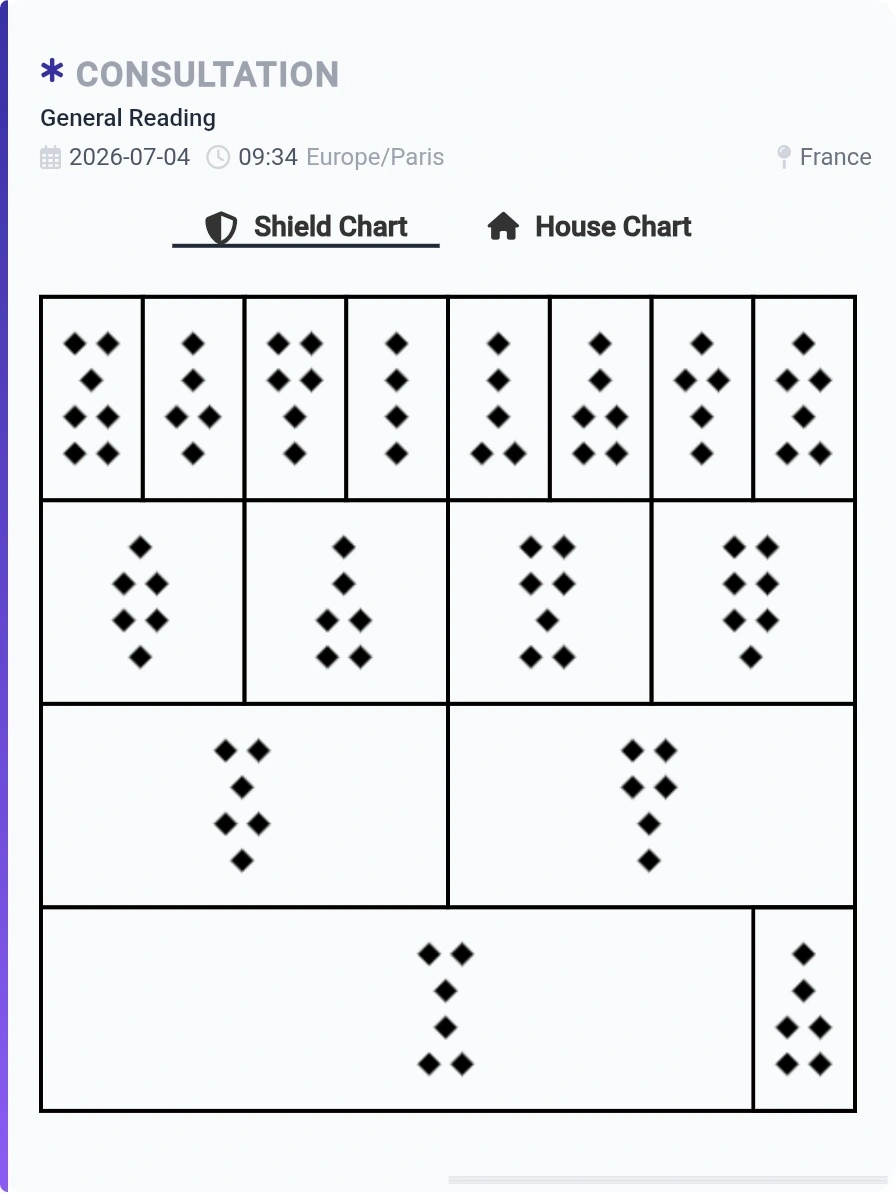
A geomantic chart, showing the four Mother figures generating the full set of sixteen positions, including the Right and Left Witnesses and the Judge.
The Real Question
People rarely arrive with a perfectly clean question. What actually shows up is usually a story — some of it relevant, much of it emotional noise, some details that don't affect the reading at all. Part of a geomancer's job, before a single line is drawn, is separating the real question from everything wrapped around it.
Equally important is being honest about what you're actually asking. "Should I take the new shop the landlord offered?" is a real, specific question. "What's going to happen to me?" is not — it's too broad for any figure to answer cleanly. The old masters were consistent on this point: a foggy question produces a foggy chart, no matter how carefully the lines are drawn afterward.
This is also where sincerity is tested. A question invented purely to try out the system, without any real stake behind it, rarely produces a reading that holds together the way a genuine question does. The figures, in other words, seem to know the difference between a real concern and a manufactured one.
The Judge and the Witnesses
There's one more principle that has to be understood before a chart can be read correctly, and beginners often skip past it in their hurry to get an answer: the relationship between the Witnesses and the Judge.
The Right Witness reflects the querent's own position — their mindset, their part in the situation, the energy they're bringing to it. The Left Witness reflects what's moving toward the querent from outside — the circumstances, the other party, the direction events are already heading. The Judge, the figure these two combine to produce, distills all of that into the chart's final answer.
Consider the same figure showing up as the Judge in two different contexts. A neutral, balancing figure like Conjunctio, paired with one difficult Witness and one favorable one, tends to describe a genuine mixed situation — a real setback, but a workable path through it. The same figure paired with two unfavorable Witnesses tells a very different story. Same Judge. Completely different reading, because the Witnesses set the terms the Judge has to answer within.
The same logic runs through the whole chart. A figure that looks purely fortunate in isolation can shift meaning entirely once you see what it's actually answering to. Skip this step, and even a technically correct figure can lead you to the wrong real-world conclusion — because you read the answer without first understanding the question it was actually responding to.
Where Geomancy Fits in Your Learning
If any of this resonates — if you've had a real question sitting with you, the kind you'd like a clear answer to rather than a vague impression — geomancy is very likely the most direct entry point into serious divination, not just a curiosity to sample once.
It doesn't ask you to first learn an entire symbolic deck or a technical system of planetary timing. It doesn't require special tools, rare materials, or years of preparation before your first real reading. It asks for one honest question and a willingness to learn a structured, logical method for reading what chance reveals. From there, the deeper layers — the full set of sixteen figures, the sixteen houses, the finer points of reading the chart beyond the Judge and Witnesses — build naturally, each one sharpening your ability to read what the figures are actually saying.
That's really the invitation geomancy makes: not "believe this works," but "try it honestly, and see what it shows you."
Frequently Asked Questions
Do I need special tools to practice geomancy?
No. This is one of geomancy's defining features. A pen and paper, or a stick and a patch of bare earth, is the entire traditional kit. Dice, cards, and sand boxes exist as conveniences, not requirements.
Do I need to believe in it for geomancy to work?
No. The traditional advice has always been to try it honestly rather than debate it first. Belief isn't the requirement — sincerity in the question and honesty in generating the lines are.
Is geomancy the same as astrology?
No, though the two share deep historical roots in the same body of Renaissance occult philosophy. Astrology reads the positions of planets at a precise moment. Geomancy reads sixteen figures built from random marks and their elemental combinations. Astrology needs technical timing; geomancy needs almost nothing but a genuine question. I've covered the distinction in more depth in my guide to horary astrology.
Can I ask a geomantic chart the same question twice?
Traditionally, no — at least not right away. A chart reflects the state of a question at the moment it's cast. Recasting immediately, hoping for a different answer, tends to muddy the reading rather than clarify it. If circumstances genuinely change, a new chart later can be appropriate.
What's the difference between the Judge and the Witnesses?
The Witnesses describe the two sides of the situation — the querent's position and what's coming toward them. The Judge, formed from the two Witnesses together, distills that relationship into the chart's final answer. Reading the Judge without the Witnesses is like reading a verdict without hearing the case.
Glossary of Key Terms
- Querent: The person asking the question, traditionally represented by the First House of the chart.
- Figure: One of sixteen fixed symbols in geomancy, each built from four lines of single or double dots.
- Mother Figures: The first four figures generated directly from the random lines, from which all others in the chart are derived.
- Judge: The fifteenth figure of the chart, formed from the Witnesses, giving the final answer to the question.
- Witnesses: The Right and Left figures that combine to form the Judge — representing the querent's position and the forces moving toward them.
- Anima Mundi: Latin for "soul of the world" — the living consciousness of the earth that, in traditional geomantic philosophy, gives rise to the patterns a chart reveals.
- Manifest / Latent: The active (single-dot) or passive (double-dot) state of an element within a figure's line.
Where to Go From Here
Geomancy is simple in its tools, disciplined in its method, and — once you understand its logic — genuinely accessible to anyone willing to try it honestly. It strips divination down to a real question, a set of random marks, and a structured way of reading what those marks reveal.
None of that requires belief up front. It only requires a real question and the patience to let the dots speak for themselves.
To unlock the meaning of all the sixteen geomancy figures check check this article The 16 Geomantic Figures: A Complete Guide to Every Figure's Meaning
So here's the natural next step: if you've been sitting with a question of your own, that's exactly where geomancy begins. Cast your free geomancy chart now. Draw the lines honestly. See what the figures show you.
If you want to understand the house system that underlies every geomantic chart — the same twelve houses that structure an astrological reading — my guide to the twelve houses is the natural next read. And if you're curious how this compares to the other major system built on the same philosophical foundation, my introduction to horary astrology walks through the parallels directly.
No comments yet.