Table of Contents
The Best Way to Learn Horary Astrology: Books, Courses, and Where to Start
Many people assume the only way to learn horary astrology is to buy every book William Lilly ever inspired, read them cover to cover, and hope the method eventually clicks. Some assume the opposite — that a single course, or a single book, will hand them mastery in a weekend.
Neither is true.
But there is a right order to learn this in, and getting that order wrong is the single biggest reason beginners give up before the method starts to make sense.
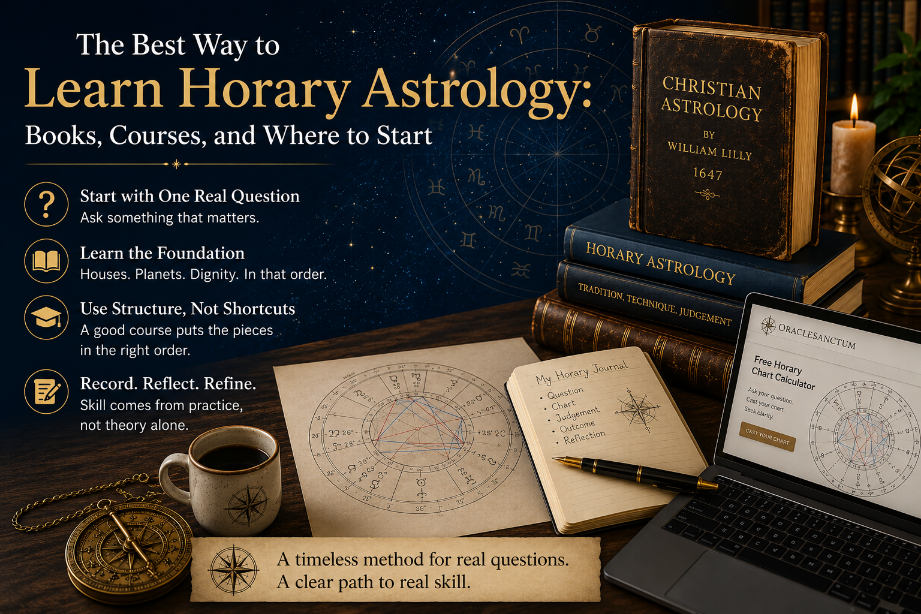
Start With One Real Question, Not a Reading List
Before you buy anything, ask yourself one real question — something you actually want an answer to. Not a test question. Not "let me see if this works." A genuine concern.
Then cast a free chart for it and read our complete guide to what horary astrology actually is. This isn't a stalling tactic before the "real" learning begins. It's the fastest way to find out whether the logic of the system makes sense to you at all, before you spend a dollar. Horary rewards people who learn by doing. Reading about a chart and reading an actual chart, cast for your own real concern, are two different experiences — and the second one is the one that decides whether you'll stick with this.
If that first chart leaves you curious rather than confused, you're ready for the next step.
Books: Where They Help, and Where They Fall Short
William Lilly's Christian Astrology (1647) is still, nearly four centuries later, the closest thing horary has to a foundational text. It rewards study. It also assumes a reader already has enough grounding to follow seventeenth-century structure and terminology — which is exactly where most beginners stall out.
This is not a reason to skip books. It's a reason to sequence them correctly. A book like Lilly's works best as a second or third resource, something you return to once you already know what a significator is, what essential dignity measures, and why the Moon gets special treatment in almost every judgement. Read it cold, with no foundation, and you'll spend more energy decoding the language than learning the method underneath it.
This matches something worth knowing before you buy: interest in horary books has actually been softening in recent search data, while interest in structured courses and chart tools has been climbing. That's not a coincidence. People are working out, on their own, that a guided path teaches the mechanics faster than an unguided one — and saving the primary texts for once the mechanics are already in place.
Courses: The Difference Between Structure and Shortcuts
A good horary course does one specific job that a book, on its own, usually can't: it puts the pieces in the right order and tells you which ones matter first.
That's the actual value of structure — not that it's faster, but that it stops you from trying to learn essential dignity, reception, and timing techniques all at once, in whatever order a search result happens to hand them to you. Houses first. Planets and their significations next. Essential dignity — how strong a planet actually is — after that. Only then does the rest of the system start to hold together on its own.
This is the exact order I built OracleSanctum's own horary academy around. Track 1 covers the foundation — the twelve houses, the seven traditional planets, the zodiac signs, and essential dignity — everything you need to cast and honestly judge your first real chart. Track 2 goes further: reception, aspects and timing, and full applied judgement across medical, financial, and specialty questions, releasing module by module as each one is finished properly rather than rushed to a deadline.
I'll be direct about why I built it this way. When I was learning, a serious course in this subject was priced like it assumed everyone learning astrology could treat several hundred dollars as ordinary money. Where I'm from, that price tag isn't a stretch — it's simply out of reach for most people, no matter how genuine the interest. That gap is why Track 1 exists at the price it does. The goal was never to make learning horary cheap. It was to make it possible for people who'd otherwise be shut out of it entirely.
What a Structured Course Should Actually Teach You
The technique itself doesn't stop at "will this happen, yes or no." Once you understand significators, dignity, and timing, the same method extends into real decisions:
- Everyday questions. Should I take this job? Will this move go well? Is this the right time to commit to something? These are the questions horary was built to answer, and they remain its most direct use.
- Financial and market questions. Traditional horary has a documented history of being applied to questions of profit, investment, and timing — treated as one input into a decision, alongside ordinary judgement, never as a replacement for it.
- Sport and event questions. There's a traditional method for judging the likely outcome of a contest from a chart cast at the right moment. It's taught as a technique within the tradition — a documented, historical way to test one's judgement against a verifiable outcome — not as encouragement to gamble.
A course that only teaches you to answer "will they call me back" is teaching you a party trick. A course that teaches you why the method works, house by house and dignity by dignity, teaches you something that generalizes to every question you'll ever ask a chart.
Where to Actually Start
If you've read this far, here's the practical sequence:
- Ask a real question. Cast it for free and see whether the logic clicks.
- Learn the foundation properly, in order, rather than piecing it together from scattered articles. Track 1 of the academy is built to do exactly this.
- Return to the primary texts once the foundation is in place. Lilly's Christian Astrology will make far more sense once you already know what a significator is.
- Keep a record of your own judgements. This is the step most people skip, and it's the one that actually builds skill. Horary is learned the way any craft is learned — by making a call, writing it down, and checking it against what actually happened.
None of this requires you to believe anything on faith. It only asks for a genuine question and a willingness to learn the method properly, in the order it was meant to be learned.
Start with the question that's actually been on your mind. Cast it now, and see what the chart shows you.
No comments yet.