Table of Contents
- Introduction
- What Is Horary Astrology?
- Meaning
- History
- How It Works • Mindsets
- Horary Chart • Time & Place
- Core Principles • Real Question · No Repeats · Default
- Fundamental Rules • Houses · Planets · Signs · Essential · Accidental
- Practical Application
- Case Study
- Common Mistakes
- FAQ
- Glossary
- Summary
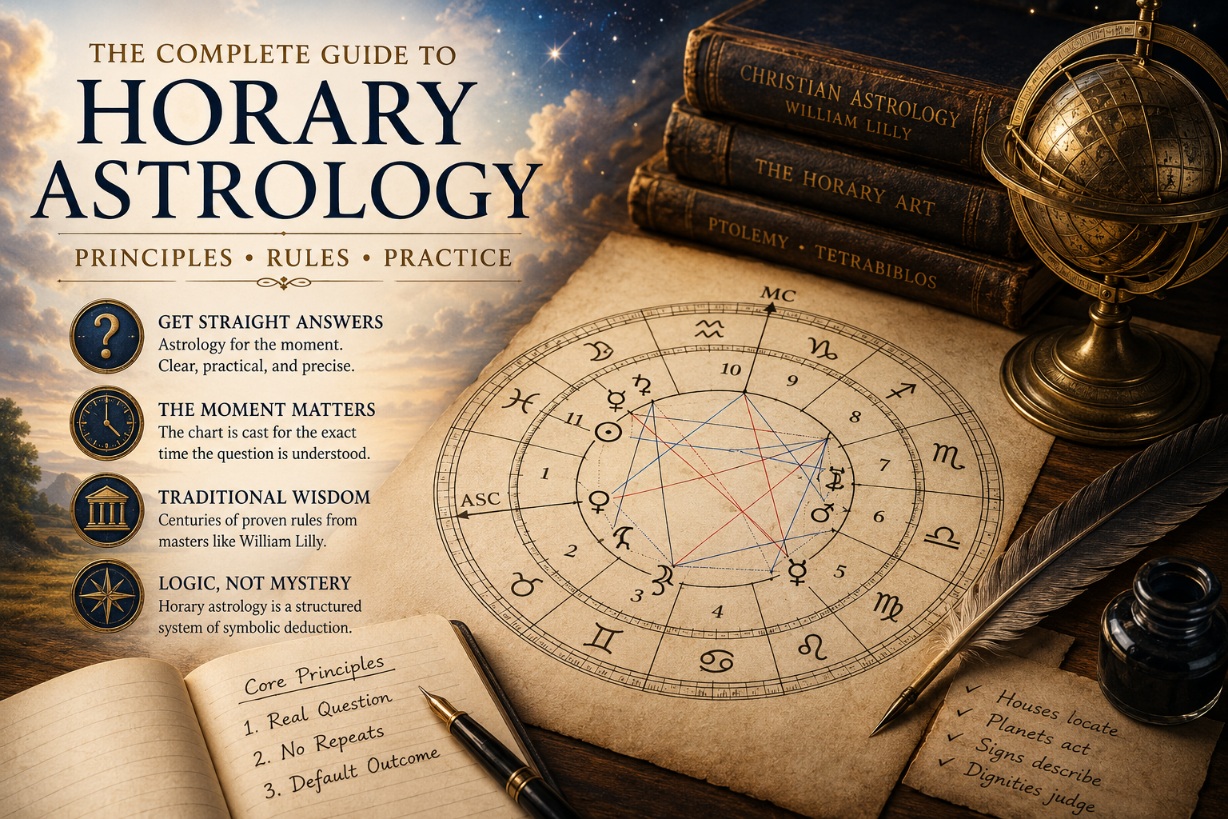
The Complete Guide to Horary Astrology: Principles, Rules, and Practice
Many people believe that astrology is only about predicting the distant future or exploring complex personality traits. Most assume you need an exact time of birth, pages of psychological data, and a deep belief in mysticism to get anything useful out of a reading.
But that is simply not true.
Astrology is also about understanding what is happening right now, or even what happened before. Have you ever had a burning question—a missing item, a career choice, a troubled relationship—and wished you could just get a straight, practical answer? That is the domain of horary astrology. It is quick, it is precise, and it works.
In this comprehensive guide, we will explore the foundational principles, the strict rules, and the practical application of traditional horary astrology. Whether you are a beginner or looking to refine your practice, this resource will walk you through the system step by step. For a more introductory approach, see our horary astrology beginners guide.
What Is Horary Astrology?
Horary astrology is the ancient art of getting straight answers to specific questions by casting an astrological chart for the exact moment the question is asked and understood.
Think of it as the "emergency room" of astrology. When someone walks in with an immediate, burning question—"Is my cat coming back?" or "Will this business deal go through?"—horary provides the answer without needing the person's time of birth or background. If you've ever wondered how to get clear answers without a birth time, horary is the solution.
Unlike natal astrology, which maps a person's entire life and character, horary is simple, specific, and without fluff. It focuses on a single, pressing issue and delivers a clear judgment.
What Does Horary Astrology Mean?
To understand the meaning of horary astrology, we must look at the word itself. "Horary" stems from the Latin word hora, meaning "hour." Therefore, horary astrology meaning translates to the astrology of the hour—or more accurately, the astrology of the moment.
When people search for the horary meaning in astrology, they are often surprised to learn that it is not about the querent (the person asking), but about the birth of the question itself. The moment a sincere question is comprehended by the astrologer, it becomes a living entity, and the chart cast for that exact time and place reflects the situation and its outcome.
Historical Background
While this guide focuses on the practical mechanics of horary, understanding its roots provides valuable context. Horary astrology is a traditional branch of the art, practiced for centuries by scholars, physicians, and advisors.
Historically, astrologers did not rely on psychological interpretation; they relied on strict, observable rules. Figures like the 17th-century English astrologer William Lilly utilized horary to find lost property, predict political outcomes, and advise on medical treatments. Lilly's masterwork, Christian Astrology (1647), remains one of the most authoritative sources on the subject. (Reference: Lilly, William. Christian Astrology. London, 1647. Available via public domain archives such as Archive.org).
These traditional scholars demonstrated that horary is not a modern invention of intuition, but a structured, logical system of symbolic deduction. Learn more about this approach in our article on the Renaissance learning method.
How Horary Astrology Works
Horary astrology is not a machine that dispenses automatic "yes" or "no" answers. It is a craft. It works by identifying the key players in a situation, finding their symbolic representatives (the planets) in the chart, and observing how those planets interact.
If the planet representing you is moving toward a harmonious connection with the planet representing the job you want, the answer is likely yes. If they are clashing, or moving away from each other, the answer is likely no. The system works because the chart is a mirror—not of the stars, but of the situation at hand.
The Core Mindsets for Sound Judgment
Before learning the technical rules, a student must adopt the right mindset:
- Stick to the basics: Avoid the urge to throw in every trick you know, like minor aspects or asteroids; that is just noise.
- There is always an answer: Do not give up early if the chart seems complex; the answer will reveal itself within the proper framework.
- Use common sense: The chart should make sense in real life; do not apply techniques blindly like a calculator.
- Talk to the querent: If the question is foggy or a context detail is missing, ask for clarification before casting.
- Accept human error: You will make mistakes, but you will learn more from missing the mark than from lucky hits.
What Is a Horary Chart?
When you practice this art, the first step is to cast a horary chart in astrology.
A horary chart is a circular map of the heavens divided into twelve segments called houses, with the twelve zodiac signs on the outer edge, and the planets moving through them. For a deeper dive, see our guide on understanding the 12 houses in horary astrology.
The Rule of Time and Place
The foundation of the work relies on casting the chart for the correct time and place. Get this wrong, and everything else you build on it will be wrong.
- The Time: The exact moment you, the astrologer, receive and comprehend the question. It is not when the querent thought of it or typed it. If you are reading an email, it is the moment you read and understand it.
- The Place: You cast the chart for your location—the astrologer's location—not the querent's, even if they are across the globe.
Core Principles of Judgment
To read a horary chart accurately, you must understand three foundational principles. These align with learning how to ask effective horary questions.
1. Identify the Real Question and the Real Querent
People do not always bring clean questions; they bring long stories and emotional noise. Your job is to cut straight to the point and find the actual issue.
You must also identify who is actually asking. The querent (the person asking) gets the First House. However, if someone is asking purely on behalf of a friend who cannot speak for themselves, the friend remains the querent. If they are simply asking about their friend, the friend is assigned a different house based on the relationship.
2. No Repeats
Can the same question be asked twice? No. Even if the words are the same, the moment cannot be repeated. A new chart means a new, slightly different question.
3. The Default Outcome
In every judgment, you must consider the baseline: what will happen if nothing interferes?.
If you ask "Will I get the job?" but haven't applied yet, the default is no job. The chart would need strong testimony to overcome that. If you have signed a contract and start next week, the default is yes, and the chart would need to show a major disruption to change that outcome. Fail to understand the default, and you will misread the chart.
Fundamental Rules: Houses, Planets, Signs, and Dignities
Horary astrology is built on a hierarchy of information. We start with the Houses to locate the matter, use the Planets as the actors, describe them with the Signs, and measure their power through Dignities. For those seeking simplicity, we recommend reading why simple methods work best in horary astrology.
I. The Twelve Houses
The chart is divided into twelve mundane houses, each containing specific areas of life. We use the traditional Regiomontanus house system. A crucial rule: if a planet is within about 5 degrees before a house cusp, and in the same sign as that cusp, we treat it as being in that next house.
Always distinguish what a thing is from what it does when assigning houses. A piano is a movable possession (2nd house), even if you use it for creative pleasure (5th house).
- 1st House: The Querent, their body (specifically the head), their identity, and their immediate environment.
- 2nd House: Movable possessions, money, bank accounts, self-worth, and things that sustain the body like food.
- 3rd House: Siblings, cousins, neighbors, routine daily journeys, elementary education, and short communications.
- 4th House: The father, parents, ancestry, immovable property (real estate, land), and buried or hidden things.
- 5th House: Pleasure, children, pregnancy (but not the act of childbirth), creative expression, and places of entertainment.
- 6th House: Illness, disease, hospitals, servants, employees, and small animals (smaller than a goat).
- 7th House: Partners (romantic and business), open enemies, the other party in a transaction, the general public, and "anyone else".
- 8th House: Death, the money or resources of other people (like a partner's wealth), and mental anguish. It does not rule sex.
- 9th House: Special or significant journeys, holidays, foreign countries, higher education, wisdom, religion, and learned professionals.
- 10th House: Career, public honor, status, authority figures (bosses, judges, kings), and traditionally the mother.
- 11th House: Wages (money from the 10th house job), favors from above, windfalls, hopes, and true friends.
- 12th House: Secret enemies, hidden matters, self-undoing, prisons, deep phobias, and large animals (horses, cows).
Turning the Chart: When asking about someone else's life (e.g., "How is my daughter's career?"), we use a technique called turning the chart. You locate the person (Daughter = 5th house), treat that house as house 1, and count forward. Her career is the 10th from the 5th, which lands on the radical 2nd house. Only turn the chart if the thing in question belongs to the person you are asking about.
II. The Planets as Actors
Planets in horary are actors playing roles; they are not personalities. A planet takes its primary meaning by the house it rules (accidental rulership). The planet that rules the sign on a house cusp represents that house.
We use only the seven traditional planets: Sun, Moon, Mercury, Venus, Mars, Jupiter, and Saturn. Outer planets (Uranus, Neptune, Pluto) do not rule signs and are ignored unless they sit directly on a relevant house cusp or tightly conjunct a main significator.
- The Moon's Special Role: The Moon is always a co-significator for the querent, representing their emotional and instinctual state. However, if the Moon rules the quesited (the thing asked about), it cannot represent the querent.
Planets also have Natural Rulerships (e.g., Mercury rules documents, Venus rules women, Moon rules lost items), which provide secondary clues if the chart emphasizes them.
III. The Signs as Adjectives
In horary, signs do not take action; they describe planets. They are the adjectives of the chart, revealing essential strength, attitude, and physical qualities.
- Elements: Fire (hot/dry, fast), Earth (cold/dry, physical, low down), Air (hot/moist, mental, high up), Water (cold/moist, emotional, near water).
- Modalities: Cardinal (fast, short-lived action), Fixed (slow, stable, chronic, resists change), Mutable (flexible, unstable, changing).
- Fertility: Water signs are Fertile (growth, yes to pregnancy); Gemini, Leo, Virgo are Barren (no growth).
- Duality: Gemini, Virgo, Sagittarius, Pisces are Double-Bodied (multiplicity, twins, transitions).
- Voice: Water signs are Mute (silent, hidden); Gemini, Virgo, Libra are Loud-voiced (speaking roles).
- Behavior: Air signs plus Virgo are Humane (reason, civility); Aries, Taurus, Leo, Sagittarius, Capricorn are Bestial (instinct, impulse). Leo and late Sagittarius are Feral (wild, unpredictable).
IV. Essential Dignities (Innate Strength)
An aspect gives the occasion for something to happen, but Essential Dignity shows if the planet has the power to act well. A dignified planet acts well; a debilitated planet acts badly.
- Rulership: The planet is in its own sign. It is like a king in his castle—strong, clear, and in total control.
- Exaltation: Like an honored guest. It signifies elevation or exaggeration—acting like the best version of itself, though it lacks true ownership.
- Triplicity: Comfort and moderate strength based on the element and whether it is a day or night chart.
- Terms (Bounds): Minor dignity. Like a non-commissioned officer—a small foothold of support.
- Face (Decan): The weakest dignity. Like standing on the porch before being thrown out—barely any footing.
- Peregrine: A planet with zero essential dignity and no debility. Like a homeless drifter—unanchored, unpredictable, and easily led into trouble.
- Detriment: The planet is in the sign opposite its rulership. It is in enemy territory, deeply weakened, uncomfortable, and struggling to act.
- Fall: The planet is opposite its exaltation. It represents a downfall, shame, or an exaggerated sense of badness—it feels worse than it really is.
Note on Contradictions: A planet can be both dignified (e.g., Triplicity) and debilitated (e.g., Fall) in the same sign. Do not cancel them out; read the nuance. It describes complexity, like enjoying a bad habit that is ultimately harming you.
V. Accidental Dignities (Strength from Circumstance)
If essential dignity is what a planet is, accidental dignity is how well it can act based on its environment.
- House Placement: Angular houses (1, 4, 7, 10) are strong. Cadent houses (3, 6, 9, 12) are generally weak, though 3 and 9 have more power. The 8th is weak despite being succedent.
- Motion: Retrograde motion is a serious affliction, acting against the natural course—unless the question is about returning (e.g., "Will I get my old job back?"). Station (pausing) is a moment of great weakness and vulnerability. Fast motion equals power.
- Sun Conditions: Combustion (within 8.5° of the Sun in the same sign) is a highly destructive affliction, meaning the planet cannot see or be seen. Cazimi (within 17.5 minutes of the Sun) is the absolute best state, like sitting beside the king. Under the Beams (within 17.5°) is a lesser weakness.
- Moon Conditions: A Void of Course Moon (making no perfecting aspects before leaving its sign) usually signals that nothing will happen. The Via Combusta (15° Libra to 15° Scorpio) indicates emotional turbulence.
- Relationships: Besiegement occurs when a planet is physically caught between two other planets. Between malefics is destructive; between benefics offers positive influence.
- The Nodes: The North Node strengthens or increases what it conjuncts. The South Node weakens or diminishes.
- Fixed Stars: Conjuncting Regulus brings success/power; Spica brings protection; Caput Algol brings loss of control and difficulty.
Practical Application
How does this look in practice? Consider a question about a lost item: "Where is my missing ring?"
You look at the significator of the missing item. If the planet is in a Bestial sign (like Leo), it points to outdoor spaces or near animals. If it is in an Earth sign, look low down, on the ground, or in a drawer. If it is in a Fixed sign, it hasn't gone far; if Cardinal, it is on the move.
Or consider a vocational choice: "Should I be an accountant or a farmer?"
Look at the 10th house (career). If its ruler is in an Air sign (logical, mental), it supports accountancy. If it is in an Earth sign (grounded, practical), it leans toward farming. By combining the rules logically, the chart provides practical guidance. For those seeking reliable tools, check out our review of the top 5 horary astrology tools for predictions.
Case Study: William Lilly and The Tradesman's Wealth
To understand how traditional horary logic is synthesized, let us examine a historical case from William Lilly's Christian Astrology.
The Question: In 1634, a tradesman asked: "If he should be rich, or subsist of himself without Marriage? By what means he should attain wealth? The time when?".
Step-by-Step Reasoning:
- General Subsistence: Lilly first checked the general disposition of the planets. He noted that the major planets were swift in motion and well posited, without violent aspects. Venus, the Lady of the Ascendant (representing the querent), was near the powerful fixed star Cor Leonis (Regulus). The Moon was increasing in light, and Jupiter was high in the 10th house. From this, he judged the man would subsist well and live in good rank.
- Will He Be Rich?: The 2nd house rules wealth. Lilly looked at Mars, the Lord of the 2nd, which was located in the Ascendant near the fortunate star Spica. Furthermore, Jupiter (a natural significator of wealth) was in its exaltation and angular.
- The Role of Marriage: The Moon was separating from a sextile with Mars (wealth) and applying to Venus (the querent), transferring light and virtue. However, because Mars is also the Lord of the 7th house (Wives), Lilly advised that he would attain his wealth primarily through marriage to a woman who would bring a good, fixed fortune. Mars in the Ascendant showed the wealth would come somewhat easily, though Mars being an infortune indicated it would still require labor and care.
- The Timing: Because the significators were swift and in the Ascendant/Oriental quarter, it promised substance in a short time. The distance between the Ascendant and Mars was about two degrees, which Lilly judged as two years until he received a portion with his wife.
Final Judgment: Lilly correctly advised the tradesman to marry, as he would not subsist as well without it. The man later confirmed he received a good fortune in money and land with his wife, and his trade prospered greatly due to Jupiter in the 10th.
Lessons Learned: Lilly did not merely look at one aspect. He weighed essential dignity (Jupiter in exaltation), accidental dignity (angularity, swift motion, fixed stars like Spica and Regulus), and the synthesis of house rulership (Mars ruling both the 2nd and 7th houses) to construct a highly specific narrative. This exemplifies the secret to reliable horary astrology.
Common Mistakes
When learning horary, beginners often fall into a few predictable traps. Avoid these to ensure your judgments remain clear:
- Relying on Outer Planets: Do not use Uranus, Neptune, or Pluto as sign rulers. The traditional seven planets do all the work. Only consider outer planets if they tightly conjunct a main significator or cusp to add background detail.
- Casting for the Wrong Time: Never cast the chart for when the client sent the email or when you saw the notification. The chart must be cast for the exact moment you understand the question.
- Ignoring the Default Outcome: If you do not ask yourself "what happens if nothing happens," you will misread the chart. You need strong testimony to overturn a solid default trajectory.
- Judging Planets as Personalities: A planet is a role, not a personality type. If Saturn signifies the querent's boyfriend, it does not mean he is cold and distant; it just means Saturn was handed that role in the chart.
For a comparison with other platforms, see why OracleSanctum beats Astro-Seek in horary.
Frequently Asked Questions
Can I ask the same horary question twice?
No. Every chart is tied to a specific moment that cannot be repeated. Even if the words are the same, the situation is different. A new chart means a new question.
Do I need the querent's birth time?
No. Horary astrology gives you the answer without needing the person's time of birth or background. It relies solely on the time the question is asked and understood. Learn more about getting clear answers without a birth time.
What if a planet has both good and bad dignity?
If a planet is both dignified (e.g., in its Triplicity) and debilitated (e.g., in Fall) in the same sign, do not cancel them out. They describe different layers of reality. It shows a nuanced situation, like finding comfort in a bad habit that is simultaneously causing harm.
Glossary of Key Terms
- Accidental Dignity: The strength a planet possesses based on its circumstances, such as house placement, motion, or relation to the Sun.
- Combustion: A severe affliction where a planet is within 8.5 degrees of the Sun in the same sign, rendering it powerless and unseen.
- Essential Dignity: A planet's innate strength and ability to act well based on the zodiac sign it occupies (e.g., Rulership, Exaltation).
- Peregrine: A planet with zero essential dignity and zero debility; an unanchored wanderer.
- Querent: The person asking the question.
- Quesited: The person, thing, or idea the question is about.
- Radical Chart: The base chart cast for the moment, with the Querent always in the 1st house.
- Turning the Chart: A technique of treating another house as the 1st house to explore someone else's specific situation (e.g., the 10th from the 5th for a child's career).
Summary
Horary astrology is specific, simple, and powerful. It strips away the psychological clutter and demands that we look at reality through structured, logical rules. By understanding the core principles—identifying the real question, acknowledging the default outcome, and utilizing the precise mechanics of houses, planetary actors, descriptive signs, and dignities—you can uncover clear answers to life's most pressing questions. Continue your journey with our horary astrology resources and academy courses.
Remember, mastery requires discipline and practice. You will make mistakes, but through consistent study and adherence to these traditional principles, the chart will begin to speak to you. Start today. Cast a chart, apply the rules, and experience the profound clarity of horary astrology for yourself.



No comments yet.